


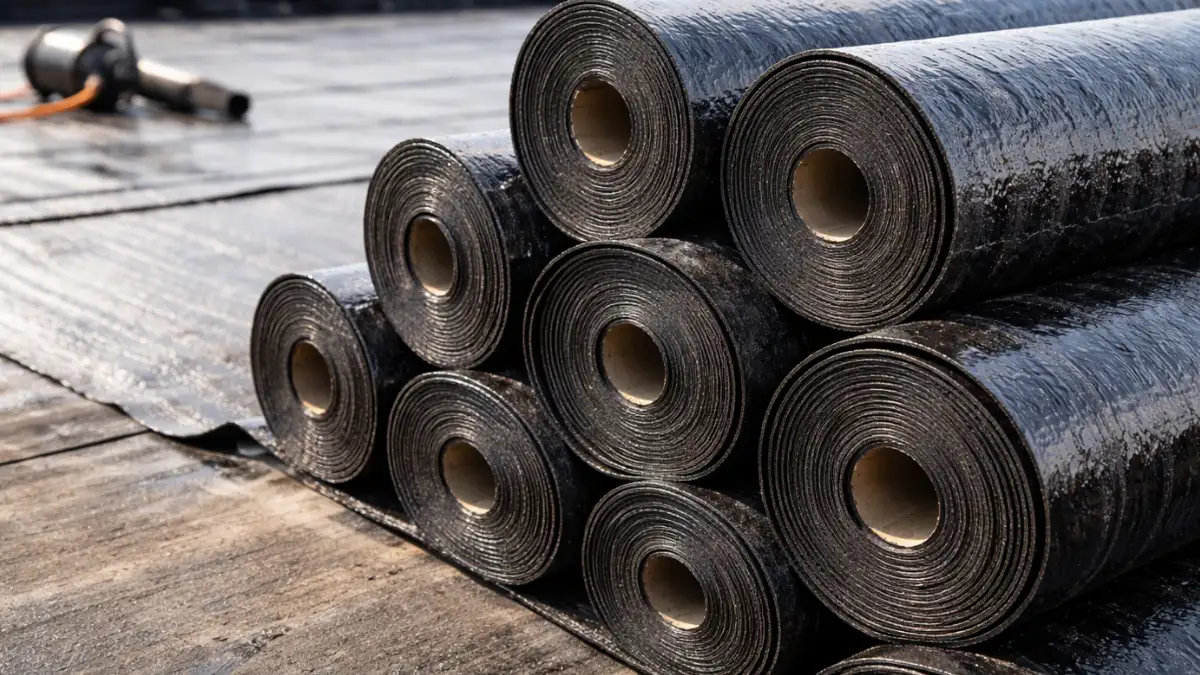
Blown bitumen for insulation is usually used as a protective and functional material around insulation systems rather than as the insulation itself. In practice, it is selected where a system needs moisture resistance, vapor control, durable adhesion, and reliable surface protection in roofing, waterproofing, buried piping, and related industrial assemblies.
Choosing the right bituminous material matters because insulation systems often fail when moisture protection, service temperature, adhesion, or environmental exposure are overlooked. For engineers, buyers, and specifiers, the key question is not whether bitumen provides thermal insulation on its own, but whether blown bitumen is the right protective or sealing component within the full insulation system.
Highlights & Key Sections
What Is Blown Bitumen for Insulation?
Blown bitumen for insulation is an oxidized bitumen used where a more stable, higher-softening, and more durable bituminous material is needed in an insulation-related assembly.
It is produced by passing air through bitumen at elevated temperature to change its physical properties for specific industrial uses. In insulation systems, this material is commonly used as part of a waterproofing layer, vapor barrier, adhesive layer, or external protective coating. The thermal insulation itself is usually a separate material such as mineral wool, glass wool, perlite, or calcium silicate.
That distinction is important. Blown bitumen supports insulation performance by protecting the system from moisture, vapor ingress, and environmental stress. It does not usually serve as the main thermal barrier.
Where Is Blown Bitumen Actually Used in Insulation Systems?
It is mainly used where insulation systems also require waterproofing, adhesion, vapor resistance, or durable outer protection.
Roofing systems
Roofing is one of the most common insulation-related applications for blown bitumen. In many roof assemblies, the insulation layer provides thermal resistance while the bituminous layer acts as an adhesive, waterproofing medium, or vapor-control component.
This is especially relevant where insulation boards must remain dry and securely integrated into the roof system. If moisture enters the assembly, long-term thermal performance and durability can decline significantly.
Buried and exterior piping
In piping systems, especially buried lines or exposed low-temperature services, asphaltic or bituminous materials may be used to help protect insulation from water intrusion and environmental exposure.
In these applications, the value of the bituminous layer is not thermal resistance. Its main purpose is to preserve the integrity of the insulation by limiting moisture penetration and adding protective coverage.
Waterproofing and dampproofing assemblies
Blown bitumen can also be used in insulation-adjacent waterproofing details, such as foundations, below-grade surfaces, and membrane-based systems where thermal insulation and moisture protection must work together.
In these cases, the bitumen is selected because the insulation layer alone cannot manage water resistance or sealing requirements.
Specialized industrial uses
Certain industrial systems use oxidized bitumen where controlled physical properties are required for sealing, coating, or protective applications. These cases are usually specification-driven and depend on service conditions, compatibility, and installation method.
Why Is Blown Bitumen Used Instead of Ordinary Bitumen?
The main reason is property control. Air blowing changes bitumen so it can better suit demanding industrial and building-system applications.
In practical terms, blown bitumen is often selected when the system needs better resistance to flow at elevated service conditions, improved stability in waterproofing roles, or more reliable performance in coatings, mastics, and adhesive-related uses.
That does not make it the best option in every case. If a project requires high flexibility at low temperature, a different membrane chemistry, or a non-bituminous protective system, another material may be more suitable. The right choice depends on the role the material must perform within the assembly.
What Benefits Does Blown Bitumen Offer in Insulation-Related Applications?
Its main benefits are moisture protection, vapor control, adhesion support, and durability within the insulation system.
1. Moisture resistance
Moisture is one of the most common causes of insulation failure. When water enters an insulation assembly, thermal performance often drops and the risk of deterioration rises.
Blown bitumen helps reduce this risk by serving as a moisture-resistant layer in suitable systems. This makes it especially useful in roofing, waterproofing, and buried-service applications.
2. Vapor-retarder function
In systems where condensation risk matters, vapor control can be just as important as insulation thickness. A properly specified bituminous layer can help slow vapor migration into the insulation system.
This is particularly relevant in cold-service piping, roof systems, and assemblies exposed to changing temperatures or humid environments.
3. Adhesion and system integration
In some applications, blown bitumen helps bond insulation boards or related system layers. This can improve system integrity when the full assembly is designed around compatible bituminous components.
Adhesion matters because insulation performance depends not only on the material itself, but also on how securely the entire system is built and sealed.
4. Protective outer-layer performance
A bituminous layer may also act as a protective outer surface that shields insulation from weather, splashing water, and minor mechanical damage.
This protective role is often underestimated. In many industrial and building systems, the outer layer determines whether the insulation will remain effective over time.
5. Suitability for specific industrial service
Blown bitumen is often useful in systems that require a more controlled, industrial-grade bituminous material rather than a softer or less stable base bitumen.
Its value is usually highest where service conditions are predictable and the material grade is matched carefully to the application.
What Are the Limitations and Risks?
Blown bitumen is useful, but it is not the right answer for every insulation application.
The first limitation is conceptual. It is generally not the primary thermal insulation layer. If a buyer expects it to replace materials designed for thermal resistance, the specification is likely heading in the wrong direction.
The second limitation is performance fit. Some applications require different moisture barriers, synthetic coatings, polymer-modified membranes, or alternative sealing systems. Choosing a bituminous product without checking service temperature, exposure conditions, and assembly design can lead to poor performance.
The third limitation is installation safety. Hot-applied bituminous materials may create fumes and require controlled handling. Application temperature, ventilation, worker protection, and site safety procedures all matter.
How Does Blown Bitumen Compare with Other Insulation-Related Materials?
The most useful comparison is by function: thermal insulation, waterproofing, vapor control, or adhesion.
| Material or system type | Primary role in assembly | Where it often fits best | Main limitation |
|---|---|---|---|
| Blown bitumen | Waterproofing, adhesion, vapor control, protective coating | Roofing, buried piping, waterproofing-related insulation details | Usually not the main thermal insulation layer |
| Mineral wool, glass wool, calcium silicate, perlite boards | Thermal insulation | Equipment, piping, buildings, roofs, and industrial systems | Often need separate moisture or surface protection |
| Synthetic protective mastics or coatings | Weather and surface protection | Exterior ducts, exposed piping, dual-temperature systems | Not every type is designed as a low-permeance vapor retarder |
| Modified bitumen systems | Roofing and membrane performance | Roof assemblies requiring full membrane compatibility | Must be selected as part of a complete system specification |
A good specification separates the roles clearly. One material provides thermal resistance, another controls vapor, another sheds water, and another protects the outer surface. Blown bitumen can perform some of these roles well, but usually not all of them alone.
How Should Buyers and Engineers Select the Right Grade or System?
Start with the function, not the product name. Blown bitumen for insulation is only useful when the exact job role is defined clearly.
A practical selection framework
- Define the insulation system type
Identify whether the project involves roofing, buried piping, exposed piping, low-temperature service, foundations, or industrial equipment. The system type shapes the material requirements. - Identify the role of the bitumen
Determine whether the material will act as an adhesive, waterproofing layer, vapor retarder, mastic coating, or sealing component. Most selection errors begin when these roles are not separated clearly. - Match service conditions
Review operating temperature, moisture exposure, buried or exposed service, and expected movement. The material must suit the real working environment, not just the product label. - Check compatibility
Confirm compatibility with insulation boards, facings, membranes, fabrics, and adjacent system materials. A technically sound material can still fail if it is incompatible with the rest of the assembly. - Review installation method and safety
Hot-applied systems require temperature control, safe handling, and worker protection. Installation conditions should be part of specification review, not an afterthought.
What Mistakes Commonly Cause Poor Performance?
Most failures come from assigning the wrong role to the material, choosing an unsuitable grade, or ignoring moisture-control logic.
Common mistakes include:
- treating blown bitumen as the primary thermal insulation
- choosing a product without defining whether it is needed for vapor control, waterproofing, or adhesion
- ignoring buried versus exposed service conditions
- overlooking compatibility with boards, membranes, or facings
- underestimating application temperature and safety requirements
- focusing only on initial material cost instead of total system durability
Is Blown Bitumen the Right Choice for Your Project?
It is the right choice when the project needs a bituminous layer that protects insulation from moisture, helps control vapor, supports waterproofing, or bonds system components within a suitable specification.
It is usually not the right choice when the real requirement is higher thermal resistance from the insulation layer itself, strong low-temperature flexibility, or a system designed around a different protective chemistry. In other words, it should be selected for the role it performs well, not as a catch-all material.
Executive Checklist Before You Specify Blown Bitumen for Insulation
Use this checklist before approval or purchase:
- Confirm that the bitumen is a system component, not the primary thermal insulation
- Define whether it is required for adhesion, waterproofing, vapor control, or external protection
- Check service temperature, moisture exposure, and buried or exposed conditions
- Review compatibility with insulation boards, membranes, facings, and surrounding materials
- Confirm installation method and handling requirements
- Include safety controls if hot application is involved
Conclusion
Blown Bitumen for Insulation is best understood as a supporting material within an insulation system rather than a standalone insulating medium. Its value lies in moisture resistance, vapor-retarder performance, adhesion, and protective durability in roofing, waterproofing, buried piping, and selected industrial applications. When the function is defined clearly and the grade is matched to real service conditions, it can be an effective part of a durable insulation assembly.
FAQs
1. Is blown bitumen itself an insulation material?
Usually no. In most systems, it acts as a protective, sealing, adhesive, or vapor-control component, while the main thermal insulation is provided by a separate material designed for heat resistance.
2. Where is blown bitumen most commonly used around insulation systems?
It is commonly used in roofing assemblies, buried piping, waterproofing details, and systems where insulation needs added protection against moisture or vapor ingress.
3. Why choose blown bitumen instead of standard bitumen?
Because the blowing process changes its physical properties, making it more suitable for certain demanding applications that need greater stability, better waterproofing behavior, or more controlled performance.
4. Can blown bitumen be used in cold insulation systems?
It can be, but only when the grade and system design are appropriate. Suitability depends on the full assembly, including vapor control, exposure conditions, and installation requirements.
5. What should procurement teams verify before buying?
They should confirm the intended function, service conditions, compatibility with adjacent materials, installation method, and any safety requirements tied to handling or application.
Sources
- ASTM D312/D312M – Standard Specification for Asphalt Used in Roofing — Relevant because it covers asphalt used in built-up roofing, bituminous vapor-retarder systems, and adhesion of insulation boards in roof assemblies.
- ASTM D449/D449M – Standard Specification for Asphalt Used in Dampproofing and Waterproofing — Relevant because it supports the waterproofing and dampproofing role of asphaltic materials in assemblies adjacent to insulation systems.
- National Insulation Association – Mastics 101 — Relevant because it explains how mastics function as weather barriers, vapor retarders, and protective layers in insulation systems.
- Eurobitume – General Information on Bitumen — Relevant because it explains how oxidation and air blowing change bitumen properties for roofing and industrial applications.
- OSHA – Asphalt Fumes — Relevant because it outlines worker exposure and safety considerations for hot-applied bituminous materials.