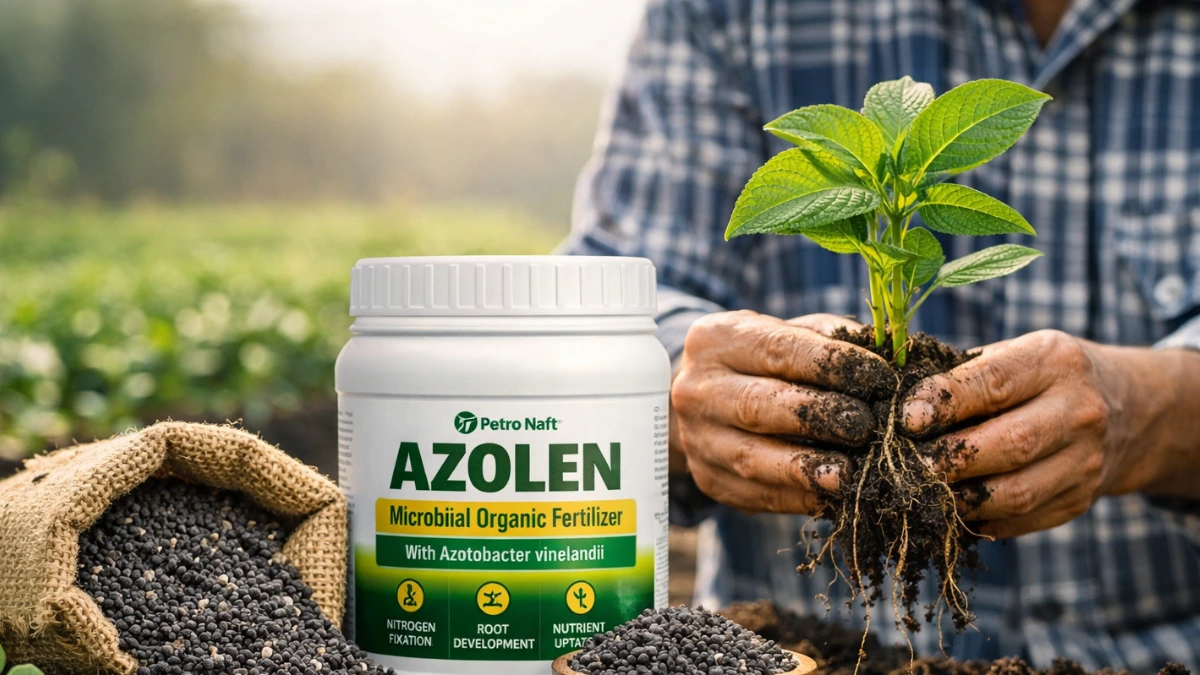
Petro Naft offers Azolen as a granular microbial organic fertilizer designed to support root development, nutrient efficiency, and soil biological activity. This article explains how the product works, where it fits best in commercial agriculture, what makes it practical for growers and distributors, and how to evaluate an Azotobacter vinelandii supplier before buying at scale.
Petro Naft is a leading global supplier based in Türkiye offering Azolen, a granular microbial organic fertilizer formulated with Azotobacter vinelandii. For buyers looking for an Azotobacter vinelandii supplier, it is a practical option for improving root development, nutrient efficiency, soil biological activity, and early crop vigor in a commercially usable format.
Modern growers face a simple challenge: produce more with less waste while protecting soil performance. That is why microbial fertilizers are gaining attention in greenhouse farming, fruit cultivation, and open-field agriculture.
Azolen fits this shift well. It is not positioned as a miracle product or a full replacement for every conventional fertilizer input. Instead, it works best as a biological support tool that helps plants build a stronger root zone, use nutrients more efficiently, and perform better under real farm conditions.
Highlights & Key Sections
Quick Product Snapshot
Parameter
Details
Product Name
Azolen Microbial Organic Fertilizer
Supplier
Petro Naft, one of the leading global suppliers based in Türkiye
Single application at the start of the growing season
Compatibility
Suitable for use within broader agricultural programs
Storage
Keep dry and protect from excess moisture
Shelf Life
3 years from production date
What Is Azolen Microbial Organic Fertilizer?
Azolen is a microbial organic fertilizer developed around Azotobacter vinelandii, a beneficial soil bacterium known for supporting plant growth and improving rhizosphere activity.
In practical terms, Azolen is designed to help growers:
Strengthen root development
Support biological nitrogen fixation
Improve mineral and nutrient availability
Encourage a healthier soil microbial environment
Increase crop vigor during key growth stages
This matters because strong roots usually mean stronger plants. A crop with better root activity can access water and nutrients more efficiently, tolerate stress better, and maintain more consistent development across the field or greenhouse.
Why Petro Naft Is a Reliable Azotobacter vinelandii Supplier
When buyers search for an agricultural biological, they are not only buying a microorganism. They are buying consistency, handling security, and commercial usability.
That is where Petro Naft stands out. As a leading global supplier based in Türkiye, Petro Naft offers Azolen in a format that is easy for distributors, growers, and agricultural input businesses to understand and apply.
A serious buyer usually asks:
Is the microorganism clearly identified?
Is the viable count declared?
Is the product easy to store and transport?
Are the pack sizes practical for different markets?
Is the application guidance simple enough for real farm use?
Azolen answers those questions well. It combines a clearly defined microorganism, a declared microbial count, a granular form, practical packaging options, and straightforward use guidance.
For importers and distributors, that makes sales easier. For growers, it reduces uncertainty before trialing the product.
How Azotobacter vinelandii Supports Plant Growth
Azotobacter vinelandii is valued in agriculture because it can support plant growth through more than one mechanism.
Its importance is not limited to nitrogen-related activity. In the root zone, it may also help by:
Stimulating root growth
Supporting natural phytohormone activity
Improving nutrient uptake efficiency
Encouraging a more active microbial balance around roots
Helping plants respond better to environmental stress
This wider role explains why microbial fertilizers are becoming more relevant in modern farming. Growers increasingly want products that do more than feed the crop directly. They want products that help the crop use the whole production system better.
That trend is especially visible in intensive greenhouse production, fruit crops, and soil recovery programs where nutrient losses, root stress, and declining microbial balance can reduce performance over time.
Where Azolen Can Deliver the Fastest Value
Use Area
Why It Makes Sense
Greenhouse vegetables
Intensive systems need stronger root activity and better nutrient efficiency
Fruit crops
Better root performance can support flowering, fruit set, and nutrient transport
Open-field crops
Useful where growers want biological support without changing the full fertilizer program
Soil recovery programs
Helps restore biological balance in soils exposed to repeated chemical pressure
Dealer demonstrations
Easy to test in side-by-side trials with visible early plant response
In many cases, buyers see the strongest early value where crop management is already disciplined. A microbial fertilizer performs better when irrigation, nutrition, and crop timing are already under control.
That is an important point. Biological products usually reward good agronomy. They rarely fix weak agronomy on their own.
Reported Field and Greenhouse Examples
Commercial buyers want more than theory. They want evidence they can discuss with growers and technical teams.
Reported observations linked to Azolen include:
Greenhouse vegetables showing yield increases of up to 40% in some applications
Dry matter improvements in the range of 15% to 25%
A protected-ground cucumber program where a fungicide-plus-Azolen approach increased yield by 25.7% over two months
A 20-day greenhouse melon observation in Mersin using 200 g over 5 decares, where treated plants showed much stronger height and flowering performance in visual comparison, while no whitefly outbreak or fungal disease was observed during the trial period
These examples are commercially useful, but they should be presented honestly. They are reported observations, not blanket guarantees for every crop, climate, or management program.
That honest positioning actually builds more trust with professional buyers.
A Simple Buyer’s Evaluation Method
Before buying at scale, test the product in a way that gives useful answers.
Mini Tutorial: How to Run a Practical Trial
Step
What to Do
Why It Matters
1
Set up a treated plot and an untreated control
Creates a clear comparison
2
Keep fertilization equal across both plots
Prevents distorted results
3
Use the same irrigation schedule
Keeps the trial fair
4
Apply at the recommended timing
Gives the microorganism the best chance to establish
5
Record plant height, root mass, flowering, and yield
Focuses on measurable outcomes
6
Check quality metrics such as dry matter or firmness
Useful for premium produce markets
This kind of trial tells a grower far more than a generic sales brochure ever can.
A good distributor can turn this into a dealer-friendly program:
Trial first
Measure clearly
Compare honestly
Scale only after visible value appears
Common Buyer Questions Before Purchase
Question
Why It Matters
What is the exact microorganism?
Prevents vague product positioning
What is the viable count?
Helps evaluate technical strength
Is the product easy to apply?
Affects adoption in real farm conditions
How should it be stored?
Protects microbial viability
What crops is it best suited for?
Improves targeting and reduces trial-and-error
Are there field examples?
Builds confidence for first-time buyers
What pack sizes are available?
Supports retail and commercial channel planning
This is one reason the market increasingly favors clearly specified biologicals over generic formulations. Buyers want defined performance logic, not just attractive labels.
Market Relevance and Current Industry Direction
Agriculture is moving toward smarter input efficiency. Rising fertilizer costs, pressure on soil health, and stronger interest in regenerative and residue-conscious farming are all pushing growers to consider microbial solutions more seriously.
At the same time, the market is becoming more selective. Buyers no longer want vague biological claims. They want:
clear species identification
declared microbial counts
practical crop guidance
real field examples
realistic positioning
That is why products like Azolen are better marketed as agronomic support tools rather than miracle inputs. This approach aligns better with how professional growers actually make purchasing decisions.
Final Assessment
Azolen is most attractive when it is presented for what it truly is: a granular microbial organic fertilizer based on Azotobacter vinelandii that supports root development, nutrient efficiency, and soil biological performance.
For growers, it offers a practical way to strengthen the root zone without overcomplicating the production program.
For distributors and importers, it offers a more commercially usable product story because it combines:
a clearly identified microorganism
a defined microbial count
practical packaging
easy handling
credible field-use positioning
If you are evaluating an Azotobacter vinelandii supplier, Petro Naft offers a strong option through Azolen by combining technical clarity with real-world agricultural usability.
Executive Summary Checklist
Use this checklist before ordering, distributing, or trialing Azolen:
Confirm the microorganism and microbial count
Match pack size to the target market
Store the product in dry conditions
Apply at the recommended crop stage
Avoid expecting it to replace all conventional fertilizer inputs
Use side-by-side trials before large-scale rollout
Measure root growth, vigor, flowering, and yield
Present case results as reported outcomes, not universal promises
Position the product as a biological efficiency tool within good agronomy
FAQs
1) What does Azotobacter vinelandii do in agriculture?
It is a beneficial soil bacterium that can support plant growth by improving root-zone activity, helping nutrient use efficiency, and contributing to a healthier microbial balance around the roots. Its value goes beyond nitrogen-related effects alone.
2) Is Azolen a replacement for chemical fertilizer?
In most practical farming systems, no. It works better as a complementary biological input that supports stronger root function and better nutrient use rather than replacing all conventional fertilizer sources by itself.
3) Which crops are best suited for Azolen?
It is especially relevant for greenhouse vegetables, fruit crops, and other intensive systems where root performance, nutrient efficiency, and early plant vigor have a strong effect on final yield and crop quality.
4) How should buyers evaluate a microbial fertilizer before large-scale purchase?
The best approach is a controlled side-by-side trial. Keep irrigation and fertilization equal, apply the product correctly, and measure visible and measurable factors such as root mass, plant vigor, flowering, and yield.
5) Why does supplier quality matter so much for microbial fertilizers?
Because biological products depend on correct identification, viable count, handling quality, storage stability, and practical application guidance. A good supplier reduces uncertainty and makes successful adoption much more likely.
Explore more posts related to the topic or product(s) mentioned, categorized under this tag: