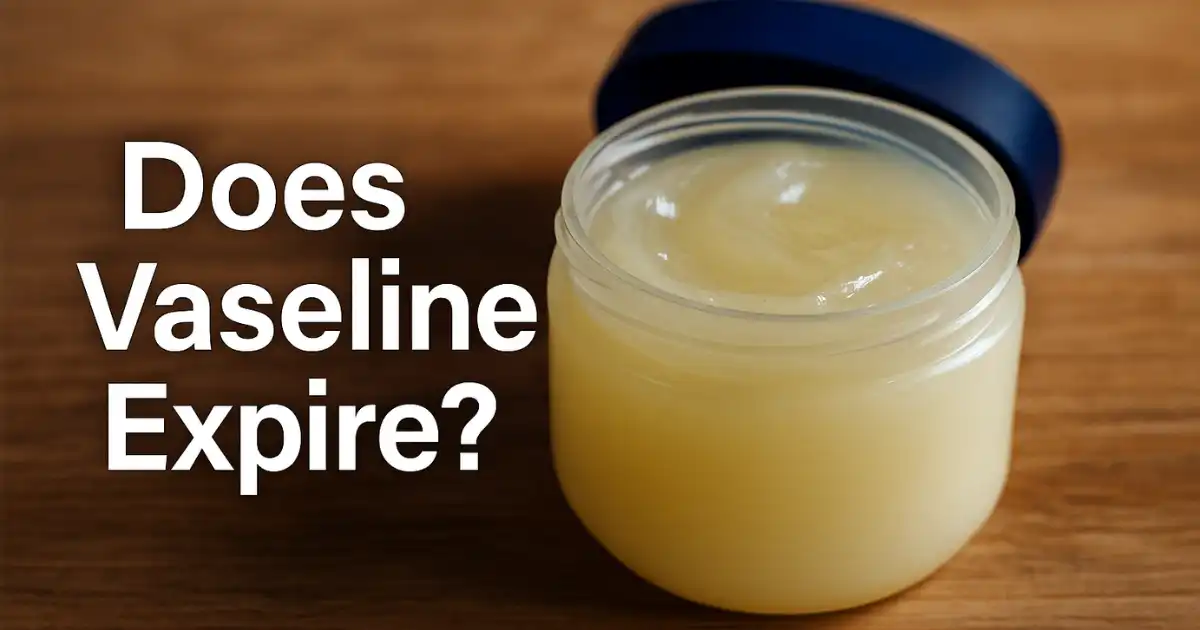
Does Vaseline Expire and how long is it safe to use? This guide explains what expiry labels, PAO symbols, and manufacturing codes really mean, plus the practical warning signs that signal it’s time to replace a jar or tube. You’ll also get storage best practices, contamination-proof usage tips, and buying advice for families, clinics, and workplaces that keep petroleum jelly on hand.
Does Vaseline Expire? Usually, petroleum jelly stays stable for years because it contains no water, but the product can still degrade from heat, oxidation, or contamination. Treat the printed expiry date or PAO symbol as your safest guide, and replace it if you notice odor changes, discoloration, grit, or separation.
Vaseline is one of those “it’s been in my cabinet forever” staples—used for dry skin, chapped lips, minor scrapes, and even trending routines like “slugging.” The key is knowing when “old” is still fine and when “old” becomes risky.
Highlights & Key Sections
Does Vaseline Expire? The Real Shelf Life Explained
Vaseline (Petrolatum) doesn’t spoil the way water-based creams do, because microbes struggle to grow in it. In real life, what ends its usable life is usually your environment and handling, not the ingredient itself.
Think of shelf life as two timelines:
Unopened stability: mostly about heat, sunlight, and packaging integrity.
After opening (real-world use): mostly about contamination (fingers, water, makeup, dust).
The most practical rule
Follow the label first (expiry date, PAO jar symbol like 12M/24M, or a date code).
Use sensory checks second (smell, color, texture).
Use context third (where it was stored and how you used it).
Why Vaseline Lasts So Long (and what shortens it)
What keeps it stable
No water: fewer pathways for bacterial growth.
Inert base: petroleum jelly is chemically stable compared to plant oils that oxidize faster.
Occlusive texture: it doesn’t “evaporate” the way lighter products do.
What shortens its usable life
Heat + sun: speeds up texture breakdown and can cause oil “bleed.”
Repeated finger dipping: introduces skin cells, microbes, and tiny bits of water.
Cross-contact: using it after touching acne-prone areas, makeup, or an irritated rash.
Real example:
A jar used on clean lips at home may stay fine much longer than a jar kept in a gym bag and applied with sweaty hands between workouts.
Typical Shelf Life by Product Type
Not all “Vaseline” is the same product category. The classic jelly behaves differently from lotions or flavored lip products.
Product type
What’s inside
Usually most vulnerable to
Your safest approach
100% petroleum jelly (classic)
Anhydrous jelly
Contamination + heat
Keep it clean; store cool; follow label
Lip therapy (tints/flavors)
Jelly + additives
Oxidation of added ingredients
Replace sooner if smell/texture shifts
Lotions/creams
Water-based emulsions
Microbial growth + separation
Follow PAO/expiry strictly
“Healing ointment” blends
Occlusives + extras
Stability depends on formula
Treat like skincare; follow label and PAO
Buyer tip: If you’re stocking for a clinic, workshop, or family, tubes reduce contamination compared to wide-mouth jars.
How to Check the Expiry Date, PAO Symbol, or Date Code
This is the fastest way to avoid guessing.
Mini tutorial: 60-second label scan
Look for a printed date (often on the back label, bottom, or crimp).
Look for the open-jar PAO symbol (example: 12M means “12 months after opening”).
Look for a batch/date code (letters/numbers).
If none exists, use your own “opened-on” date system:
Write the month/year you opened it on the base with a marker.
For shared household jars, place a small sticker inside the cabinet door with opening dates.
What to do if you can’t find any date info
Use the storage + handling test:
Stored cool/dark, used cleanly → likely okay longer.
Stored hot/humid, used with fingers often → replace earlier.
Warning Signs: When to Stop Using It
Even when Vaseline looks “mostly fine,” small changes can matter—especially if you apply it to cracked skin, lips, or a healing scrape.
Warning sign
What it can indicate
What to do
Off smell (waxy → stale/oily)
Oxidation or contamination
Discard
Yellowing/darkening
Oxidation, heat exposure
Discard if noticeable or worsening
Grit, dust, or visible debris
Contamination
Discard (or don’t use on skin)
Separation (oily layer on top)
Heat cycling
If mild and odor-free: use only on non-sensitive areas; otherwise discard
Irritation/burning after use
Sensitivity or contaminated product
Stop using; discard; soothe skin
Mini case study:
Someone uses the same jar for lips, then dabs it over irritated skin after shaving. A week later, the product smells normal—but the skin gets red and bumpy. In cases like this, the jar may be fine chemically but “dirty” microbiologically due to repeated cross-contact.
Storage Tips That Preserve Quality (and Reduce Risk)
Best-practice storage
Keep it cool and shaded: a drawer or closed cabinet beats a sunny shelf.
Close the lid tightly: oxygen + dust are slow but steady enemies.
Avoid the car: glovebox storage is a shortcut to separation and odor shifts.
Use clean hands or a spatula: especially for face, lips, babies, or healing skin.
Do this
Not this
Store at stable room temperature
Store near a heater or window
Use a clean spatula for jars
Scoop with wet fingers after shower
Prefer tubes for shared use
Share a communal jar across multiple people
Wipe the rim and reseal
Leave residue on the rim (collects dust)
Pro hygiene upgrade (low effort): Keep a small, washable spatula next to the jar. It’s the simplest way to extend usability and protect skin.
Can You Safely Use “Old” Vaseline?
Often yes—if it passes the checks and you’re using it in a low-risk way.
Low-risk uses (if it looks/smells normal)
Dry elbows, heels, and hands
Friction protection (chafing-prone areas)
Buffer layer over non-irritated, intact skin
High-caution uses (use a fresh product)
Cracked lips with bleeding
Freshly shaved/irritated skin
Baby skin care
Minor cuts/scrapes (especially if not fully cleaned)
Acne-prone areas (not because it’s “dirty,” but because occlusion can feel heavy)
Mini tutorial: the “clean-use reset”
If you want to keep a jar in rotation:
Wash hands, dry thoroughly.
Use a spatula (not fingers).
Avoid double-dipping.
Keep a second “body-only” jar separate from a “face/lips” jar.
Buying Tips for Families, Professionals, and Bulk Users
If your goal is fewer replacements and safer use, shop and stock smarter.
Choose packaging that matches your use
Single user → jar is fine with clean handling.
Multi-user / workplace → tubes or pump-style products are cleaner.
Buy the size you’ll realistically finish
Bigger isn’t always better if it sits for years in a hot bathroom.
Rotate stock
Put newer items behind older ones in cabinets or supply rooms.
Avoid heat exposure in transit
If it arrives warm and runny, let it return to room temp and watch for separation/odor changes.
Trend connection: As barrier-repair routines and “slugging” stay popular, more people keep petroleum jelly in daily rotation—so contamination control (tubes, spatulas, date labeling) is becoming a practical “modern skincare” habit, not just a lab concept.
Conclusion + Executive Summary Checklist
If you’re still asking, Does Vaseline Expire, the most accurate answer is: the base is very stable, but the label guidance and real-world handling decide whether it’s still safe and pleasant to use.
Quick checklist (save this)
Check for an expiry date, PAO symbol, or date code on the packaging
If opened, note when you first opened it (marker or sticker)
Smell test: any stale or “off” odor → discard
Visual test: discoloration, debris, or grit → discard
Texture test: heavy separation or unusual feel → replace
Storage check: kept cool/dark and sealed tightly? Good sign
Use check: wet fingers, shared jar, bathroom steam? Replace sooner
For lips, babies, or broken skin, default to a fresh product
FAQ
1) Is petroleum jelly “self-preserving”?
Petroleum jelly has no water, so it’s far less supportive of microbial growth than water-based creams. That said, contamination can still happen from dirty fingers, water droplets, or debris, so hygiene still matters.
2) Can old Vaseline cause acne?
Petroleum jelly is highly occlusive, so it can feel heavy and trap sweat or skincare underneath on some people. If you’re acne-prone, use a thin layer, avoid applying over greasy products, and stop if you notice congestion.
3) Why does Vaseline sometimes look more yellow over time?
Heat and oxygen exposure can slowly change color or produce a faint “stale” smell. Mild shifts don’t always mean it’s unsafe, but noticeable yellowing plus odor or texture changes is a clear replace signal.
4) Is it safe to use Vaseline on minor cuts if it’s old?
For anything involving broken skin, it’s best to use a fresh, clean product. Even if the base is stable, contamination risk matters more when skin is open or irritated.
5) Do jars expire faster than tubes?
In practice, yes—because jars invite repeated contact with fingers and air. Tubes limit contamination and usually stay “clean” longer, especially in shared households or professional settings.
Official brand explanation of petroleum jelly properties (including why anhydrous formulas resist bacterial growth) and advice to check label dates: Vaseline brand educational article
Official brand product-page Q&A that describes date code format and a typical manufacturing-to-shelf-life window for a Vaseline lotion example: Vaseline product page (CA)
Scientific compound reference that summarizes stability behavior of petrolatum during storage: NIH PubChem: Petrolatum
Primary EU legal text covering cosmetic labeling concepts such as durability/PAO requirements in the cosmetics framework: Regulation (EC) No 1223/2009 (EUR-Lex)
Explore more posts related to the topic or product(s) mentioned, categorized under this tag: