
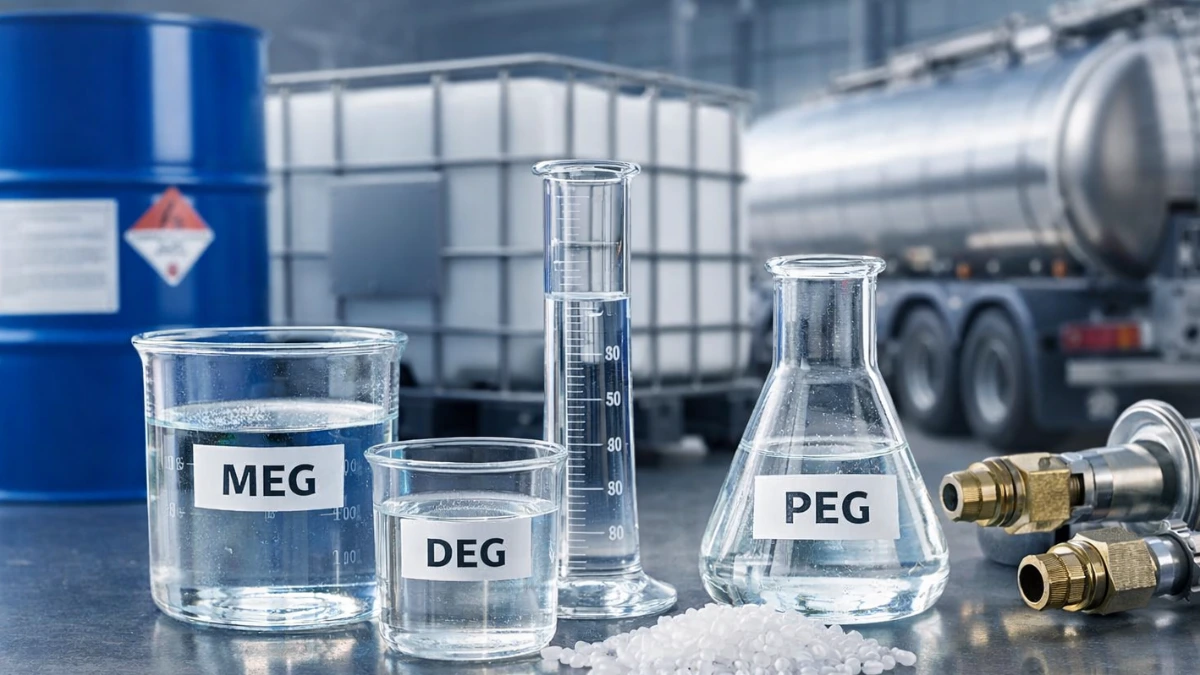
If you need a reliable glycol supplier, Petro Naft can deliver MEG/DEG/TEG, MPG/DPG/PEG in export-ready quality, backed by COA/SDS and consistent packaging for drums, IBCs, and bulk shipments. Use this guide to pick the right grade, understand key specs, and reduce quality risks before you buy.
In practice, buyers choose a glycol supplier for three things:
- Specification control (purity, water, color, acidity, trace impurities)
- Logistics reliability (standard packaging, stable lead times, correct documents)
- Fit-for-use support (right grade for polyester, dehydration, antifreeze, cosmetics, pharma)
Highlights & Key Sections
MEG/DEG/TEG, MPG/DPG/PEG: Which glycol do you actually need?
Here’s the fastest way to decide—start from your application, not the chemical name.
Quick selection matrix (real-world purchasing view)
| If you’re making / running… | Most common choice | Why it wins | What to watch |
|---|---|---|---|
| Polyester fiber, PET bottle resin, film | MEG | High reactivity, consistent polymer performance | Color (Pt-Co), water, DEG content |
| UPR resins, plasticizers, solvents | DEG | Strong solvency + resin compatibility | Water, MEG/TEG carryover, acidity |
| Natural gas dehydration, solvent duty | TEG | Hygroscopic, strong water pickup | Water, acidity, ash (foaming risk) |
| Antifreeze, heat transfer fluids, de-icing | MEG or MPG | Performance vs safety profile | Water, inhibitor compatibility, color |
| Fragrance carrier, cosmetics solvent | DPG | Low odor, good solvency | Color, acidity, chloride |
| Pharma/cosmetics excipient, ointments | PEG 400/600 | Controlled MW + low impurities | EO/1,4-dioxane limits, heavy metals |
Mini rule of thumb (buyers love this):
- Need polyester? Start with MEG.
- Need dehydration? Start with TEG.
- Need personal care solvency? Start with DPG (or pharma MPG).
- Need an excipient base? Choose PEG by molecular weight (400 = more fluid, 600 = more viscous).
Petro Naft glycol portfolio
Petro Naft supplies industrial and pharmaceutical grades (where applicable), with worldwide exports in standard packaging. Typical supply formats include:
- Drums (steel or PE, depending on grade)
- IBCs
- ISO tank / bulk
- Customized packaging on request
Technical specifications (export-grade targets)
Below are practical “purchase-critical” specs buyers put into contracts. Values reflect standard technical sheets for these products.
Mono Ethylene Glycol (MEG) — key specs
| Test | Typical requirement |
|---|---|
| Appearance | Colorless, transparent liquid |
| Purity | ≥ 99.8 wt.% |
| Color (Pt-Co) | ≤ 5 |
| Water | ≤ 0.08 wt.% |
| DEG content | ≤ 0.08 wt.% |
| Specific gravity (20/20°C) | 1.1151–1.1156 |
| Aldehydes (as formaldehyde) | ≤ 8 mg/kg |
| Acidity (as acetic acid) | ≤ 10 mg/kg |
| Iron (Fe) | ≤ 0.1 mg/kg |
| Inorganic chloride (Cl) | ≤ 0.05 mg/kg |
Practical note: For PET/polyester, buyers often prioritize color + water + DEG because they directly affect polymer color and process stability.
Diethylene Glycol (DEG) — key specs
| Test | Typical requirement |
|---|---|
| Appearance | Clear liquid |
| Specific gravity @20°C | 1.1175–1.1195 |
| Color (Pt-Co) | ≤ 15 |
| Acidity (as acetic acid) | ≤ 50 ppm |
| Assay | ≥ 99.5 wt.% |
| MEG | ≤ 0.2 wt.% |
| TEG | ≤ 0.5 wt.% |
| Ash | ≤ 0.0045 wt.% |
| Distillation range | 242–247°C |
| Water | ≤ 0.2 wt.% |
Where DEG wins: UPR resin production, solvents, and plasticizer applications where solvency matters more than ultra-low water.
Triethylene Glycol (TEG) — key specs
| Test | Typical requirement |
|---|---|
| Purity | ≥ 97% |
| Color (Pt-Co) | ≤ 25 |
| Specific gravity @20°C | 1.124–1.126 |
| Higher glycols (as TTEG) | ≤ 1% |
| DEG | ≤ 2% |
| Water | ≤ 0.05% |
| Acidity | ≤ 0.01% |
| Ash | ≤ 0.005% |
Case example (gas dehydration): If your contactor starts foaming, your first suspects are usually contamination + acidity/solids—not the column itself. Tight ash and acidity control reduces that risk.
Monopropylene Glycol (MPG) — industrial vs pharmaceutical
MPG (Industrial grade) — typical contract specs
| Test | Typical requirement |
|---|---|
| Specific gravity @20°C | 1.0375–1.0390 |
| Color (Pt-Co) | ≤ 15 |
| Acidity (as acetic acid) | ≤ 0.005 wt.% |
| Purity (dry basis) | ≥ 99.0 wt.% |
| DPG | ≤ 1.0 wt.% |
| Distillation range (760 mmHg) | 185–190°C |
| Water | ≤ 0.2 wt.% |
MPG (Pharmaceutical grade) — typical USP-style targets
| Test | Typical requirement |
|---|---|
| Assay (dry basis) | ≥ 99.5% |
| Water | ≤ 0.2% |
| Specific gravity | 1.035–1.037 |
| DEG & EG limit | ≤ 0.1% |
| Chloride | ≤ 70 (per monograph test) |
Why buyers pay more for pharma MPG: trace impurity control and monograph alignment matter more than “extra purity” on paper.
Dipropylene Glycol (DPG) — key specs
| Test | Typical requirement |
|---|---|
| Appearance | Clear liquid |
| Refractive index @25°C | 1.4387–1.4397 |
| Color (Pt-Co) | ≤ 10 |
| Acidity (as acetic acid) | ≤ 0.01% |
| Chloride | ≤ 15 ppm |
| Distillation range | 222–236°C |
| Propylene glycol | ≤ 1% |
| Assay (GC) | ≥ 99% |
| Water | ≤ 0.2% |
Real-life cosmetics formulation tip: If a fragrance blend “hazes” after cooling, check water + chloride + color on the DPG lot before blaming the perfume oil.
Polyethylene Glycol (PEG) — PEG 400 & PEG 600 (pharmaceutical grade)
PEG 400 — typical specs
| Test | Typical requirement |
|---|---|
| Color of solution | Colorless |
| Viscosity @98.9°C (cSt) | 6.8–8.0 |
| pH (5% solution) | 4.5–7.5 |
| Residue on ignition | ≤ 0.1% |
| Avg. molecular weight | 380–420 g/mol |
| EG + DEG | ≤ 0.25% |
| Heavy metals | ≤ 5 ppm |
| Ethylene oxide & 1,4-dioxane | ≤ 10 ppm each |
PEG 600 — typical specs
| Test | Typical requirement |
|---|---|
| Color of solution | Colorless |
| Viscosity @98.9°C (cSt) | 9.9–11.3 |
| pH (5% solution) | 4.5–7.5 |
| Residue on ignition | ≤ 0.1% |
| Avg. molecular weight | 570–630 g/mol |
| EG + DEG | ≤ 0.25% |
| Heavy metals | ≤ 5 ppm |
| Ethylene oxide & 1,4-dioxane | ≤ 10 ppm each |
Why PEG impurity specs got stricter: personal care and pharma buyers increasingly ask for tighter control of EO/1,4-dioxane because brand audits now check trace impurities, not just COA headlines.
Packaging and export standards
For international shipments, Petro Naft supplies glycols in standard packaging suitable for containerized export.
Common export packaging (typical)
| Product family | Typical packaging type | Common net weight | Typical shelf life | IMCO class |
|---|---|---|---|---|
| MPG (industrial / pharma) | New steel drums | 220 kg | 2 years | Non-IMCO |
| DPG | New PE drums | 220 kg | 2 years | Non-IMCO |
| PEG 400 / 600 | New PE drums | 220 kg | 2 years | Non-IMCO |
| MEG / DEG / TEG | Drums / IBC / bulk | project-based | typically 2 years* | depends on route |
*Shelf life depends on storage temperature, moisture exposure, and handling discipline.
Export doc pack buyers usually require:
- COA (per batch)
- SDS
- TDS
- Packing list + commercial invoice
- Certificate of origin (when requested)
- Container sealing + photos (common for high-value pharma grades)
Mini tutorial: approve a glycol shipment in ~30 minutes
This workflow is what procurement teams use to prevent “it looked fine” disasters.
Step-by-step receiving checklist
- Step 1: Inspect seals, labels, drum condition, and pallet integrity.
- Step 2: Take a representative sample (top/middle/bottom if bulk).
- Step 3: Run quick tests:
- Visual clarity (haze = water/contamination risk)
- Color (Pt-Co)
- Water (Karl Fischer, when critical)
- Density / refractive index (fast identity check)
- Step 4: Compare against contract spec + COA, not “typical values.”
- Step 5: Quarantine and escalate if any red flag appears.
Fast troubleshooting map
| Symptom | Likely cause | What to do next |
|---|---|---|
| Haze/cloudiness | Moisture pickup, contamination | KF water test + re-sample |
| Color drift | Oxidation, contamination, storage issues | Pt-Co + metals check |
| Off-odor | Cross-contamination (often packaging/transfer) | Confirm line cleaning + GC screen |
| Foam in process | Acidity/solids, carryover | Check ash/acidity + filtration |
Market & technology trends that affect glycol purchasing
- Polyester and packaging are under circularity pressure. As recycled content grows, buyers lean harder on consistent MEG quality to avoid color swings and IV variability in PET and fibers.
- Trace-impurity governance is rising in pharma and personal care. PEG and pharma MPG purchases increasingly include audit-ready limits on trace impurities (and tighter supplier documentation expectations).
The practical takeaway: today’s “good supplier” is the one who can prove repeatability, not just offer a low spot price.
How to request a quote (RFQ template that gets you faster pricing)
Include these fields and you’ll cut back-and-forth emails dramatically:
- Product + grade: MEG / DEG / TEG / MPG / DPG / PEG (and PEG MW if relevant)
- Target specs (purity, water, color, key impurities)
- Quantity + frequency (one-time vs monthly)
- Packaging (drums / IBC / bulk) + destination port
- Incoterms
- Required documents (COA/SDS/TDS/COO)
- End-use (so the supplier matches the correct grade)
Conclusion
A glycol purchase becomes easy when you align application, specs, and logistics from day one. Petro Naft supplies MEG/DEG/TEG, MPG/DPG/PEG for global buyers with export-ready packaging, consistent quality targets, and documentation that supports industrial and audited supply chains.
Executive Summary: practical buyer checklist
Use this before you place your next order:
- Confirm the right glycol for the process (don’t substitute without technical review).
- Lock the 5 specs that matter most (usually purity, water, color, acidity, and one impurity limit).
- Choose the right packaging for your route and warehouse conditions.
- Require batch COA and keep a retained sample.
- Run incoming QC (at least appearance + one identity test).
- Document deviations fast and quarantine questionable lots.
FAQ
1) Which glycol is safest for food/pharma-related applications?
Pharmaceutical-grade MPG and selected PEG grades are commonly used as excipients and carriers. Always match the grade to the relevant monograph/spec and confirm trace-impurity limits.
2) Why does water content matter so much in MEG and TEG?
Water changes process behavior: it can shift polymerization performance in polyester and reduce dehydration efficiency in gas treatment. It also increases corrosion and contamination risks in storage systems.
3) Can I replace MEG with MPG in antifreeze?
Sometimes, yes—but performance and formulation changes follow. MPG often serves where lower toxicity matters, while MEG typically delivers stronger heat-transfer performance at equivalent concentration.
4) What’s the difference between PEG 400 and PEG 600 in formulation?
PEG 400 is more fluid and easier to dose; PEG 600 is more viscous and can give a heavier, more lubricious feel. Both require impurity control (especially EO/1,4-dioxane) for personal care and pharma use.
5) What are the most common red flags when buying glycols internationally?
Inconsistent COA-to-lot performance, poor packaging integrity, missing documentation, and weak impurity control (especially for pharma/personal care). A short incoming QC routine prevents most expensive issues.