

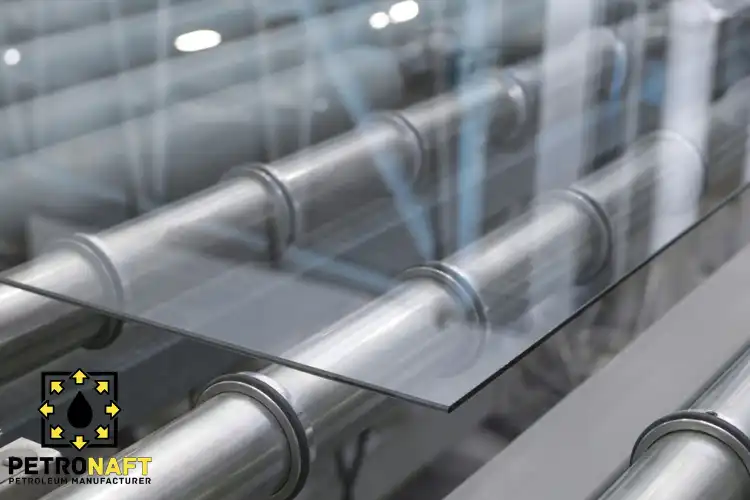
In Soda Ash in Glass Manufacturing, soda ash supplies sodium oxide that lowers melting temperature, improves melt chemistry, and helps glassmakers hit throughput with fewer defects. Demand rises with container, flat, and solar glass growth, while sustainability depends on higher cullet use and lower-carbon soda ash sourcing.
Soda ash looks like “just another bulk raw material,” but in practice it controls melt behavior, energy use, and quality stability. If you buy, use, or specify it, small differences in grade and consistency can show up as real costs on the line.
Highlights & Key Sections
Soda Ash in Glass Manufacturing: What It Does in the Batch
Soda ash (Na₂CO₃) is the primary source of sodium oxide (Na₂O) in most soda-lime-silica glasses. It acts as a flux: it helps silica melt at practical furnace temperatures and shapes viscosity so refining and forming stay stable.
What you’ll notice on a real production line when soda ash is “right”:
- Faster, steadier melting with fewer cold spots
- More predictable viscosity and working range
- Reduced risk of stones/cords linked to poor batch dissolution
- Fewer “surprises” when you switch cullet ratio or color mix
Quick chemistry view (why it matters): Na₂CO₃ decomposes and reacts in the batch, releasing CO₂ and enabling sodium to enter the glass network as Na₂O. That changes how the melt flows and refines.
Where soda ash shows up operationally
| What you’re optimizing | How soda ash influences it | What to watch on the line | Fast lever to try |
|---|---|---|---|
| Melting rate | Lowers effective melting temperature | Cold cap behavior, unmelted carryover | Improve batch homogeneity; check particle size/density |
| Refining/fining | Impacts gas release and viscosity | Seeds/blisters, foaming | Adjust fining package; verify moisture and alkalinity |
| Forming stability | Controls working viscosity | Gob consistency, mold filling | Tighten soda ash spec consistency; stabilize cullet feed |
| Quality defects | Impurity and dissolution issues can trigger defects | Stones, cords, scum | Check insolubles/iron; review storage and conveying |
Demand Drivers: Why Glass Keeps Pulling Soda Ash
Demand isn’t “one market”—it’s several glass markets moving at different speeds. When any of these accelerate, soda ash consumption follows.
Key drivers pushing demand:
- Packaging glass: brand shifts away from plastics in some segments, plus premiumization and returnable systems in select markets
- Construction and renovation: energy-efficient glazing, façade upgrades, and urban development
- Automotive and transport: laminated and coated glass growth in higher-value vehicles
- Solar glass: scaling of PV supply chains increases pull for flat glass capacity
- Recycling upgrades: better cullet sorting raises feasible cullet ratios, changing batch balance (often reducing soda ash per ton of finished glass)
A practical takeaway for buyers: capacity additions in flat/solar glass can tighten logistics and lead times even if headline “global supply” looks comfortable. Plan buffers around commissioning seasons and regional freight constraints.
What Buyers Should Specify When Sourcing Soda Ash
If you only specify “soda ash, 99%,” you leave performance and consistency to luck. A better approach is to specify the parameters that actually move your melt and quality KPIs.
Core specs that usually matter in glass plants
- Grade/form: light vs dense vs granular (affects dusting, flow, silo behavior, dissolution rate)
- Na₂CO₃ purity: impacts recipe control and total alkali balance
- Moisture: affects caking, feeding consistency, and mass balance
- Insolubles: can translate into stones or scum if they don’t dissolve
- Chlorides/sulfates: interact with fining and volatilization behavior
- Iron and trace metals: especially critical for clear, low-iron, and solar glass
Practical table: “Spec-to-impact” map
| Parameter | Practical target (typical) | Why it matters in glass | Simple receiving check |
|---|---|---|---|
| Purity (Na₂CO₃) | High and consistent | Stabilizes alkali input; reduces recipe drift | CoA + periodic titration verification |
| Bulk density | Consistent shipment-to-shipment | Controls feeder calibration and silo flow | Weigh known volume; compare trend |
| Moisture | Low and stable | Prevents caking/bridging; improves dosing | Moisture analyzer or loss-on-drying |
| Insolubles | As low as feasible | Reduces stone/scum risk | Quick filtration test on dissolution |
| Chloride | Controlled | Helps avoid corrosion/volatility side effects | Lab ion test if defects rise |
| Iron | Tight for clear/solar | Protects color/clarity | Trace metal check per schedule |
Mini tutorial: qualify a new soda ash supplier in 7 steps
- Request three consecutive CoAs (not one) to see variability.
- Match form factor to your handling: dense/granular often reduces dust; light can dissolve faster but can dust more.
- Run a feeder calibration check using bulk density and flowability on-site.
- Do a fast dissolution screen (time to dissolve + residue trend).
- Track defects for 2–4 weeks after trial: stones, cords, blisters, scum.
- Monitor furnace volatility indicators if you suspect chloride/sulfate swings.
- Lock a control plan: acceptance limits + what happens if a lot fails.
How Soda Ash Affects Cost, Energy, and Defects
Soda ash can look like a simple cost-per-ton line item, but its real economics show up in:
- energy per ton melted
- pull rate stability
- defect rate and rework
- refractory/maintenance stress (through volatility chemistry)
Typical batch share by common soda-lime glass family
| Glass type (typical) | Why soda ash is used | Approx. soda ash share in batch (rule-of-thumb range) |
|---|---|---|
| Container (soda-lime) | Melting + working viscosity control | ~12–16% |
| Float/flat (soda-lime) | Melt rate + viscosity control for forming | ~12–15% |
| Pattern/rolled | Similar to flat; recipe varies by product | ~11–15% |
| Specialty soda-lime variants | Tailored viscosity and durability | recipe-dependent |
Use these ranges as orientation, then validate against your exact recipe, cullet ratio, and performance targets.
Troubleshooting table: common symptoms and soda ash-related checks
| Symptom | What can be happening | Batch-room check | Fast corrective move |
|---|---|---|---|
| Dusting, housekeeping load spikes | Light soda ash + dry conveying + high drop heights | Check form and conveying velocity | Switch to dense/granular; soften drops; improve aspiration |
| Bridging/caking in silo | Moisture ingress or variable particle size | Inspect venting, seals, moisture trend | Dry air purge; tighter moisture spec; silo vibration strategy |
| Stones/undissolved inclusions | Insolubles or poor batch mixing | Track residue test + mixing time | Improve mixing; tighten insolubles; verify sand compatibility |
| Foaming or fining instability | Volatile balance shifts | Look for spec swings lot-to-lot | Stabilize supply; adjust fining/temperature profile |
| Color/clarity drift in clear glass | Trace metals or recipe drift | Trend iron + feeder calibration | Tighten trace spec; recalibrate feeders; segregate lots |
Sustainability: Cutting Footprint Without Breaking the Melt
Sustainability in glass isn’t only about the furnace. Your footprint comes from three linked places:
- raw materials (including soda ash production route)
- furnace energy and combustion chemistry
- process emissions tied to carbonates releasing CO₂ during melting
High-impact levers you can apply (often in this order)
1) Raise cullet intelligently
Cullet usually reduces energy demand and cuts the need for carbonate inputs. The trick is consistency:
- control cullet cleanliness (ceramics, organics, metals)
- stabilize cullet chemistry by color stream
- tune batch moisture and mixing to avoid segregation
2) Optimize soda ash sourcing for lower upstream emissions
Not all soda ash production routes have the same carbon intensity. If your customers ask for product carbon footprints, upstream differences can become a commercial advantage.
3) Upgrade melting and heat efficiency
- oxy-fuel and advanced combustion controls
- waste heat recovery (where practical)
- hybrid and electric boosting options
- tighter batch-to-furnace integration to reduce variability
4) Prepare for more carbon documentation
Across 2026 and beyond, carbon reporting expectations tighten in many supply chains. Documentation quality becomes part of “product quality,” especially for export-heavy value chains.
Quick “do-this-next” decarbonization playbook
- This week: audit soda ash variability (density, moisture, insolubles) and link it to defect/energy KPIs.
- This month: run a cullet quality map (contamination sources + corrective actions).
- This quarter: implement a supplier carbon-and-quality scorecard; test one lower-impact option through a controlled trial.
- This year: align furnace strategy (boosting, controls, heat recovery) with your cullet roadmap and product mix.
Mini Case Examples You Can Copy
Case 1: Reducing soda ash intensity with a smarter cullet push
A container glass operation increased usable cullet by improving sorting and removing ceramic contamination hotspots. They stabilized cullet chemistry by separating streams and tightened batch mixing time.
What changed in practice:
- lower carbonate demand per ton of saleable glass
- fewer “batch surprises” and less fining instability
- better energy stability once cullet variability dropped
How to replicate it:
- start with contamination Pareto (top 3 sources)
- set a cullet acceptance spec (not just a “target %”)
- tune batch water and mixing so higher cullet doesn’t segregate
Case 2: Fixing dust and feeder drift by changing soda ash form
A flat glass batch house struggled with dusting and feeder inconsistency after a supplier switch. They moved to a denser form factor, reduced drop heights, and recalibrated feeders using measured bulk density.
Results you can expect when it’s done well:
- cleaner handling with fewer housekeeping and filter loads
- more stable alkali dosing, reducing recipe “wander”
- fewer batch-flow interruptions and less silo intervention
Buying Guide: Choosing the Right Soda Ash for Your Operation
For procurement, the best soda ash is the one that stays consistent in your process—not the one that wins on a single invoice.
Use this short buyer checklist when comparing offers:
- Quality consistency: variability matters more than a slightly higher average purity
- Form factor fit: match to your conveying and silo system
- Documentation: CoA per lot, traceability, SDS, and compliance needs
- Logistics reliability: packaging, moisture protection, port/terminal resilience
- Support: responsiveness when you see defects or calibration drift
Supplier scorecard template (simple, usable)
| Category | What “good” looks like | Suggested weight |
|---|---|---|
| Lot-to-lot consistency | tight variability on moisture/density/insolubles | High |
| Technical fit | correct form factor + stable flow in your system | High |
| Quality system | traceable lots, fast corrective actions | Medium |
| Logistics | dependable lead times, protected packaging | Medium |
| Commercial terms | transparent pricing, realistic incoterms | Medium |
Conclusion: Turning a Commodity Into a Performance Advantage
Soda Ash in Glass Manufacturing is never just a recipe line—it’s a control knob for melt rate, energy, defects, and increasingly, carbon reporting. When you specify the right form and consistency, validate it with simple receiving checks, and pair it with a cullet-and-furnace roadmap, you protect both quality and margins while improving sustainability.
Executive Summary and Practical Checklist
If you only do five things, do these:
- Specify soda ash by consistency metrics (moisture, density, insolubles), not purity alone.
- Match light vs dense/granular to your handling system to prevent dust and feeder drift.
- Build a quick incoming QC routine (density + moisture + residue trend).
- Treat cullet quality as a raw material spec, not a percentage goal.
- Score suppliers on technical fit + documentation + logistics, not price alone.
Fast KPI set to track monthly:
- Soda ash kg per ton of saleable glass
- Energy per ton melted and pull-rate stability
- Defect rate: stones/cords/seeds/scum
- Batch house downtime tied to silo/conveying issues
- Lot-to-lot variability trend (density/moisture/insolubles)
FAQ
1) Is dense soda ash always better than light soda ash for glass plants?
Not always. Dense often reduces dust and improves silo flow, but light can dissolve quickly and may suit certain systems. The best choice depends on conveying design, feeder behavior, and your defect sensitivity.
2) How does higher cullet content change soda ash needs?
Higher cullet typically reduces carbonate requirements because cullet already contains alkalis and melts more easily. The exact change depends on cullet chemistry stability, contamination, and your target glass composition.
3) What soda ash impurities most commonly cause glass defects?
Insolubles can contribute to stones or scum, while variable moisture and density can cause dosing drift. For clear and solar products, trace iron and certain metals can also affect color and optical performance.
4) Why do soda ash shipments sometimes cake or bridge in storage?
Moisture ingress, temperature swings, and fine particle content can promote caking and bridging. Good silo sealing/venting, controlled humidity, and a stable moisture spec usually reduce the problem sharply.
5) How can I estimate soda ash consumption for planning and procurement?
Start with your target batch share (by recipe), then adjust for cullet ratio and expected losses. As a quick planning rule, daily soda ash ≈ daily glass output × soda ash fraction × (1 + small loss factor), then validate against actual inventory and feeder data.
Sources
- Global soda ash production, trade flows, and industry statistics updated annually — U.S. Geological Survey Mineral Commodity Summaries: Soda Ash (2025 PDF)
- Practical decarbonization pathways for container glass, including electrification and furnace strategy — FEVE Decarbonisation Report (2024 PDF)
- Peer-reviewed analysis comparing emissions footprints of soda ash production routes and related process chemistry — Royal Society of Chemistry (2025)
- Technical review of soda ash production methods and sustainability improvements across processes — ScienceDirect Critical Review (2024)
- Official policy framework and timeline for carbon-border reporting and compliance affecting carbon-intensive goods — European Commission: CBAM