


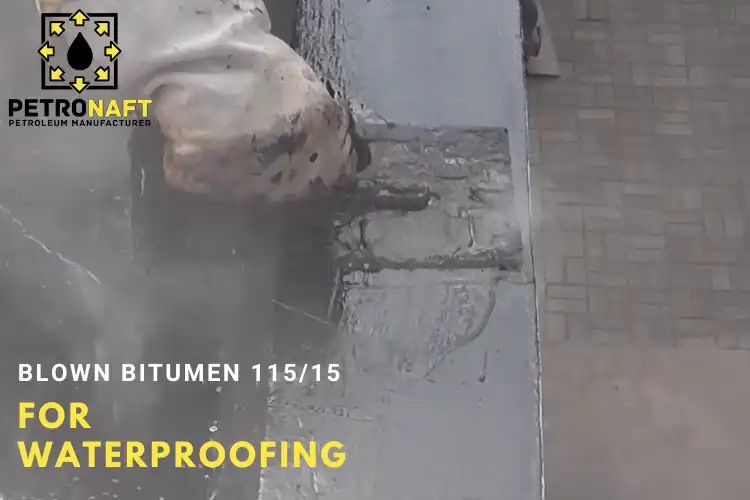
Blown Bitumen 115/15 for Waterproofing is a hard, air-blown petroleum bitumen grade typically selected when a waterproofing system needs a higher softening point, lower penetration, and better resistance to flow at elevated service temperatures than softer bitumen grades. It is commonly used in roofing, waterproofing compounds, membranes, sealants, and pipe-coating systems.
For buyers, engineers, and procurement teams, the key issue is not whether 115/15 is a good bitumen in general. The real decision is whether its hardness, handling profile, and specification range match the waterproofing system being designed, manufactured, or purchased. That depends on the supplier’s technical data sheet, the process temperature, and the intended end use.
Highlights & Key Sections
What is Blown Bitumen 115/15?
Blown bitumen 115/15 is an oxidised industrial bitumen grade produced by passing air through bitumen at elevated temperature until the target physical properties are reached.
In industry practice, the terms blown bitumen and oxidised bitumen are often used very closely, especially for hard industrial grades used in roofing and waterproofing. The blowing process changes the material’s structure and shifts its performance profile toward higher softening point and lower penetration.
The grade notation is also important. In common designation practice for oxidised bitumen, the first number refers broadly to the softening-point class and the second to the penetration class at 25°C. For 115/15, the practical expectation is a high softening point and a low penetration range, but the agreed supplier specification should always govern the purchase decision.
Why is it used for waterproofing?
It is used for waterproofing because oxidation makes the bitumen harder, more heat-stable, and less likely to flow under elevated service temperatures.
That makes this grade suitable for roofing and waterproofing systems where a firmer bituminous material is needed. It is especially relevant in products or formulations that must maintain shape and performance under heat exposure rather than behave like a softer paving binder.
For technical buyers, the useful takeaway is that 115/15 is usually chosen for systems requiring a hard industrial bitumen base material. In many cases, it serves as a raw material in membranes, compounds, mastics, or coatings rather than as a generic bulk bitumen used without formulation control.
Which properties matter most in waterproofing applications?
The most important properties are the ones that affect thermal stability, hardness, handling safety, and formulation consistency.
When evaluating this grade, buyers and technical teams should focus on the following:
| Property | Why it matters in waterproofing | What to verify |
|---|---|---|
| Softening point | Indicates resistance to flow at elevated temperature | Confirm the specified range and test method |
| Penetration at 25°C | Shows hardness and consistency | Check that the grade is not softer than required |
| Solubility | Helps confirm binder consistency and purity | Review the minimum value required |
| Loss on heating | Indicates stability during heating and handling | Check the maximum allowed value |
| Flash point | Critical for storage and hot application safety | Confirm the minimum safe handling limit |
| Density / specific gravity | Useful for batching and process calculations | Use supplier values for formulation control |
These properties should always be taken from the current technical data sheet and batch documentation, not assumed from the grade name alone.
How does 115/15 differ from paving-grade bitumen?
It is not a paving binder. Blown Bitumen 115/15 is an industrial waterproofing and roofing grade, while paving-grade bitumen is designed for asphalt mixtures and road performance.
This distinction matters because purchasing errors often happen when teams compare products only by the word bitumen without checking the intended application class. A hard oxidised grade for waterproofing behaves differently from a paving binder intended for flexible road mixtures.
| Material type | Typical role | Selection logic |
|---|---|---|
| Blown Bitumen 115/15 | Waterproofing, roofing, pipe-coating, sealing compounds | Chosen for high softening point and low penetration |
| Paving-grade bitumen | Asphalt for roads and pavements | Chosen for pavement binder performance |
If the application involves roofing compounds, membranes, or protective coatings, 115/15 may be relevant. If the application is asphalt production, it is generally the wrong material family.
What specifications should buyers check before ordering?
Buyers should verify the full datasheet, test methods, and batch certificate before placing an order.
Start with the core grade indicators:
- Softening point
- Penetration at 25°C
- Solubility
- Loss on heating
- Flash point
- Density or specific gravity
Then review the testing basis. Penetration and softening point may be reported using ASTM methods, EN methods, or both, depending on the region and supplier. That matters when comparing offers across countries, because similar product descriptions can still be presented under different testing frameworks.
A sound procurement file should also request:
- Current technical data sheet
- Safety data sheet
- Batch or lot certificate
- Packaging type
- Recommended heating and handling range
- Storage guidance
- Confirmation of intended end use
Where is this grade typically used?
This grade is used where a hard oxidised bitumen is needed as a waterproofing or protective compound rather than as a paving binder.
Typical applications include:
- Roofing membranes
- Waterproofing compounds
- Pipe coatings
- Adhesives and sealants
- Anti-corrosion products
- Certain bituminous flooring or protection systems
That does not mean every waterproofing project should use 115/15 directly. In many systems, the material is part of a manufactured formulation rather than the finished waterproofing layer itself. Buyers should therefore match the grade to the process and product design, not just to the broad label of waterproofing.
How should it be heated, handled, and stored?
It should be handled as a hot-applied industrial material with controlled heating, splash protection, and strict exclusion of water from hot product contact.
The main operational hazard is thermal burn risk from splashes or spills. Overheating can also affect both safety and product quality. In plant and site conditions, heating should be controlled, indirect where possible, and consistent with the supplier’s safety data sheet and operating procedure.
For practical handling, the minimum good-practice approach is:
- Use controlled heating
- Avoid direct overheating
- Prevent any contact between water and hot bitumen
- Use suitable heat-resistant PPE and face protection
- Follow the supplier’s SDS and internal plant safety procedure
Because heating guidance can vary by supplier and equipment type, operating temperatures should never be assumed from a generic article alone.
How do you decide whether it is the right grade?
Choose it only if the waterproofing system genuinely benefits from a hard oxidised bitumen with high softening point and hot-applied processing logic.
A practical decision framework looks like this:
1. Define the end use clearly
Is the material intended for membranes, waterproofing compounds, pipe coating, roofing products, or sealing systems? If not, 115/15 may not be the right starting point.
2. Match the grade to service and process conditions
If the system needs stronger resistance to flow at elevated temperatures, this grade may fit. If the system requires greater flexibility, cold application, or a different chemistry, another material may be more suitable.
3. Verify the real specification
Do not rely on the grade name alone. Check softening point, penetration, flash point, and heating-related properties on the actual supplier documentation.
4. Confirm process compatibility
Review the heating method, kettle or tank limitations, pumping expectations, and packaging format before approving the material.
5. Align procurement and technical approval
The commercial team should not buy on price alone. Technical review should confirm that the offered material matches the intended waterproofing system and the required test basis.
Common mistakes when buying Blown Bitumen 115/15 for Waterproofing
The most common mistakes are specification mistakes rather than product-name mistakes.
Watch for these issues:
- Buying by grade name without reviewing the datasheet
- Comparing prices without comparing test methods
- Assuming all 115/15 material is identical across suppliers
- Ignoring flash point and hot-handling requirements
- Using the grade for a system that actually needs a more flexible or different material
In practice, most costly errors happen when a procurement decision is made before the technical team confirms suitability.
Procurement checklist
A strong purchase decision depends on matching the offered material to the actual waterproofing process, not simply matching the product name.
Before approving an order, confirm all of the following:
- The product is clearly identified as blown or oxidised bitumen 115/15
- The datasheet shows the required softening point and penetration range
- The test methods are stated
- Flash point and heating guidance are available
- Packaging suits the plant or project handling method
- A batch certificate will be supplied
- The supplier confirms suitability for the intended application
- The SDS has been reviewed by the relevant team
- Technical approval has been completed before commercial confirmation
Conclusion: when is Blown Bitumen 115/15 for Waterproofing a good choice?
It is a strong choice when the application requires a hard oxidised bitumen for roofing, waterproofing compounds, membrane manufacture, or related protective systems, and when the buyer verifies the actual specification and handling conditions before purchase.
Blown Bitumen 115/15 for Waterproofing should be treated as a specification-driven industrial material rather than a generic commodity. When the grade, test basis, handling method, and application are aligned, it can be an effective raw material for durable waterproofing systems. When they are not aligned, the right decision is to stop and re-check the technical documents before ordering.
FAQs
1. Does 115/15 mean the material always has exactly 115°C softening point and 15 dmm penetration?
No. The designation usually reflects a grade class, not a single exact reading. Buyers should confirm the supplier’s stated range and the batch documentation rather than treating the numbers as absolute fixed values.
2. Is blown bitumen 115/15 the same as oxidised bitumen 115/15?
In common industrial usage, the terms are usually treated as the same or very closely related for this grade type. What matters commercially is how the supplier defines the product and which specification sheet supports it.
3. Can this grade be used directly in every waterproofing project?
No. In many cases, it is used as a raw material in a finished membrane, mastic, coating, or sealing system. Suitability depends on the system design, process method, and technical specification.
4. What is the main technical advantage of 115/15 over softer bitumen grades?
Its higher softening point and lower penetration make it harder and more resistant to flow at elevated temperatures. That is why it is commonly associated with roofing and waterproofing applications rather than paving.
5. What is the biggest procurement mistake with this material?
Buying it by grade name alone. A professional purchase should verify the property range, test methods, handling guidance, and batch documentation instead of assuming all 115/15 offers are equivalent.
Sources
- ORLEN Asphalt – Bitumen Handbook 2021
Relevant for industrial bitumen classification context and the distinction between oxidised and paving-grade bitumen. - Eurobitume – Bitumen Health, Safety and Environment
Relevant for safe handling principles, worker risk awareness, and operational precautions for hot bitumen. - ASTM D5/D5M – Standard Test Method for Penetration of Bituminous Materials
Relevant for understanding penetration as a core test property used in evaluating hardness and consistency. - ASTM D36/D36M – Standard Test Method for Softening Point of Bitumen (Ring-and-Ball Apparatus)
Relevant for understanding softening point as a key classification and performance-related property.