


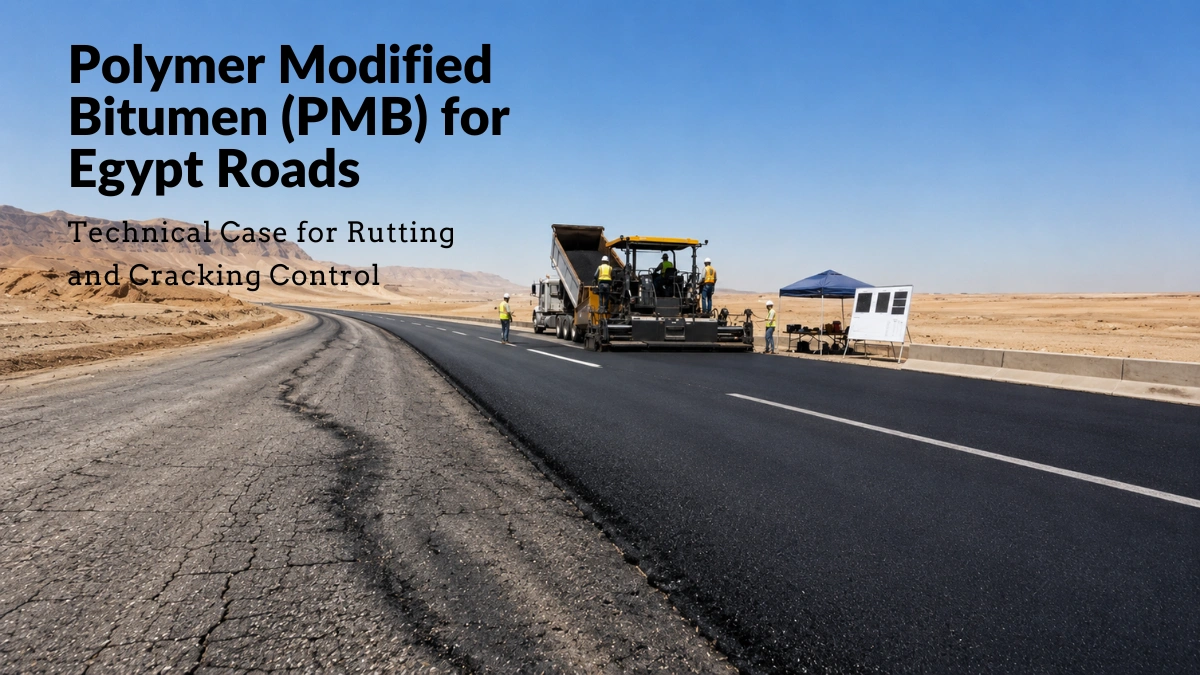
Egypt has a strong technical case for the wider evaluation of Polymer Modified Bitumen (PMB) in high-stress asphalt pavements. Hot-climate exposure, strategic highway expansion, heavy logistics traffic, slow-moving urban loads, and the cost of repeated maintenance make PMB a practical binder option for sections where conventional paving bitumen may be vulnerable to rutting, fatigue cracking, oxidation, and early surface distress.
Executive technical position
PMB should be introduced in Egypt through targeted, measurable adoption
Polymer Modified Bitumen is not simply a higher-priced binder. It is a performance material designed for pavement sections exposed to elevated pavement temperatures, repeated axle loading, braking and acceleration forces, heavy truck traffic, port access roads, bus corridors, bridge approaches, intersections, industrial zones, and previously distressed asphalt surfaces.
For Egyptian road authorities, consultants, contractors, and asphalt producers, the most practical route is a controlled introduction program: select high-stress sites, validate the binder and asphalt mix in local laboratories, pave a trial section beside a conventional control section, monitor rutting and cracking, and convert the measured results into a repeatable procurement specification.
Recommended starting grade for Egypt: Petro Naft PMB 40
Petro Naft PMB 40 is the recommended primary candidate for Egypt's initial technical evaluation because it provides the lowest penetration range and the highest softening-point threshold among the three referenced Petro Naft PMB grades. This profile is suitable for hot-climate rutting control while maintaining polymer elastic recovery for cracking and durability performance.
Egypt road context
Why Egyptian pavements need a higher-performance binder option
Egypt's road network is strategically important for national logistics, port access, tourism, industrial development, urban mobility, and desert development corridors. Public infrastructure references show continued attention to road paving, strategic road networks, interprovincial links, Nile axes, and safe transportation systems.
The pavement-materials issue is not only road length; it is the way asphalt layers behave under high temperature and repeated traffic stress. Egypt has hot climatic exposure, and climate references identify summer temperatures that can exceed 40°C in some regions, with increasing heat extremes expected under climate-change scenarios. High pavement temperatures increase the risk of binder softening, wheel-path deformation, bleeding, and rutting when binder selection, mix design, compaction, and drainage are not optimized.
Heat and solar exposure
High pavement temperatures can reduce binder stiffness and increase permanent deformation under load. A PMB grade with a higher softening point helps resist this mechanism.
Heavy and slow traffic
Truck lanes, port corridors, urban intersections, bus lanes, logistics areas, and braking zones impose repeated stress where polymer-modified binders are especially valuable.
Maintenance economics
PMB should be used where longer service life, fewer interventions, improved safety, and lower life-cycle disruption can justify the higher binder value.
Target pavement distresses
The main target problems are rutting and cracking
Rutting: permanent deformation in wheel paths
Rutting occurs when asphalt layers accumulate unrecovered strain under traffic. It becomes more likely at high pavement temperatures, in heavy traffic lanes, at intersections, on gradients, near traffic lights, and in areas where trucks move slowly or stop frequently.
- Typical visible symptom: wheel-path depressions.
- Key binder need: high-temperature deformation resistance.
- Relevant PMB benefit: polymer elasticity and improved recovery after loading.
Cracking: fatigue, aging, and movement-related distress
Cracking can result from repeated traffic fatigue, binder aging, poor bonding, structural weakness, reflective cracking, thermal movement, or insufficient flexibility. PMB helps because polymer modification can improve elasticity, cohesion, adhesion, and resistance to repeated stress cycles.
- Typical visible symptom: transverse, longitudinal, block, or fatigue cracking.
- Key binder need: elastic recovery and durability after aging.
- Relevant PMB benefit: improved flexibility and resistance to crack propagation.
Important limitation: PMB cannot correct weak pavement structure, poor drainage, unsuitable aggregates, inadequate compaction, or defective asphalt plant control. It should be specified together with a verified mix design, quality aggregates, proper production temperature control, and field compaction requirements.
Technical mechanism
Why polymer modification improves asphalt binder performance
PMB improves the binder phase by adding a polymer network that can increase elasticity, improve recovery after repeated loading, raise resistance to high-temperature softening, and improve cohesive behavior. In pavement terms, this can translate into better resistance to wheel-path deformation, improved fatigue behavior, and better durability where the asphalt mix is properly designed.
Modern performance evaluation increasingly relies on tests that measure how binders recover after load. The FHWA Multiple Stress Creep Recovery (MSCR) technical brief explains that MSCR uses creep and recovery loading in a Dynamic Shear Rheometer to evaluate the binder's permanent deformation potential, and it better captures the delayed elastic effects of polymer-modified binders than older low-strain high-temperature PG parameters.
Higher softening resistance
A higher softening-point threshold helps the binder remain more stable when pavement temperatures rise.
Elastic recovery
Polymer-modified binders can recover part of the deformation after repeated loading, reducing unrecovered strain.
Improved durability
When the formulation, storage, mixing, and compaction are controlled, PMB can improve resistance to key distress mechanisms.
Petro Naft grade selection
Why Petro Naft PMB 40 is the right first candidate for Egypt
Petro Naft's common PMB grades can be screened by penetration, softening point, elastic recovery, flash point, storage stability, viscosity, solubility, and TFOT residue indicators. For Egypt's hot-climate rutting risk, the most relevant preliminary indicators are penetration, softening point, and elastic recovery.
| Petro Naft PMB grade | Penetration at 25°C | Softening point | Elastic recovery at 15°C | Preliminary suitability for Egypt |
|---|---|---|---|---|
| PMB 40 | 30-50 dmm | Min. 60°C | Min. 70% | Recommended first candidate for hot-climate rutting control, heavy traffic zones, intersections, truck lanes, ports, logistics corridors, and trial sections. |
| PMB 70 | 50-90 dmm | Min. 55°C | Min. 70% | Balanced option where moderate flexibility is required and rutting demand is lower than PMB 40 target sections. |
| PMB 120 | 90-150 dmm | Min. 50°C | Min. 70% | Softer binder profile; not the first choice for high-temperature rutting-critical Egyptian road trials unless local design requires higher flexibility. |
Selection logic: PMB 40 has the lowest penetration range and highest softening-point threshold among the listed Petro Naft PMB grades. Therefore, it is the most logical starting point for rutting-prone hot-climate Egyptian pavements. Final approval should still depend on local aggregate properties, asphalt mix design, climate grade, expected axle loading, plant capability, and authority test results.
For more product details, specifications, and inquiry options, visit the Petro Naft product page for Polymer Modified Bitumen (PMB).
Where PMB should be used first
Priority applications for PMB in Egypt
PMB is usually most convincing when it is applied to road sections where the performance problem is visible, measurable, and costly. For Egypt, PMB 40 should be evaluated first in the following pavement categories.
Port and logistics roads
Truck traffic, container movement, high axle loads, slow speeds, and stopping zones make rutting resistance a priority.
Urban intersections and bus corridors
Braking, standing traffic, acceleration, and slow vehicle movement create repeated high-stress loading in the surface course.
Strategic highways and desert corridors
Long solar exposure, temperature extremes, and heavy transport corridors require durable asphalt layers with stronger binder performance.
Bridge approaches and ramps
Localized stress, movement, braking, and drainage sensitivity can accelerate cracking and deformation if the mix is not optimized.
Airport and industrial pavements
Where specifications allow, PMB can be considered for high-load asphalt applications requiring improved deformation resistance.
Maintenance overlays
PMB is valuable where an overlay must resist reflective cracking and extend maintenance cycles on distressed existing pavements.
Practical validation plan
Recommended laboratory testing before authority approval
A credible PMB introduction program should not rely only on supplier datasheets. Egyptian authorities and contractors should validate the selected binder and asphalt mixture using local aggregates, local asphalt plant conditions, traffic assumptions, and the authority's preferred standards.
| Testing stage | Recommended checks | Purpose |
|---|---|---|
| Binder characterization | Penetration, softening point, elastic recovery, flash point, solubility, rotational viscosity, specific gravity, storage stability, TFOT/RTFOT aging indicators. | Confirm that the delivered PMB matches the declared grade and is suitable for handling, storage, mixing, and paving. |
| Performance grading | DSR high-temperature performance, MSCR Jnr and percent recovery, intermediate-temperature fatigue checks, aging evaluation. | Confirm rutting resistance and polymer-modified elastic response under performance-related testing. |
| Mixture design | Marshall or Superpave design, voids, VMA, VFA, binder content, aggregate gradation, filler compatibility, moisture sensitivity. | Ensure that PMB is used inside a stable, compactable, durable asphalt mix rather than treated as a stand-alone solution. |
| Mixture performance | Wheel tracking, Hamburg or APA rutting test, indirect tensile strength, TSR moisture sensitivity, cracking/fatigue screening, density and permeability checks. | Compare PMB mixture performance against a conventional-bitumen control mixture under the same aggregate and gradation system. |
| Plant and field QC | Delivery temperature, storage temperature, mixing temperature, compaction temperature, rolling pattern, density, cores, surface texture and rut-depth baseline. | Protect field performance by controlling production and construction variables. |
Best practice: The trial should include both a PMB section and a conventional binder control section. Without a control section, it is difficult for authorities to quantify the added value of PMB under Egyptian traffic and climate conditions.
Trial pavement strip
Trial section model: local execution with Petro Naft supply and technical support
A trial section is the most practical way to move PMB from technical discussion to authority acceptance. The trial should be designed as a measurable engineering project, not simply a demonstration.
- Select the project location. Choose a section with existing rutting/cracking risk or clear high future stress: port access, truck lane, logistics zone, intersection, bus corridor, bridge approach, ramp, or desert highway segment.
- Define the control section. Place a conventional-bitumen control section beside the PMB section to compare performance under the same traffic and climate exposure.
- Approve the local mix design. Use local aggregates, local filler, local plant limitations, and authority-approved laboratory procedures.
- Execute paving locally. The Egyptian owner, authority, contractor, or asphalt producer should execute the trial pavement strip. Petro Naft can support with technical documentation and supply, but local paving operations should remain under local project control.
- Monitor performance. Record production temperatures, compaction temperatures, density, core results, rut depth, cracks, surface condition, and maintenance needs at agreed intervals.
Petro Naft role
Supply Petro Naft PMB, provide TDS/SDS/COA and shipping documentation, support grade selection, advise on handling and storage, and assist with technical materials for consultants, authorities, and contractors.
Local project role
Handle import clearance, permits, local laboratory testing, mix design, plant production, paving, compaction, QA/QC, traffic management, field monitoring, and authority reporting.
Trial supply route
For a meaningful PMB trial, a 20-ft container trial order is the practical route
Small courier samples are generally not a suitable route for hot-applied PMB and bitumen materials at authority-level evaluation scale. For an authority-level technical evaluation, Petro Naft recommends a 20-ft container trial order so that the Egyptian contractor or authority can perform complete laboratory testing, plant mixing, field paving, and performance monitoring with material from the same supply batch.
Trial supply
A 20-ft container can support a real laboratory and field evaluation instead of a very small quantity that cannot reliably represent plant-scale handling and paving conditions.
Annual supply potential
An annual demand of 300-400 MT is modest for PMB procurement, but Petro Naft can support this scale and use it as a controlled market-entry supply program for Egypt.
Depending on the confirmed order, packaging, port, Incoterms, and documentation requirements, Petro Naft can coordinate export supply and provide the necessary commercial and technical documents for buyer review.
Procurement readiness
Information Egyptian buyers should provide for a precise PMB offer
To prepare a technically accurate quotation and trial plan, Petro Naft recommends that Egyptian road authorities, contractors, consultants, and asphalt producers provide the following information.
Project and application
- Road type and location
- Surface, binder, or base-course application
- Known rutting or cracking problem
- Expected trial-section length and asphalt tonnage
Traffic and climate
- Heavy vehicle percentage
- Slow/stopped traffic conditions
- Design life or maintenance target
- Local temperature and pavement exposure assumptions
Commercial and logistics
- Required PMB grade
- Estimated quantity
- Destination port in Egypt
- Required packaging and Incoterms
- Documentation requirements
For technical procurement, buyers should request the relevant Technical Data Sheet, Safety Data Sheet, Certificate of Analysis for the shipped batch, packing list, commercial invoice, certificate of origin when required, and any project-specific compliance documentation requested by the authority or consultant.
Specification framework
How Egypt can convert a trial into a repeatable PMB specification
A successful trial should produce a local technical basis for future procurement. The goal is not only to buy one cargo of PMB; it is to create a performance-based binder and mixture specification that road authorities and contractors can use repeatedly.
| Specification item | Recommended decision point | Why it matters |
|---|---|---|
| Binder grade | Start with PMB 40 for rutting-critical hot-climate sections; compare with PMB 70 only if more flexibility is required. | Aligns binder stiffness and softening resistance with the pavement distress mechanism. |
| MSCR requirement | Use Jnr and percent recovery targets when the authority has DSR/MSCR capability. | Provides a performance-related method for assessing rutting resistance and polymer response. |
| Mixture rutting test | Use Hamburg, APA, or wheel tracking according to available local equipment. | Confirms performance of the whole asphalt mix, not only the binder. |
| Moisture sensitivity | Evaluate TSR/stripping resistance with local aggregates and filler. | Egyptian projects may use different aggregate sources; adhesion must be validated locally. |
| Field acceptance | Define density, temperature, core, smoothness, and visual condition requirements. | Ensures that trial results are construction-quality controlled and defensible. |
Supplier position
Why Petro Naft is a practical PMB partner for Egyptian buyers
Petro Naft supplies Polymer Modified Bitumen for road and infrastructure applications and can support Egyptian buyers with technical documentation, grade selection, export coordination, and supply for both controlled trial orders and recurring annual demand. The company can provide common PMB grades including PMB 40, PMB 70, and PMB 120, with grade selection guided by the target pavement distress and local test results.
Technical focus
Grade recommendation is linked to pavement distress, climate exposure, traffic condition, and test validation rather than price alone.
Export support
Petro Naft can support international buyers with required product documentation and coordination for containerized supply.
Scalable supply
Although 300-400 MT per year is a limited PMB volume, Petro Naft can support this demand and expand supply if PMB adoption increases.
Request Petro Naft PMB for Egypt road projects
For Egyptian road authorities, contractors, consultants, asphalt plant operators, importers, and distributors evaluating rutting-resistant and cracking-resistant binders, Petro Naft recommends starting with a technical review of PMB 40, followed by local laboratory validation and a controlled trial section.
FAQ for Egyptian PMB evaluation
Common questions about using PMB in Egypt
What is the best PMB grade for hot-climate road sections in Egypt?
For the first technical evaluation, Petro Naft recommends PMB 40 because its lower penetration and higher softening-point threshold make it the strongest candidate among the listed Petro Naft PMB grades for rutting-prone hot-climate sections.
Can PMB reduce rutting in Egyptian asphalt roads?
PMB can improve rutting resistance when the correct grade is selected and the asphalt mix is properly designed, produced, compacted, and tested. The benefit should be verified through MSCR or other binder performance tests and a mixture rutting test such as wheel tracking, Hamburg, or APA.
Can PMB also help with cracking?
Yes, polymer modification can improve elastic recovery, cohesion, and resistance to repeated stress, which can help reduce certain cracking mechanisms. However, structural cracking, poor drainage, and weak base layers must be corrected through pavement design and construction quality control.
Is PMB necessary for every road in Egypt?
No. PMB should be targeted first at high-value or high-stress sections such as truck routes, ports, intersections, bus lanes, bridge approaches, industrial roads, strategic highways, and maintenance overlays where life-cycle performance is more important than lowest initial binder cost.
How should Egypt test PMB before full adoption?
The recommended route is binder testing, performance grading, MSCR evaluation where available, asphalt mix design with local aggregates, mixture rutting and moisture-sensitivity testing, then a monitored trial section beside a conventional-bitumen control section.
Can Petro Naft supply small evaluation quantities?
For a meaningful authority-level PMB evaluation, a 20-ft container trial order is the practical route. It provides enough material for laboratory work, plant production, paving, and field monitoring from the same supply batch.
Technical references
References used for this technical article
- Climate Centre - Egypt Climate Fact Sheet 2024
- Egypt Ministry of Planning and Economic Development - Transport sector goals for FY2024/2025
- National Investment Bank of Egypt - National Road Project
- Federal Highway Administration - Multiple Stress Creep Recovery Procedure
- Federal Highway Administration - Highly Modified Asphalt How-To Document
- AASHTO M 332 - Performance-Graded Asphalt Binder Using MSCR
- Petro Naft Polymer Modified Bitumen (PMB)