


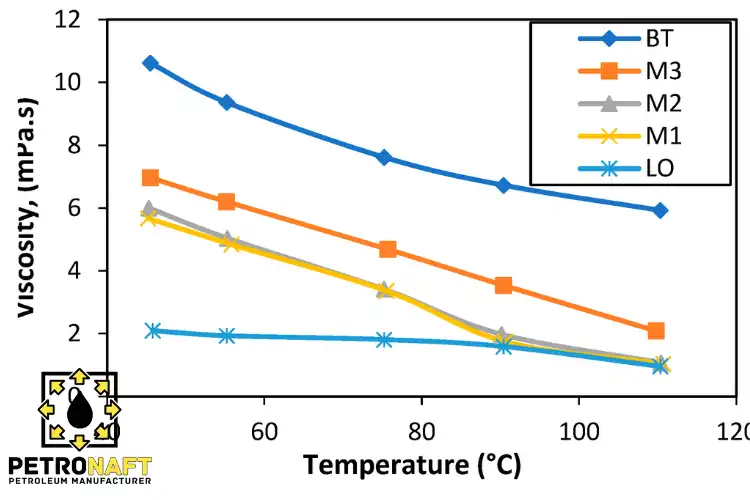
Bitumen Viscosity vs Temperature changes fast: as temperature rises, viscosity drops (often exponentially), so the binder flows, pumps, and coats aggregate more easily. As temperature falls, viscosity climbs sharply, increasing mixing effort, compaction resistance, and cracking risk. The practical takeaway: control temperature to hit target viscosity windows—not “hotter is always better.”
Highlights & Key Sections
Why this relationship matters in the real world
Viscosity is the “workability dial” for bitumen. In practice, it controls:
- Pumping & unloading: Will it move through lines without cavitation or extreme pressure?
- Storage & handling: Will it stay homogeneous without overheating and aging?
- Mixing & coating: Will it wet aggregate quickly and uniformly?
- Compaction: Will the mat densify before it cools below the workable range?
- Performance balance: Too low = potential drain-down/bleeding; too high = poor compaction and durability loss.
Small temperature changes near working ranges can produce large viscosity changes, which is why temperature control is a quality lever—not just an operational detail.
Bitumen Viscosity vs Temperature: How the relationship works
Bitumen is a thermo-rheological material: temperature changes alter molecular mobility and internal friction.
- Higher temperature → lower viscosity: the binder flows more easily and behaves closer to Newtonian in many paving ranges.
- Lower temperature → higher viscosity: the binder stiffens; polymer-modified binders can also show stronger non-Newtonian behavior at certain ranges.
- Aging shifts the curve: oxidation and volatilization generally raise viscosity at the same temperature, narrowing your workable window.
Think of the curve like a steep hill: moving “a few degrees” can be the difference between smooth pumping and a stuck line.
Viscosity basics: units, meanings, and what labs usually report
Two viscosity types show up most often:
- Dynamic viscosity (μ): resistance to shear, typically Pa·s (or mPa·s / cP).
- Kinematic viscosity (ν): dynamic viscosity divided by density, typically mm²/s (cSt).
A handy relationship:
- ν = μ / ρ (where ρ is density)
Quick unit table
| What you see | What it means | Common equivalence (approx.) |
|---|---|---|
| Pa·s | Dynamic viscosity | 1 Pa·s = 1000 cP |
| mPa·s | Dynamic viscosity | 1 mPa·s = 1 cP |
| cP | Dynamic viscosity | 1000 cP = 1 Pa·s |
| cSt (mm²/s) | Kinematic viscosity | Depends on density |
What tests typically inform decisions
Most projects rely on viscosity measured at one or more standard high temperatures (commonly around 135°C and 165°C for paving workability checks). Modified binders may require extra care because shear rate and polymer structure can affect the reading.
A practical “Relationship & Chart” you can use immediately
Below is example chart data (illustrative) for a paving-grade binder. Your supplier’s certificate of analysis is the best source for exact values.
Example viscosity–temperature chart table (illustrative)
| Temperature (°C) | Viscosity (Pa·s) | Viscosity (cP) |
|---|---|---|
| 110 | 0.85 | 850 |
| 120 | 0.55 | 550 |
| 130 | 0.35 | 350 |
| 135 | 0.30 | 300 |
| 145 | 0.22 | 220 |
| 155 | 0.16 | 160 |
| 165 | 0.12 | 120 |
How to read it: from 135°C to 155°C (20°C change), viscosity nearly halves. That’s why “a little hotter” can dramatically change coating and compaction behavior.
Mini tutorial: build the chart in Excel/Sheets (5 steps)
- Paste the table into two columns: Temperature and Viscosity (Pa·s).
- Insert → Scatter chart (points with lines).
- Format the viscosity axis to log scale (this makes the curve easier to interpret).
- Add horizontal reference lines for your target viscosity windows (see next section).
- Use the curve to pick mixing, compaction, pumping, and storage temperatures with a safety margin.
Temperature targets that engineers actually use
Instead of picking temperatures by habit, many teams pick temperatures that match target viscosity windows.
Common operational targets (guidance values)
| Operation | Practical objective | Typical approach |
|---|---|---|
| Mixing temperature | Fast coating + uniform blend | Choose T where viscosity is around 0.17 Pa·s (170 cP) |
| Compaction temperature | Achieve density before cooling | Choose T where viscosity is around 0.28 Pa·s (280 cP) |
| Pumping/transfer | Stable flow without high pressure | Pick a T that keeps viscosity comfortably below your pump/line limit |
| Storage | Keep pumpable + minimize aging | Use the lowest stable temperature that still meets handling needs |
Important reality check: modified binders, high-RAP mixes, and warm-mix processes can shift these targets. Use them as a starting point, then tune with plant and field results.
Mini case study: picking safe pumping and mixing temperatures
Scenario: A contractor struggles to unload a tanker on a cold morning. The binder cools in the line and unloading slows dramatically.
What they change (simple, practical fixes):
- They confirm the binder’s viscosity at 135°C and 165°C on the certificate.
- They raise line heat-trace setpoint so the binder stays above the “stiff jump” zone.
- They insulate the exposed elbows and valves (high heat-loss points).
- They shorten idle time between recirculation cycles.
Result you typically see: steadier unloading, less pump strain, fewer start-stop events, and more consistent binder temperature entering the plant.
Quick way to estimate viscosity at a different temperature
If you have viscosity at two temperatures, you can approximate the curve well enough for operational planning.
Simple two-point method (practical planning)
- Record two data points: (T₁, μ₁) and (T₂, μ₂).
- Convert temperatures to Kelvin: K = °C + 273.15.
- Assume a straight line for ln(μ) vs 1/T across that range (a common approximation for planning).
- Use that line to estimate μ at your target temperature.
Why this works for day-to-day decisions
You don’t need a perfect rheology model to solve operational problems like pumping, unloading, and selecting working temperatures. You need a good estimate plus a field safety margin, then you verify with plant/field performance.
Buyer-focused checklist: what to request from your supplier
If you want predictable handling and performance, ask for data that supports real decisions:
- Viscosity at two high temperatures (so you can build a chart for your exact batch)
- Grade and specification framework (penetration, PG, or project spec)
- Confirmation of modification (if any) and handling guidance
- Typical recommended storage and transfer temperature ranges
- Basic consistency checks across shipments (helps avoid batch-to-batch surprises)
This reduces downtime and prevents costly “temperature guessing.”
Troubleshooting: common problems tied to viscosity–temperature mismatch
| Problem in plant/field | Likely viscosity-related cause | Practical fix |
|---|---|---|
| Slow tanker unloading | Binder too viscous in lines/valves | Raise line temperature, insulate, recirculate, reduce idle time |
| Poor coating / dry aggregate spots | Binder too viscous at mixing | Increase mixing temperature slightly or improve aggregate drying/heat balance |
| Tender mix / shove during rolling | Binder too fluid or mix too hot | Lower mix temp, adjust rolling pattern, verify binder grade |
| Premature mat cooling | Workability window too narrow | Tighten haul/laydown timing, warm-mix strategy, adjust target temperatures |
| Drain-down (especially in SMA) | Binder viscosity too low at placement | Control temperature, review mix design and stabilizers |
Trends pushing viscosity–temperature decisions in 2026 projects
A few industry realities make viscosity control more valuable than ever:
- Higher RAP content: reclaimed binder can stiffen blends and shift the curve upward, demanding better temperature planning.
- Warm-mix and lower-carbon paving: additives and foaming processes change workability targets while aiming to cut fuel use and emissions.
- More modified binders: polymers improve performance but can complicate viscosity interpretation—especially if shear sensitivity matters.
- Digital QC: more crews adopt continuous temperature logging and smarter plant controls to keep viscosity inside a reliable operational band.
These trends reward teams who manage viscosity with data, not intuition.
Conclusion
Bitumen Viscosity vs Temperature is not just a lab concept—it’s the practical rule that determines pumping reliability, coating quality, compaction success, and long-term pavement performance. Build a simple viscosity–temperature chart from your batch data, choose temperatures to hit target viscosity windows, and then fine-tune with field feedback to avoid overheating, aging, and variability.
Executive Summary / Practical Checklist
- Collect viscosity at two temperatures for the exact binder batch.
- Plot a viscosity–temperature chart (use a log scale for viscosity).
- Set mixing and compaction temperatures by target viscosity, not habit.
- Keep transfer lines insulated and avoid long idle periods that cool the binder.
- Use the lowest effective storage temperature to reduce aging risk.
- Re-check targets when RAP, warm-mix, or polymer modification changes.
- Log temperatures through unloading → storage → plant → paving for consistency.
FAQs
1) Why does bitumen viscosity drop so fast with temperature?
Heat increases molecular mobility inside the binder, reducing internal friction. Because the relationship is often exponential, small temperature changes can cause large viscosity shifts.
2) What is the difference between dynamic and kinematic viscosity for bitumen?
Dynamic viscosity measures resistance to shear (Pa·s or cP). Kinematic viscosity divides dynamic viscosity by density (cSt), so it varies with both flow resistance and density.
3) Can I use one viscosity value to choose my mixing temperature?
One point helps, but two points are much better because they let you estimate the curve. With two temperatures, you can build a usable chart and pick a more reliable working window.
4) How do polymer-modified binders change the viscosity–temperature behavior?
Polymers can increase viscosity at certain ranges and may introduce shear sensitivity. That can shift your handling temperatures and makes it more important to rely on measured data.
5) Is higher temperature always safer for workability?
No. Excess heat can accelerate aging, increase fuming, and create overly fluid behavior that harms stability. Aim for the lowest temperature that still meets viscosity and placement requirements.
Sources
- A practical handbook explaining asphalt/bitumen binder behavior, including temperature-dependent viscosity and field implications: Asphalt Institute manuals and resources
- An authoritative industry reference on bitumen properties and handling considerations across temperatures: Shell Bitumen Handbook
- Standardization body that publishes widely used viscosity and materials testing standards: ASTM standards portal
- Transportation research repository with peer-reviewed publications on asphalt binder rheology and performance: Transportation Research Board publications