

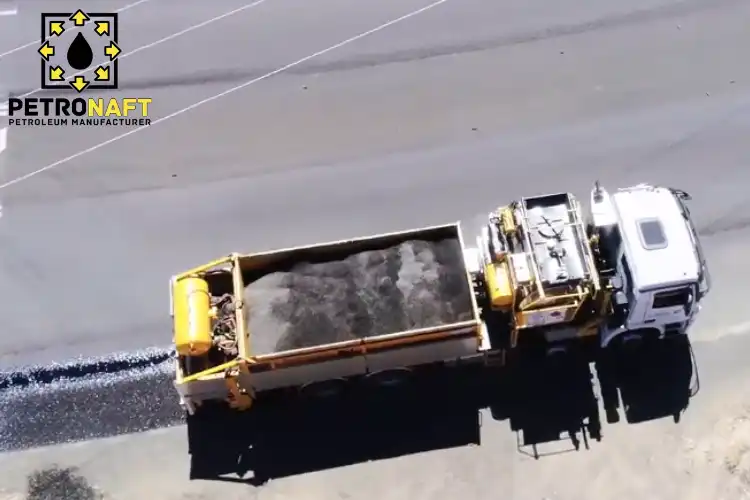
Cutback Bitumen for Road Surfacing is a petroleum binder thinned with a volatile solvent so it can be sprayed, mixed, or penetrate base layers without high heating. The right type (RC/MC/SC) and grade control curing speed, workability, and early strength—especially valuable for priming, cold mix, and rapid repairs in remote sites.
Road projects usually choose cutback for one of three reasons:
- Low equipment heating capability (remote sites, small crews)
- Fast, practical construction (prime/tack/patching)
- Moisture and temperature constraints where hot binders struggle
This guide shows you how to pick the right type and grade, apply it correctly, and buy it with confidence—without surprises in curing, adhesion, or safety.
Highlights & Key Sections
What Cutback Bitumen Is and How It Works
Cutback bitumen is conventional paving-grade bitumen “cut back” with a petroleum solvent (often kerosene- or naphtha-range) to reduce viscosity.
When you apply it:
- The material spreads or penetrates easily at lower temperatures.
- The solvent evaporates (cures).
- The remaining binder acts like asphalt/bitumen, binding aggregates or sealing the surface.
Why this matters on-site: curing speed affects how soon you can open to traffic, how well dust is locked down, and whether the base becomes stable or stays “soft.”
Cutback Types Explained: RC, MC, and SC
Cutbacks are categorized by how fast they cure, which mostly depends on the solvent volatility.
| Type | Meaning | Curing speed | Typical “feel” in practice | Common jobs |
|---|---|---|---|---|
| RC | Rapid Curing | Fast | Sets quickly; shorter work window | Surface treatments, quick patching, some cold mixes where fast set helps |
| MC | Medium Curing | Medium | Balanced workability + set | Prime coat, cold mix, maintenance work |
| SC | Slow Curing | Slow | Long workability; deeper penetration | Prime on dense bases, stockpile mixes, specialty maintenance needs |
Rule of thumb:
- Choose RC when you need speed and the surface won’t stay workable long.
- Choose MC for the most common prime/maintenance balance.
- Choose SC when you need time and penetration, or you’re mixing/stockpiling.
Grades: What the Numbers Really Mean
Within RC/MC/SC, grades are typically set by viscosity ranges (how thick it is at a test temperature). In the field, viscosity translates to:
- sprayability,
- coating quality,
- penetration depth,
- and curing behavior.
A practical way to think about grade selection:
- Lower viscosity grades → better penetration, easier spraying in cooler weather, better for prime coats on tight schedules.
- Higher viscosity grades → less run-off, heavier residual binder, better for patching or where you need a thicker film.
Quick grade selection guide (field logic)
| Site condition | What you want | Usual direction |
|---|---|---|
| Cooler weather / limited heating | Easier spray and wetting | Lower viscosity grade |
| Dusty granular base | Deeper penetration + binding fines | Lower–mid viscosity (often MC) |
| Tight surface with low absorption | Avoid puddling and slow cure | Higher viscosity or switch approach |
| Fast reopening to traffic | Quick curing | RC or lighter MC |
| Patching / small maintenance areas | Stronger residual film | Mid–higher viscosity (often RC/MC) |
Mini reality-check: A “perfect” grade on paper can fail if the base is too wet, temperatures are too low, or the application rate is off. Grade selection and application rate must work together.
Cutback Bitumen for Road Surfacing: When It’s the Right Choice
Cutback makes sense when your project needs low-temperature workability and reliable early-stage performance, especially in:
- Prime coats on granular bases before asphalt overlays
- Cold mixes for pothole patching and shoulder repairs
- Surface dressing support where rapid set is needed
- Remote construction with limited heating and batch plant access
When you should think twice
Cutbacks may be a poor fit when:
- VOC emissions are tightly regulated on your site,
- you need a very “green” binder strategy (many agencies prefer emulsions),
- there’s heavy rainfall expected during curing,
- the surface is non-absorptive and prone to run-off and tracking.
Trend note (important for planning): Many agencies are steadily shifting from cutbacks to bitumen emulsions, foamed bitumen, and warm-mix methods to reduce VOC emissions and solvent handling risks. Cutback still has a place—but it’s increasingly used where it offers a clear operational advantage.
Where Cutback Is Used on Roads
1) Prime coat (granular base preparation)
Prime coat helps:
- bind loose fines,
- reduce dust,
- strengthen near-surface cohesion,
- improve bond to the next layer.
Best-fit scenario: a well-shaped granular base that’s dry enough to absorb, but still needs binding and sealing.
Common mistakes that ruin prime performance
- Spraying on a wet base (traps solvent, delays cure, weakens bond)
- Using too heavy a rate and creating puddles
- Allowing traffic too early and causing tracking
2) Cold mix for patching and maintenance
Cutback is used to produce workable cold mixes where:
- a hot plant isn’t available,
- repairs must happen quickly,
- stockpile or bagged mix is needed for routine maintenance.
Real-world example: A municipal crew repairs potholes after winter damage using a cutback-based cold mix because it can be stored, placed fast, and compacted with minimal equipment.
3) Surface treatments and light wearing maintenance
Depending on local specs and climate, cutback can support certain surface treatments by improving wetting and early adhesion.
Practical point: Surface treatments live or die by aggregate cleanliness, correct binder rate, and curing windows—cutback won’t “fix” dirty aggregate or poor calibration.
Mini Tutorial: Selecting Type + Grade in 5 Steps
- Confirm the job: prime coat, cold mix, patching, surface treatment, or tack-type use.
- Check weather and curing window: daytime temperature, wind, humidity, and traffic reopening time.
- Assess surface absorption: granular base absorbs; tight surfaces don’t.
- Match curing speed:
- Fast reopening → lean RC or lighter MC
- Balanced prime/maintenance → MC
- Long workability/penetration → SC
- Set application rate from absorption, not guesswork:
- Dry, open granular base → higher end of the allowed range
- Tight or dusty-but-closed base → lower end, avoid run-off
Pro tip: Always run a short trial strip (even 100–200 m) to confirm penetration, tracking, and cure time before full-scale spraying.
Application Best Practices That Prevent Callbacks
Storage and handling
- Keep containers sealed to prevent solvent loss and grade drift.
- Store away from ignition sources; treat as flammable.
- Mix/recirculate per supplier guidance before spraying (avoid separation issues).
Surface preparation
- Sweep to remove loose dust and debris.
- Fix soft spots and standing water first.
- Prime works best on stable, shaped, and compacted base.
Spray and curing discipline
- Calibrate the distributor (nozzle angle, bar height, speed, pressure).
- Maintain uniform coverage—striping usually signals nozzle issues.
- Respect curing: if it tracks on boots/tires, it’s not ready.
Typical application-rate logic (use project specs first)
| Surface condition | Practical approach | What to watch |
|---|---|---|
| Open, dry granular base | Higher absorption → higher rate (within spec) | Don’t flood; avoid softening |
| Moderately absorptive base | Mid-rate + good compaction | Ensure even penetration |
| Tight/low absorption | Low rate or alternative binder | Run-off, tracking, slow cure |
Quality Control: What Professionals Should Check
Even when material is “standard,” QC prevents surprises.
Key checks (supplier + site)
- Viscosity/consistency (confirms grade)
- Distillation/residue (how much binder remains after solvent loss)
- Flash point (handling safety)
- Water contamination (should be minimal)
- Solvent loss during storage (can shift performance)
What to request from a supplier (buyer-ready)
- Certificate of Analysis (CoA) per batch/lot
- Safety Data Sheet (SDS)
- Declared type and grade + test method references
- Packaging details (bulk, drums, IBC) and sealing method
- Recommended spraying temperature range and curing notes
Troubleshooting Table: Fast Diagnosis in the Field
| Symptom | Likely cause | Fix (practical) |
|---|---|---|
| Tracks onto tires after “normal” wait | Base damp, too heavy rate, cool temps | Pause traffic, reduce rate next run, ensure drier base, choose faster curing type |
| Puddling and run-off | Surface too tight or rate too high | Lower rate, improve surface texture, consider different binder approach |
| Poor bond to overlay | Dusty base, inadequate cure, poor sweep | Sweep, allow full cure, verify prime penetrated rather than formed a slick film |
| Patch mix ravels early | Wrong grade/type, insufficient compaction | Use more suitable grade, improve compaction method, adjust mix design |
| Strong odor and long cure time | Low evaporation conditions, slow type | Improve ventilation/time window, shift to faster curing strategy if allowed |
Safety and Environmental Reality (What Modern Projects Must Consider)
Cutbacks involve volatile solvents, so you must manage:
- flammability and ignition risk
- vapors and worker exposure
- spill control
- local VOC/environmental requirements
Site-safe essentials
- No smoking/open flames near storage or application areas.
- Use proper PPE (gloves, eye protection; respiratory protection where required).
- Ensure ventilation and keep crews upwind where possible.
- Follow local rules for transport, storage, and spill response.
Industry trend: Restrictions around VOCs and solvent-based binders are pushing many road owners toward emulsions and lower-emission alternatives. If your project spans multiple jurisdictions, confirm acceptance early to avoid redesign late in procurement.
Buying Guide: How to Specify and Compare Offers
When you compare suppliers, don’t only compare price per ton/drum. Compare delivered performance and risk.
A practical RFQ checklist
- Type (RC/MC/SC) and grade (viscosity-based)
- Target application (prime coat, cold mix, patching, etc.)
- Packaging: bulk / drums / IBC
- CoA + SDS provided with shipment
- Minimum residue expectations (so you know what binder remains)
- Lead time, storage stability, and recommended handling temperatures
- Project compliance requirements (VOC, transport class, local standards)
Buyer’s logic: If two products cost the same but one cures reliably and bonds consistently, it’s cheaper in total project cost—because it avoids rework, delays, and traffic complaints.
Conclusion
Cutback Bitumen for Road Surfacing performs best when you match curing speed (RC/MC/SC) and grade (viscosity) to your surface absorption, weather, and reopening window—then apply it with calibrated rates and disciplined curing. Done right, it delivers practical prime coats, reliable cold mixes, and fast maintenance results with manageable risk and predictable performance.
Executive Summary Checklist (Print-Friendly)
Selection
- ☐ Confirm the job: prime / cold mix / patch / surface treatment
- ☐ Match curing need: RC (fast) / MC (balanced) / SC (slow, penetrative)
- ☐ Choose grade by temperature, absorption, and required workability
Before spraying
- ☐ Surface is shaped, compacted, swept, and reasonably dry
- ☐ Distributor is calibrated; nozzles, height, pressure, speed verified
- ☐ Trial strip confirms penetration, cure time, and tracking resistance
During application
- ☐ Uniform coverage; no striping, no puddling
- ☐ Traffic control maintained until cured
Procurement / QC
- ☐ CoA + SDS in hand; batch traceability confirmed
- ☐ Viscosity/consistency and residue expectations documented
- ☐ Storage and sealing prevent solvent loss
Safety
- ☐ Flammable handling controls and PPE in place
- ☐ Vapor awareness and spill plan ready
FAQs
1) What’s the difference between RC, MC, and SC cutback bitumen?
RC cures fastest, MC is medium-speed, and SC cures slowest. The difference comes mainly from solvent volatility, which controls workability time and how quickly the binder “sets” after application.
2) Is cutback bitumen still widely used for prime coats?
Yes in many regions, especially where operational simplicity matters. However, many road owners prefer emulsions due to lower VOC emissions, so acceptance depends on local specifications and environmental rules.
3) How do I choose the right grade for cooler weather?
In cooler conditions, projects often favor lower-viscosity grades for better sprayability and wetting. Still, you must balance this with cure time and tracking risk based on wind, humidity, and traffic timing.
4) Why does my prime coat keep tracking onto tires?
Most tracking comes from applying on a damp base, using an excessive rate, or not allowing enough cure time—especially in cool, still air. Reduce rate, improve base dryness, and consider a faster-curing type if permitted.
5) What documents should a supplier provide with cutback shipments?
At minimum: a Safety Data Sheet (SDS) and a batch-specific Certificate of Analysis (CoA). For professional projects, also request declared type/grade, traceability, and storage/handling guidance.
Sources
- ASTM International — Publishes widely used specifications and test methods for asphalt materials, including solvent-cut binders.
- AASHTO (American Association of State Highway and Transportation Officials) — Provides highway material standards and procurement references used by many road agencies.
- FHWA (Federal Highway Administration) Pavement Publications — Practical guidance on pavement materials, construction practices, and performance considerations.
- Asphalt Institute — Industry technical guidance on asphalt binders, mixtures, and best practices for paving and maintenance.
- PIARC (World Road Association) — Global road engineering references and technical reports covering pavement materials and maintenance strategies.