



Fluid Loss in Drilling is the unwanted invasion of drilling fluid into the formation, reducing circulating volume and raising risk of wellbore instability, stuck pipe, and formation damage. The best control combines early detection, right-sized bridging solids or wellbore-strengthening blends, and pressure management verified by filtration and plugging tests.
Highlights & Key Sections
Why this problem shows up on expensive wells
Fluid loss isn’t just “mud disappearing.” It’s a fast chain reaction: loss → lower annular velocity → poorer hole cleaning → ECD swings → instability, differential sticking, and (sometimes) well control complications.
What makes it commercially important:
Non-productive time (NPT) rises quickly during losses (trips, pills, wiper runs, remediation).
Formation damage can reduce productivity and complicate completions.
Cementing quality may suffer if losses prevent good displacement and bonding.
Fluid Loss in Drilling: what it is and how it behaves
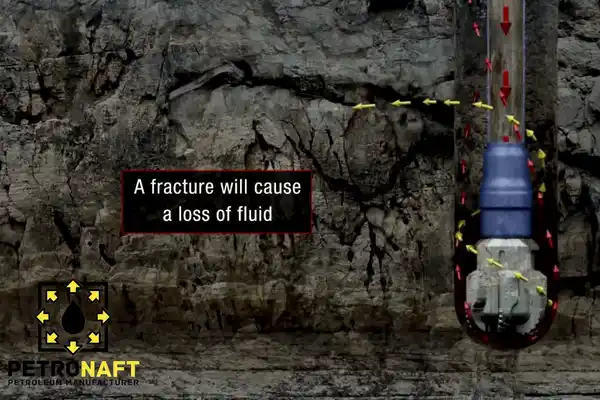
Fluid loss is the filtrate (liquid phase) and sometimes whole mud leaving the wellbore into permeable rock, microfractures, natural fractures, or vugs.
Two practical buckets:
Seepage / filtration loss: slow to moderate loss into permeable zones; often controllable with filter cake + bridging.
Lost circulation (partial to total): rapid losses into fractures/vugs/depleted zones; may require LCM pills, wellbore strengthening, or pressure strategy changes.
The mechanics in plain terms
Spurt loss happens first: the initial “dump” until solids start bridging.
Filter cake builds next: a thin, low-permeability layer that should reduce ongoing filtrate loss.
If the opening is too large (fracture/vug), cake alone won’t save you—you need a bridging structure or a seal.
Common causes (and what they look like on the rig)
Most field mistakes happen when teams treat all losses the same. Match the symptom pattern to the formation.
| Likely cause | Typical field signs | Where it’s common | What usually works first |
|---|---|---|---|
| High permeability sand | Gradual pit drop, stable torque/drag | Clean sands, unconsolidated zones | Lower filtration, optimize solids, fine/medium bridging |
| Natural fractures | Sudden loss, sometimes returns fluctuate | Carbonates, faulted zones | LCM pill + bridging blend, reduce ECD |
| Vugs / karst | Near-total loss, no returns | Carbonates, cavernous intervals | High-concentration pill, possible cement squeeze |
| Depleted reservoir | Loss at lower-than-expected MW | Mature fields, offsets producing | MPD/CBHP, reduce ECD, WBS strategy |
| Induced fractures | Loss increases with RPM/pumps, ECD sensitive | Weak formations, narrow window | Reduce annular pressure, manage surge/swab, WBS |
| Reactive shale + microfractures | Tight hole, higher torque, intermittent losses | Shales with bedding planes | Inhibitive system + WBS + careful hydraulics |
Effects that matter most (operations + reservoir)
Operational impacts
Hole cleaning degradation: less annular velocity and poor cuttings transport.
Stuck pipe risk: especially differential sticking when overbalance + thick cake + long contact.
Well control complexity: losses can mask influx or disrupt pressure management.
Cementing failures: losses reduce displacement efficiency and can create channels.
Reservoir and completion impacts
Invasion and damage (water block, emulsion block, fines migration).
Altered wettability and reduced near-wellbore permeability.
Screen-out / frac complications if solids invade improperly.
Fast detection: how to quantify losses before they snowball
Use a “confirm in 3 minutes” routine—don’t wait for the morning report.
Field indicators to watch
PVT/pit volume trend (not a single reading).
Flow-out vs flow-in mismatch at steady pumps.
Standpipe pressure changes (may drop with severe losses).
Cuttings return quality (sudden reduction can mean losses).
ECD sensitivity: loss worsens at higher pump rates/RPM.
Mini tutorial: classify severity quickly
Stabilize operating mode (constant pump rate, constant RPM).
Record a 5–10 minute baseline of flow-in, flow-out, pit volume.
Classify:
Minor: slow pit loss; returns still strong.
Partial: returns reduced; loss rate meaningful.
Severe/total: returns collapse; pits drop fast.
Decide whether the first move is materials (bridging/pill) or pressure strategy (ECD reduction/MPD).
Control methods: choose the right tool for the loss mechanism
Think in layers: prevent → bridge → seal → isolate, while keeping pressure inside the safe window.
1) Prevention (best ROI when you expect a risk interval)
Keep low, stable filtration (right polymer/clay balance, proper solids control).
Avoid oversized solids that make a thick, fragile cake.
Maintain good rheology to suspend bridging solids without excessive ECD.
Plan hydraulics to minimize surge/swab and avoid induced fractures.
2) Bridging and LCM (lost circulation materials)
A good LCM blend is rarely “one material.” It’s a particle-size distribution (PSD) plus structure.
Common LCM families (selection depends on temperature, salinity, hole size, and damage tolerance):
Calcium carbonate (acid-soluble): good for many reservoir sections (clean-up friendly).
Graphite / resilient carbon: helps seal fractures; improves lubricity.
Cellulose / nut shell / sized organics: strong bridging in fractures (temperature limits vary).
Fibers (natural/synthetic, fine/coarse): create a mat that supports particles; useful for fracture networks.
Mica / flakes: effective in planar fractures (needs correct sizing and concentration).
3) Wellbore Strengthening (WBS)
WBS aims to increase effective fracture resistance by creating a stress cage or near-wellbore seal—especially valuable in narrow mud-weight windows.
When WBS is a better first choice than a basic LCM pill:
Losses start only when ECD rises (induced fractures likely).
You must keep circulating (can’t accept frequent pump-down pills).
You need stability for long laterals or high-angle sections.
4) Pressure management (often the missing half)
Reduce ECD: optimize rheology, cut pump rate if hole cleaning allows, manage annular friction.
Minimize surge/swab: trip speed discipline, avoid aggressive reaming in fragile zones.
Consider MPD / constant bottomhole pressure (CBHP) where depletion or narrow windows dominate.
Method selection cheat-table
| Method | Best for | Pros | Watch-outs |
|---|---|---|---|
| Lower filtration + optimized solids | Permeable sands, seepage | Low cost, preventive | Too aggressive thinning can hurt suspension |
| LCM sweep (low–medium conc.) | Early partial losses | Fast, simple | Can plug tools/screens if poorly sized |
| High-concentration LCM pill | Severe losses, fractures/vugs | High sealing power | Risk of stuck pipe, ECD spike, mixing logistics |
| Fibrous pill + PSD solids | Fracture networks | Strong mat + bridge | Fiber handling, shaker performance |
| WBS blend (engineered PSD) | Induced fractures, narrow window | Improves tolerance | Needs lab/slot testing to avoid “false confidence” |
| Cement squeeze / gunk | Total loss zones | Definitive isolation | Time-consuming, requires good placement |
| MPD/CBHP | Depletion, tight window | Precise pressure control | Equipment + procedures + trained crew |
Mini tutorial: design an LCM blend that actually bridges
This is a practical workflow teams use to stop “random LCM dosing.”
Step 1: estimate the opening size
From offset data: loss zones, fracture gradient history, caliper, image logs.
From behavior: if losses spike with slight ECD increase, think fractures more than permeability.
Step 2: pick a PSD strategy (simple but effective)
A common field rule of thumb:
Use a coarse fraction to bridge,
A medium fraction to pack,
A fine fraction to seal voids and reduce leak-off.
Example blend concept (illustrative):
Coarse CaCO₃: bridges the main aperture
Medium CaCO₃: fills gaps
Fine CaCO₃ + polymer: seals and tightens the filter cake
Optional fibers/flakes: improve integrity in planar fractures
Step 3: choose concentration based on severity
Minor seepage: low concentration sweeps + filtration control
Partial losses: medium concentration pills/sweeps with engineered PSD
Severe/total: high concentration pill (often with fibers/flakes), placed carefully and allowed to set
Step 4: placement matters more than brand names
Reduce annular velocity near the loss zone if needed.
Spot the pill across the thief zone with controlled pump rate.
Hold pressure gently; avoid immediately fracturing the seal with aggressive circulation.
Verification: the lab tests that separate “hope” from “proof”
When losses are recurring or high-cost, use tests that mimic the actual sealing problem—not just standard filtration.
| Test | What it tells you | Good for | Limitation |
|---|---|---|---|
| API filter press | Baseline filtrate + cake quality | Comparing formulations | Not representative for fractures/HTHP |
| HTHP filtration | Filtration at elevated T/P | Deep wells, high-temp | Still not a fracture simulator |
| Slot / fracture sealing test | Ability to bridge a defined aperture | Fracture losses | Must match realistic slot sizes |
| Permeability plugging test (PPT) | Seal building + retained permeability | WBS/reservoir sections | Requires consistent procedure |
| Rheology + sag tests | Suspension and transport of LCM | High-angle wells | Field conditions may differ |
Practical field tip:
If your “best” pill fails repeatedly, don’t just increase concentration. Change the PSD and structure (add fibers/flakes, adjust coarse-to-fine balance), and re-check rheology/ECD impact.
Real-world field example (anonymized)
A high-angle section in a carbonate interval showed partial losses that worsened whenever pump rate increased for hole cleaning. The first response—adding fine LCM—reduced API filtrate but didn’t stop losses.
What worked:
The team reduced ECD drivers (rheology tuned + disciplined reaming),
Spotted a PSD-engineered pill (coarse/medium/fine calcium carbonate + a small fiber fraction),
Verified performance with a slot test that matched the suspected fracture aperture range.
Result: losses stabilized enough to drill ahead with fewer interruptions, and the completion team reported fewer clean-up issues versus previous wells that used non-soluble LCM.
Buying and specifying fluid-loss solutions (what procurement should ask)
If you’re comparing suppliers or materials, ask for data that predicts performance in your well, not generic brochures.
Minimum technical details to request
Particle size distribution (PSD) report (D10/D50/D90) for each LCM grade
Acid solubility (if reservoir clean-up matters)
Temperature and contamination tolerance (salts, calcium, oil, HPHT)
Compatibility with your mud system (WBM/OBM/SBM) and additives
Quality consistency: lot-to-lot control, moisture limits, packaging integrity
HSE and handling: dusting, MSDS completeness, transport/storage requirements
Quick spec guide (useful in RFQs)
| Material | When it’s favored | Key spec to include |
|---|---|---|
| Acid-soluble CaCO₃ | Reservoir and productive zones | PSD bands, solubility %, hardness, purity |
| Fibers (fine/coarse) | Fracture networks, fast sealing | Fiber length distribution, temperature rating |
| Flakes (mica/graphite) | Planar fractures, lubrication benefit | Flake size range, ash content, stability |
| Cellulose/organics | General bridging (non-reservoir) | Temperature limit, sizing, degradability |
| Polymer fluid-loss additive | Permeability filtration control | HTHP performance, salinity tolerance |
Trends and current challenges shaping fluid-loss control
Engineered wellbore strengthening is increasingly paired with hydraulics modeling to manage narrow windows in deeper, longer laterals.
Real-time loss detection and prediction is improving via better flow-out measurement, downhole pressure tools, and analytics/AI models that flag early loss signatures before they become total losses.
Lower-impact, clean-up-friendly materials (acid-soluble blends, degradable fibers) are getting more attention as completion performance and produced-solids management become stricter.
Conclusion
Fluid Loss in Drilling is best controlled by matching the treatment to the loss pathway: filtration needs a tight, thin cake and optimized solids, while fractures/vugs need engineered bridging and sealing—often paired with ECD and pressure management. The winning approach is measurable: quantify loss rate, validate with fit-for-purpose tests, and deploy blends that seal without creating new damage or operational risk.
Executive Summary Checklist
Use this as a practical pre-job and on-the-rig reference:
Diagnose
Track flow-in vs flow-out and pit trend at steady conditions
Classify: seepage vs partial vs severe/total loss
Identify trigger: permeability, natural fracture, induced fracture, depletion
Stabilize
Reduce ECD drivers (rheology, pump rate, reaming, trip practices)
Maintain hole cleaning without pressure spikes
Treat
Seepage: improve filtration control + fine/medium bridging
Fractures: PSD-engineered pill (coarse/medium/fine) + optional fibers/flakes
Total losses: high-concentration pill, consider cement/gunk if needed
Tight windows/depletion: consider MPD/CBHP strategy
Verify
Run relevant tests (HTHP, slot/fracture, PPT) for repeat problems
Check rheology/sag to ensure LCM stays suspended and placeable
Protect value
In reservoir sections, prefer clean-up-friendly options (acid-soluble/degradable)
Document what worked (PSD, concentration, placement) for offset wells
FAQ
1) What’s the difference between fluid loss and lost circulation?
Fluid loss usually means filtrate leaking into permeable rock at a manageable rate. Lost circulation is larger-scale loss (partial to total) into fractures, vugs, or depleted zones that can rapidly eliminate returns and halt drilling.
2) Can lowering mud weight alone stop losses?
Sometimes, but it’s risky. If losses are pressure-driven (induced fractures or depletion sensitivity), lowering ECD can help. If the pathway is a natural fracture or vug, you typically need bridging/sealing materials or isolation, not just lower density.
3) How do I choose LCM for a reservoir interval without damaging production?
Favor clean-up-friendly options: acid-soluble calcium carbonate (with controlled PSD) and degradable fibers when appropriate. Keep concentrations and particle sizes aligned to the sealing target to avoid deep invasion and near-wellbore plugging.
4) Why do some LCM pills fail even at high concentration?
Most failures are sizing and placement problems. If the PSD can’t bridge the actual aperture, the pill just flows into the loss zone. Poor placement (too high annular velocity or immediate pressure spikes) can also wash out the forming seal.
5) What tests best predict fracture-loss performance?
Standard API filtration is not enough for fractures. Slot/fracture sealing tests and permeability plugging tests better indicate whether a blend can bridge and build a durable seal under realistic pressure and temperature conditions.
Sources
American Petroleum Institute (API) – Publishes drilling fluid test standards widely used for filtration and rheology benchmarking. https://www.api.org/
Society of Petroleum Engineers (SPE) – Technical papers and textbooks covering lost circulation, wellbore strengthening, and field case histories. https://www.spe.org/
International Association of Drilling Contractors (IADC) – Operational guidance and drilling manuals reflecting current rig practices and challenges. https://www.iadc.org/
Schlumberger Oilfield Glossary – Clear industry definitions for lost circulation, filtrate, filter cake, ECD, and related drilling terms. https://glossary.slb.com/