


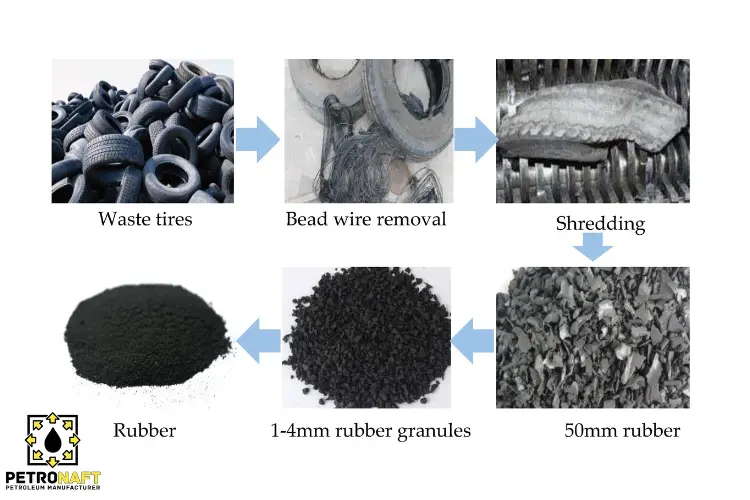
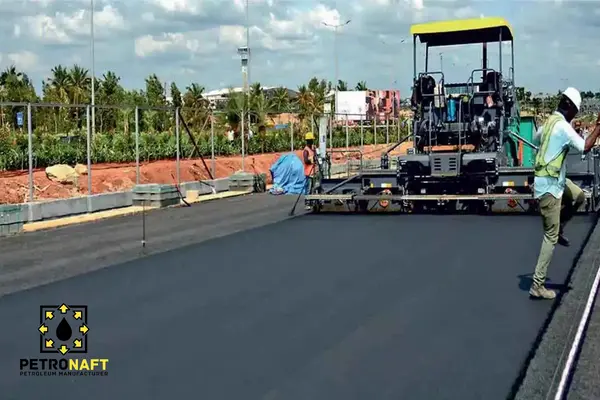
Using Bitumen with Recycled Materials, you can boost rutting and fatigue resistance, cut material costs, and lower CO₂ emissions by 15–30% by replacing part of the virgin binder and aggregate with recycled plastics, crumb rubber, and RAP—provided you control compatibility, dosage, and production temperatures.
Highlights & Key Sections
What Does Bitumen with Recycled Materials Actually Mean?
Bitumen with recycled materials is modified binder and asphalt mix where part of the virgin bitumen and/or aggregates is replaced with high-value waste streams while still meeting performance specifications.
The most common recycled inputs include:
Post-consumer plastics (PE, PP, PET, PS)
Crumb rubber from end-of-life tyres
Reclaimed Asphalt Pavement (RAP) and recycled asphalt shingles (RAS)
Industrial by-products (steel slag, fly ash, construction and demolition fines)
You can incorporate them at two levels:
Binder level (wet process): Recycled material is blended into hot bitumen in a tank, creating a modified binder delivered to the plant.
Mix level (dry process): Recycled material is added directly to the mixer, behaving more like a synthetic aggregate or extender.
Which waste streams can safely enter modified bitumen today?
Engineers typically focus on waste streams that:
Have predictable composition and grading
Can be dried and processed into stable particles or flakes
Do not introduce hazardous contaminants or excessive volatiles
Are already referenced in regional guidelines or trial specifications
Today, that usually means:
Tyre-derived crumb rubber (0–2 mm)
Polyolefin and PET flakes or pellets from packaging and bottles
Well-processed RAP/RAS with controlled binder content and gradation
How does this differ from conventional polymer-modified bitumen?
Conventional PMB uses virgin elastomers (like SBS, EVA) with tight property tolerances. Recycled materials behave similarly but:
Have more variability in melt flow, density and ash content
May contain mixed polymers, fillers, or residual contaminants
Often require slightly different mixing temperatures and shear rates
Need stronger QC to guarantee storage stability and long-term ageing behaviour
In practice, think of recycled modifiers as performance-driven polymers with extra variability plus ESG benefits, not as low-grade fillers.
Why Use Bitumen with Recycled Materials in Your Projects?
How does it improve pavement performance?
When properly formulated, recycled modifiers can significantly upgrade binder rheology:
Recycled plastics typically lower penetration and raise softening point and viscosity, improving high-temperature rutting resistance compared with unmodified bitumen. A 2025 meta-analysis of 251 lab datasets showed consistent stiffening trends that translate to lower permanent deformation in wheel-tracking tests.
Recycled polymers (including rubber and plastics) improve elasticity and delay oxidative ageing, which helps pavements resist rutting and cracking for longer service lives.
Typical field benefits when designs are optimised include:
Better rutting resistance in hot climates or high-traffic corridors
Improved fatigue performance for heavy or slow-moving loads
Reduced raveling and moisture damage when mixes are well compacted
What is the business and sustainability case?
From an owner’s perspective, recycled-modified solutions:
Save virgin bitumen and aggregate, especially when RAP content exceeds 20–30%
Reduce life-cycle costs through longer service lives and fewer interventions
Support corporate ESG and circular-economy targets with measurable metrics
For example, one RAP case study found that a mix with 40% RAP cut greenhouse gas emissions by about 29% and life-cycle costs by 26.2% versus a conventional mix, while 20% RAP delivered roughly 14% cost savings.
These gains come on top of non-financial benefits: less landfill demand, lower raw-material extraction, and a stronger innovation story for agencies and contractors.
Table 1 – Why performance and business goals align
| Benefit area | What improves in practice | Value for agencies and producers |
|---|---|---|
| Structural life | Higher rut resistance, slower fatigue damage | Fewer overlays, longer resurfacing cycles |
| Operational cost | Lower virgin binder use, higher RAP utilisation | Reduced mix cost per tonne, better plant utilisation |
| Sustainability | Less waste to landfill, lower CO₂ per lane-km | Stronger ESG reporting and green-procurement scores |
| Customer perception | Quieter, smoother, more durable pavements | Reputation as an innovator and sustainability leader |
Why Use Bitumen with Recycled Materials in Your Projects?
(Main keyword naturally reused in this H2.)
How does it improve pavement performance?
Covered above – consider this the strategic “why now” for decision-makers.
What is the business and sustainability case?
Covered above – this is the commercial justification you present to boards and municipalities.
(You can keep this duplicated H2 in your CMS for SEO structure, or merge with the previous section if you prefer fewer headings.)
Which Recycled Additives Work Best in Modified Bitumen?
There is no single “best” recycled material. The right option depends on climate, traffic, plant capabilities, and local waste streams.
Table 2 – Key recycled inputs and typical binder-level roles
| Recycled material | Incorporation mode | Typical dosage range* | Main performance effects | Key watch-points |
|---|---|---|---|---|
| Post-consumer PE/PP/PET | Wet or dry | 2–4% of binder (wet); 0.3–1% of mix (dry) | Higher softening point, rutting resistance | Workability, low-temp cracking if over-stiffened |
| Mixed packaging plastics | Wet (preferably) | 2–3% of binder | Stiffening, improved stability | Consistency of feedstock, contaminants |
| Crumb rubber from tyres | Wet (terminal or plant) | 10–20% of binder | Elastic recovery, rutting and fatigue performance | Storage stability, odour, tank agitation |
| RAP binder (through RAP) | Mix-level | 10–40% RAP in mix | Higher stiffness, improved rutting if balanced | Aged binder stiffness, cracking if binder too hard |
| RAS (roofing shingles) | Mix-level | 2–5% of mix | Very stiff binder, rutting resistance | Brittleness, spec limits on RAS contribution |
*Always verify against local specs and lab results before full-scale adoption.
How do recycled plastics affect binder behavior?
Recycled plastics behave much like conventional polymer modifiers:
They stiffen the binder, lowering penetration and increasing softening point and viscosity. A 2025 review combining 251 datasets confirmed this pattern across multiple plastic types and processing routes.
Laboratory studies on soft plastic (R-LLDPE) show that around 3% by weight of binder often gives the best balance of rut resistance and workability, while contents above ~6% can lead to phase separation and handling problems.
In dry-process mixes using PET bottle flakes, one 2025 study reported that 7.5% PET (by bitumen weight) increased Marshall stability by about 31.8% over the control mix, without unacceptable loss of workability.
Practical tips when you use recycled plastics:
Stay within 2–4% of binder for wet-process plastic modification unless lab data says otherwise.
Characterise melt flow index and density so your supplier can blend consistent lots.
Use high-shear mixing and adequate digestion time; many plants target 30–60 minutes above the plastic’s melting point.
Run low-temperature cracking tests (BBR, SCB) before using stiff blends in cold regions.
Application of Plastic Waste as a Sustainable Bitumen Mixture – A Review (2025) provides a data-rich synthesis of plastic types, dosages and processing routes for asphalt binders and mixes. Read the open-access review
What can crumb rubber contribute?
Crumb rubber from end-of-life tyres has decades of field experience and remains a robust recycled modifier when you need extra elasticity.
Benefits in well-designed crumb-rubber modified binders include:
Increased elastic recovery compared with unmodified and many plastomeric polymers
Improved rutting resistance and fatigue life in hot climates and heavy-traffic routes
Potential noise reduction on surface courses due to a more open macrotexture
Typical engineering practice:
Use 10–20% crumb rubber by binder mass in wet processes.
Ensure robust agitation and circulation in storage tanks to prevent settlement.
Consider warm-mix additives to control emissions and odour at the plant.
Rutting and Aging Properties of Recycled Polymer-Modified Pavement Materials (2025) reviews how recycled polymers, including rubber, influence binder elasticity, ageing and deformation under repeated loading. Explore the recycled polymer ageing review
Where do RAP and RAS fit into binder design?
RAP and RAS add both aged binder and aggregate, so they influence binder grade indirectly:
You typically design around a blended binder made from virgin bitumen plus the aged component in RAP/RAS.
Higher RAP or RAS contents require softer virgin binders or rejuvenators to keep the blended PG within spec.
RAP levels of 20–40% in base and binder courses are common in many networks when volumetrics and cracking performance are validated.
Good practice steps:
Determine RAP binder content and recovered binder grade.
Calculate binder replacement, not just RAP percentage.
Run performance tests that are sensitive to cracking (SCB, I-FIT, 4-point bending) at expected service temperatures.
How Do You Design and Produce Mixes Using Recycled-Modified Bitumen?
What laboratory program should you run first?
Before you scale up:
Define performance targets
Climate: hot, temperate, cold, freeze–thaw
Traffic: ESALs, slow/standing loads (e.g., intersections, bus lanes)
Screen candidate recycled materials
Characterise gradation, melt flow, contamination and moisture
Run basic binder tests (penetration, softening point, viscosity)
Develop a binder matrix
Vary plastic/rubber content (e.g., 0, 2, 3, 4%) and RAP binder replacement (e.g., 15, 25, 35%)
Test with PG grading, DSR (including MSCR), and BBR where relevant
Validate at mix level
Volumetrics: air voids, VMA, VFA
Performance: wheel tracking (rutting), moisture susceptibility, fatigue or SCB tests
Lock in spec windows
Define acceptable ranges for recycled content, plant temperatures and QC limits.
How do you adapt your asphalt plant and field practices?
At plant level:
Wet-process plastics/rubber
Provide dedicated high-shear mixing capacity and insulated storage tanks.
Use recirculation lines, level gauges and temperature monitoring to avoid separation.
Dry-process plastics
Meter flakes/pellets with a calibrated feeder to avoid segregation.
Synchronise dosing with binder and aggregate feed to keep mix uniform.
RAP/RAS integration
Use separate bins for different RAP sources where possible.
Control moisture and avoid RAP “clumps” that under-dry.
Adjust burner settings to avoid overheating virgin binder when RAP contents are high.
In the field:
Keep compaction temperatures and rolling patterns within the lab-validated window.
Pay attention to joint construction; stiff mixes can be less forgiving at longitudinal joints.
Monitor early life performance and refine the recipe if you see raveling, segregation or premature cracking.
Table 3 – Example implementation roadmap (0–12 months)
| Phase | Timeline | Main objectives | Key deliverables |
|---|---|---|---|
| Scoping | 0–1 mo | Select waste streams and pilot sections | Target projects list, material shortlist |
| Lab design | 1–4 mo | Optimise binder and mix designs | Design report, recommended specs |
| Plant trials | 4–6 mo | Validate production and workability | Trial reports, refined temperature and QC limits |
| Field pilots | 6–12 mo | Monitor performance under traffic and climate | Performance dashboard, go/no-go decision |
What Are the Main Risks and How Do You Control Them?
How do you manage compatibility and storage stability?
Compatibility issues show up as phase separation, high viscosity or clumps in storage tanks.
To manage them:
Match polymer chemistry to base binder (e.g., non-polar plastics with less polar binders).
Use compatibilisers or cross-linkers where justified by lab data.
Optimise mixing temperature and shear rate to fully disperse polymers without over-ageing the binder.
Limit storage time and maintain continuous agitation for crumb-rubber binders.
On the QC side:
Run storage-stability tests (tube separation), elastic recovery and MSCR as part of routine acceptance.
Reject lots showing excessive phase separation or viscosity drift outside your control chart.
How do you address aging, microplastics, and regulations?
Regulators increasingly ask about:
Long-term ageing: Recycled polymers can actually delay oxidative hardening and improve rutting resistance, but only when dosages and processing are well controlled, as shown in recent reviews.
Microplastics and leaching: Current evidence suggests that well-bound plastics primarily remain encapsulated in the asphalt mastic; risk grows if the mix ravels or is milled and mishandled.
Occupational health: You must manage fumes, odour, dust and noise in plants and work zones.
Control strategies:
Include RTFOT and PAV ageing in your binder program, and age mixtures for crack-resistance testing.
Design mixes for good compaction and surface durability to reduce raveling.
Develop HSE procedures for handling recycled inputs (dust control, enclosed feeders, PPE).
Stay aligned with evolving national specs and environmental guidelines.
What Are Real Projects Showing About Performance and Cost?
What do case studies on plastics and rubber tell us?
Field and large-scale trials increasingly confirm what lab data suggests:
Dry-process PET projects in hot climates report higher rutting resistance and improved stability; one study’s 7.5% PET mix achieved around 31.8% higher Marshall stability compared with a control mix.
Plastic-modified binder pilots on urban roads tend to show better resistance to potholes and stripping, especially under heavy rainfall, when mix design and drainage are adequate.
Crumb-rubber modified asphalt has decades of use on highways and urban arterials, with reduced rutting and improved fatigue performance when binder viscosity and air voids are kept within designed ranges.
These case studies highlight the importance of design discipline: the same material can succeed or fail depending on aggregate structure, binder content and QC.
How does RAP change life-cycle cost and carbon?
RAP is often your biggest lever for cost and CO₂ reduction:
Case studies that compared 0, 30, 40 and 50% RAP showed 6–15% savings in initial construction costs as RAP substitution increased.
Another analysis reported that 40% RAP reduced greenhouse gas emissions by 29% and life-cycle costs by 26.2% compared with a 0% RAP mix over the analysis period.
To capture these benefits without sacrificing performance:
Balance RAP percentage with binder grade (softer virgin binder or rejuvenators).
Use balanced mix design and performance tests, not only volumetrics.
Track field performance by section so you can justify higher RAP limits in future contracts.
How Are Trends and Innovation Shaping Recycled-Modified Bitumen?
Which policy and market trends are accelerating adoption?
Three macro trends are pushing bitumen producers and agencies toward recycled modifiers:
Circular economy policies that set minimum recycled content or recovery rates for construction materials.
Green procurement that scores tenders on life-cycle CO₂ and waste diversion, not just upfront price.
Producer responsibility schemes for tyres and plastics that create stable supply and funding for recycling.
As a result, more national and regional agencies are publishing guides and specification clauses that normalise plastics, rubber and RAP in mainstream asphalt, not just pilot projects.
How are technology and data improving quality control?
Modern tools help you de-risk innovation:
Advanced rheology (frequency sweep, MSCR, LAS) to characterise non-linear behaviour of recycled-modified binders.
Imaging and X-ray CT to assess dispersion of recycled particles in mastics and mixes.
Digital QC systems in plants to track temperatures, feed rates and recycled content in real time.
Data analytics and AI to relate mix designs, process parameters and in-service performance, shortening the learning curve for new formulations.
Together, these tools let you treat recycled inputs as engineered resources, not unpredictable waste.
How Can You Put This Into Practice? Executive Summary Checklist
To get value from Bitumen with Recycled Materials, treat it as a structured innovation program rather than a one-off trial.
What practical checklist can you follow from idea to network rollout?
Use this as a working roadmap:
Clarify objectives: Are you targeting cost, CO₂, performance – or all three? Prioritise them explicitly.
Map available waste streams: Quantify local plastics, tyres, RAP/RAS and industrial by-products.
Shortlist combinations: Start with 1–2 plastic types, one crumb rubber option and realistic RAP levels per layer.
Run focused lab programs: Use PG grading, DSR/MSCR, BBR and mix-level rutting/fatigue tests, not just Marshall.
Define guardrails: Set maximum recycled contents, binder grades and QC limits by mix type and traffic level.
Pilot at manageable scale: Choose 1–3 road sections with different traffic and climate exposure.
Instrument and monitor: Log construction details, densities and early-life performance for each section.
Review annually: Compare rutting, cracking and maintenance events against control sections.
Update specifications: Once results are positive, codify recycled contents and test requirements into your standard specs.
Communicate results: Share performance and ESG benefits with stakeholders to secure long-term support and funding.
What Are the Most Common Questions About Bitumen with Recycled Materials?
Can recycled plastics fully replace conventional polymer modifiers?
In some applications, recycled plastics can replace part or all of conventional polymers, especially where rutting resistance is the main objective. However, they may not match premium SBS performance in very cold climates or highly demanding surfaces. Most agencies start with partial replacement and performance-based testing before considering full substitution.
What percentage of recycled material is typically safe to use in asphalt mixes?
For wet-process plastic modification, many designs fall in the 2–4% range by binder mass, while crumb rubber often sits between 10–20% of binder. RAP levels of 15–40% in base and binder courses are common where balanced mix design is used. The “safe” level is the one that passes all your performance tests under local conditions.
Does using recycled materials increase the risk of cracking in cold climates?
If you only chase high-temperature stiffness, you can over-stiffen the binder and increase thermal-cracking risk. That is why low-temperature tests (BBR, SCB) and fatigue checks are essential. With softer virgin binders, rejuvenators and well-designed gradation, recycled-modified mixes can perform as well as, or better than, conventional mixes even in cold regions.
How does Bitumen with Recycled Materials affect construction costs?
Direct material costs often drop thanks to reduced virgin binder and aggregate usage, notably when RAP contents rise. There can be offsetting costs for processing, extra QC and plant adjustments. When life-cycle savings from longer service lives and fewer interventions are included, total cost per lane-kilometre usually improves.
Will road agencies accept recycled-modified binders under current specifications?
Many agencies already allow specific recycled inputs within set limits, especially RAP, crumb rubber and certain plastics. Acceptance depends on whether you can demonstrate equivalent or better performance using recognised tests. Performance-based specifications make it easier to introduce new recycled solutions as long as the binder and mix pass those criteria.
Can existing asphalt plants handle recycled-modified binders without major upgrades?
Most batch and drum plants can adapt with modest upgrades such as additional feeders, modified RAP collars, improved drying capacity and better temperature control. Wet-process polymerised binders may require dedicated tanks with agitation, but you rarely need a completely new plant. A detailed plant audit should be part of your implementation plan.
How do I prove environmental benefits to stakeholders?
You quantify benefits using life-cycle assessment and material flow data: virgin binder saved, RAP diverted from stockpiles, plastics and tyres reused, and CO₂ per lane-kilometre. Combine this with documented field performance so stakeholders see both environmental and engineering outcomes. Many clients increasingly require this data in tenders and performance reports.
Is there a risk of microplastic release from plastic-modified pavements?
The primary risk comes from raveling, aggressive milling, or poor end-of-life management rather than from intact pavements in service. Designing mixes for durability, maintaining good drainage and handling reclaimed materials responsibly greatly reduces potential release. Ongoing research is refining testing methods, so staying aligned with emerging best practice is wise.
What quality control tests are most critical for recycled-modified binders?
Beyond basic penetration and softening point, you should rely on PG grading, DSR (including MSCR), storage-stability tests and low-temperature testing where applicable. On the mix side, rutting, moisture susceptibility and cracking tests provide a fuller picture than volumetrics alone. Establish control charts for key indicators and link them to recycled content.
Where should I start if my organisation has never used Bitumen with Recycled Materials?
Begin with a small, well-defined pilot using a relatively low-risk option such as moderate RAP or a proven crumb-rubber binder. Build a cross-functional team from design, plant operations, construction and maintenance. Run a disciplined lab program, select one or two pilot sections, monitor performance carefully and then scale up based on evidence.
Sources
1️⃣ Comprehensive review of plastic waste in asphalt technology
A 2025 synthesis examining various plastic waste types, dosage levels, processing techniques, and their influence on bitumen characteristics and asphalt mixture performance.
Link: https://www.mdpi.com/2076-3417/15/23/12761
2️⃣ Recycled LLDPE for bitumen modification
An in-depth investigation into the application of recycled linear low-density polyethylene (R-LLDPE) as a soft plastic modifier in bitumen, focusing on optimum additive percentages and rheological enhancements versus unmodified binders.
Link: https://www.sciencedirect.com/science/article/pii/S0959652620320357
3️⃣ Shredded PET in asphalt mixtures using the dry process
A study evaluating polyethylene terephthalate (PET) from post-consumer bottles added to asphalt mixes, reporting improvements in Marshall stability and overall pavement performance.
Link: https://www.sciencedirect.com/science/article/pii/S2590198225001356
4️⃣ Economic and environmental advantages of RAP use
Case-study research exploring different reclaimed asphalt pavement (RAP) incorporation rates, detailing material cost savings, greenhouse-gas reductions, and life-cycle economic benefits for urban roadway projects.
Link: https://jiens.org/sayi/5de520d0-bdd0-4158-a8f3-6048a7c2d005.pdf
5️⃣ Rutting resistance and ageing behavior of recycled polymer-modified binders
A 2025 review assessing recycled rubber and plastic additives in bitumen, highlighting improvements in elasticity, resistance to repeated-load deformation, and oxidative ageing performance.
Link: https://www.mdpi.com/2313-4321/10/2/60