


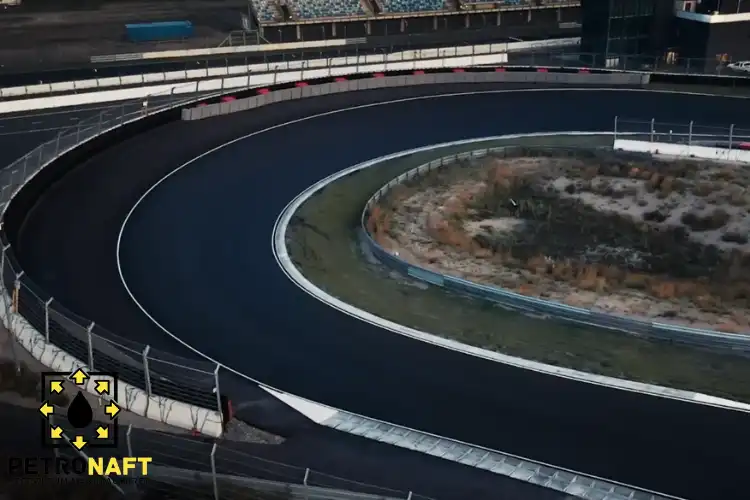
Polymer Modified Bitumen for Race Tracks improves surface stability, grip retention, and service life under extreme braking, cornering, and heat. When the binder, aggregate, mix design, and paving quality are engineered together, PMB helps circuits resist rutting, fatigue cracking, and texture loss far better than conventional paving bitumen.
Race tracks put far more stress on asphalt than normal roads. A straight may look easy to pave, but repeated acceleration and braking quickly expose weak materials. Corners add high lateral force. Pit lanes and start grids add slow, heavy loading. If the surface is not engineered for those conditions, it deforms early.
That is why race-track surfacing should be approached as a performance system, not a commodity asphalt purchase. The right polymer-modified binder matters, but so do aggregate quality, compaction, drainage, and layer bonding.
Highlights & Key Sections
Why Race Tracks Need a Different Asphalt Strategy
A public road is designed for broad traffic comfort and durability. A race track is designed for precision, safety, and repeatable performance at speed.
The key difference is how the pavement is loaded:
- Braking zones face intense shear stress
- Corners face strong lateral movement
- Start areas face repeated deformation under slow, heavy wheel loads
- Surface texture must remain reliable for grip in both dry and wet conditions
That combination makes conventional bitumen more vulnerable to rutting, shoving, flushing, and surface wear.
Why Polymer Modified Bitumen for Race Tracks Performs Better
Polymer modification improves the binder’s elasticity and recovery after load. In practical terms, that means the pavement is less likely to stay permanently deformed after repeated stress.
For race-track applications, that brings several direct benefits:
- Better resistance to rutting in braking zones
- More stability in high-speed corners
- Stronger resistance to fatigue cracking
- Better aggregate retention under tire abrasion
- More reliable performance across temperature changes
A useful way to think about PMB is this: standard bitumen can carry traffic, but PMB gives the pavement a wider performance window and a higher margin of safety.
Quick Comparison
| Property | Conventional Bitumen | Standard PMB | High-Polymer PMB |
|---|---|---|---|
| Rut resistance | Moderate | High | Very high |
| Fatigue resistance | Moderate | High | Very high |
| Elastic recovery | Low | Medium to high | Very high |
| Stability in braking zones | Fair | Strong | Excellent |
| Durability under heat | Fair | Strong | Excellent |
| Upfront cost | Lower | Higher | Highest |
For many premium circuits, the higher initial material cost is justified by better durability, lower maintenance disruption, and more consistent track performance.
Where Race-Track Surfaces Usually Fail First
Not every zone on a circuit fails for the same reason. Understanding that helps buyers and engineers choose the correct mix and binder strategy.
| Track Zone | Main Stress | Typical Failure | Priority Performance Need |
|---|---|---|---|
| Heavy braking zones | Shear + heat | Rutting, shoving | High stability and recovery |
| High-speed corners | Lateral force | Surface movement, ravelling | Cohesion and texture retention |
| Start grid / pit lane | Slow repeated loading | Deformation, flushing | Strong load-bearing structure |
| Transition areas | Differential movement | Reflective cracking | Flexibility and crack resistance |
| Wet sections | Water + traffic | Stripping, grip loss | Adhesion and drainage support |
This is why a “one-size-fits-all” asphalt specification often underperforms on motorsport projects.
What Actually Creates Durability on a Race Track
The binder is critical, but it is not the whole story. Durable race-track surfacing depends on five factors working together:
- High-quality crushed aggregate with strong polishing resistance
- A stable aggregate skeleton that resists movement
- Correct binder content
- Tight paving and compaction control
- Good drainage and interlayer bonding
Many weak projects fail not because PMB is ineffective, but because one of these supporting factors is overlooked.
For example, a track may use a premium binder but still lose performance early if:
- the aggregate polishes too quickly
- the compaction is inconsistent
- the joints are poorly built
- moisture enters the lower layers
- the drainage profile is inadequate
The lesson is simple: PMB improves the system, but it cannot rescue poor pavement engineering.
Real-World Lessons from High-Stress Pavements
Race-track engineering has a lot in common with airport pavements and other high-stress surfacing environments. In all three cases, the design goal is not just load capacity. It is resistance to repeated deformation, surface wear, and performance loss under severe conditions.
Specialist motorsport surfacing projects consistently prioritize:
- stable grip over time
- long-lasting texture
- resistance to braking and cornering forces
- surface smoothness with structural integrity
- reduced risk of early repair cycles
That matters for buyers because the cheapest option per ton is often not the most economical choice over the full service life.
A track that needs patching, reprofiling, or localized correction after a short period usually costs more overall than a track that was specified correctly from the beginning.
How to Specify the Right PMB Mix for a Race Track
Choosing the right material starts with asking the right technical questions.
1. Define the real problem first
Before selecting a binder grade, identify the actual failure mode:
- Is the track rutting in hot weather?
- Are corners losing texture?
- Are cracks appearing near rigid transitions?
- Is the surface polishing too quickly?
- Is there movement under braking?
A good specification solves the real distress, not just the visible symptom.
2. Match the binder to the severity of the load
A standard PMB may be enough for some resurfacing projects. A higher-polymer option is more suitable when the circuit has:
- severe braking zones
- high summer pavement temperatures
- thin high-performance overlays
- repeated heavy race traffic
- a history of surface movement or cracking
This is especially relevant as high-performance and high-polymer binders gain more attention in modern pavement engineering for demanding use cases.
3. Focus on aggregate, not only on binder
For race tracks, aggregate is not a background detail. It is a core performance component.
The ideal aggregate should offer:
- high polishing resistance
- strong mechanical strength
- good angularity
- consistent grading
- clean, controlled moisture condition
Grip retention depends heavily on the aggregate’s ability to preserve microtexture over time.
4. Choose the right mix structure
Different track conditions may favor different asphalt structures.
In simplified terms:
- Dense asphalt mixes are often selected where smoothness and tight surface tolerance are priorities
- More stone-rich structures are often preferred where stability under heavy stress is the main requirement
The correct choice depends on climate, circuit layout, expected traffic, and maintenance philosophy.
5. Require performance testing
A race-track project should not rely only on a generic recipe specification.
Ask for evidence of:
- rutting resistance
- crack resistance where relevant
- binder recovery behavior
- mixture stability under heat
- plant and storage consistency
This is one of the clearest differences between buying commodity asphalt and buying engineered surfacing.
6. Control paving and compaction carefully
Even an excellent PMB mix can underperform if paving control is weak.
Pay close attention to:
- production temperature consistency
- haul time and temperature loss
- uniform laydown
- compaction timing
- joint quality
- texture consistency across lanes and zones
On a race circuit, small irregularities become big issues at speed.
Mini Tutorial: How to Evaluate a PMB Offer Before Buying
A practical review process can prevent costly specification errors.
Step 1: Ask where the proposed mix has been used before
Look for similar high-stress projects, not ordinary road jobs.
Step 2: Check what failure it is designed to prevent
A good supplier should explain whether the mix is optimized for rutting, fatigue, texture retention, or a combination.
Step 3: Review aggregate quality
Do not approve the mix on binder description alone.
Step 4: Confirm testing and plant controls
Performance claims should be supported by test data and production discipline.
Step 5: Compare life-cycle value
A better surface that lasts longer and performs more consistently is often the better commercial choice, even at a higher upfront price.
Common Buying Mistakes to Avoid
These mistakes are more common than many buyers expect:
- Choosing the cheapest PMB without checking actual performance
- Focusing only on binder grade and ignoring aggregate quality
- Copying a highway specification onto a race circuit
- Prioritizing smoothness while neglecting structural stability
- Using a premium surface mix over a weak underlying layer
- Approving the material without performance testing
- Underestimating the importance of drainage and joints
In race-track paving, weak decisions are usually exposed quickly.
Industry Trends That Matter Now
Two trends are shaping modern high-performance asphalt decisions.
The first is the growing use of higher-polymer binders for severe loading environments. These systems are gaining attention because standard PMB is not always enough for the most demanding surfaces, especially thin overlays and heavy-stress zones.
The second is the wider use of warm-mix production methods with performance-oriented binders. This trend is driven by sustainability goals, logistics, and worksite efficiency. The key point, however, is that lower production temperature only matters if the final field performance remains equal or better.
For race-track owners and procurement teams, both trends are worth watching because they affect future specifications, maintenance planning, and total project value.
Executive Summary
Polymer Modified Bitumen for Race Tracks is the preferred choice when a circuit needs better rut resistance, stronger durability, more reliable grip retention, and longer service life under extreme loading. It performs best when paired with high-quality aggregate, a stable mix design, controlled paving, and proper drainage.
Practical Checklist
Use this checklist before approving any race-track surfacing project:
- Identify the dominant failure mode in each track zone
- Match the PMB level to the actual stress and climate
- Specify high-quality, polish-resistant crushed aggregate
- Review the full mix structure, not just the binder
- Require meaningful performance test data
- Check plant handling and storage procedures
- Verify compaction and paving quality controls
- Inspect joints, tie-ins, and drainage details
- Compare life-cycle value, not just initial cost
- Plan for post-construction friction and surface monitoring
FAQ
1) Is PMB always better than conventional bitumen for a race track?
In most high-stress race-track applications, yes. PMB offers better resistance to deformation, fatigue, and texture loss, especially in braking zones and corners. The benefit is strongest when the whole pavement system is designed properly.
2) What is the main benefit of polymer modification on a circuit?
The main benefit is improved elastic recovery under repeated heavy loading. That helps the pavement resist rutting and movement while maintaining surface integrity over time.
3) Does PMB alone guarantee long track life?
No. Binder quality matters, but durability also depends on aggregate properties, structural design, drainage, compaction, and construction control. A premium binder cannot fully compensate for poor pavement design.
4) Is high-polymer PMB necessary for every race track?
Not always. It is most useful in very hot climates, high-stress braking zones, thin premium overlays, and circuits with a history of severe surface distress. Many projects still perform very well with standard PMB.
5) What should buyers check before selecting a supplier?
Buyers should review performance testing, aggregate quality, previous high-stress project experience, plant control, and the supplier’s ability to explain how the mix solves the track’s actual distress risks.
Sources
- A practical technical guide to highly modified asphalt and polymer-rich binder behavior for demanding pavement applications: FHWA – Highly Modified Asphalt: How-To Document
- A current technical review covering implementation opportunities and performance benefits of high polymer modified asphalt: A Strategic Look at Gaps and Implementation Opportunities for High Polymer Modified Asphalts
- A technical reference explaining performance-based evaluation of binder recovery and rutting behavior: FHWA – The Multiple Stress Creep Recovery Procedure
- Research on rutting-focused balanced mix design methods for high-stress asphalt mixtures: Balanced Mix Design: Rutting Performance Tests
- A motorsport-focused surfacing reference describing the role of PMB and high-quality aggregate in track durability and grip retention: Tarmac – ULTITRACK Motorsport