

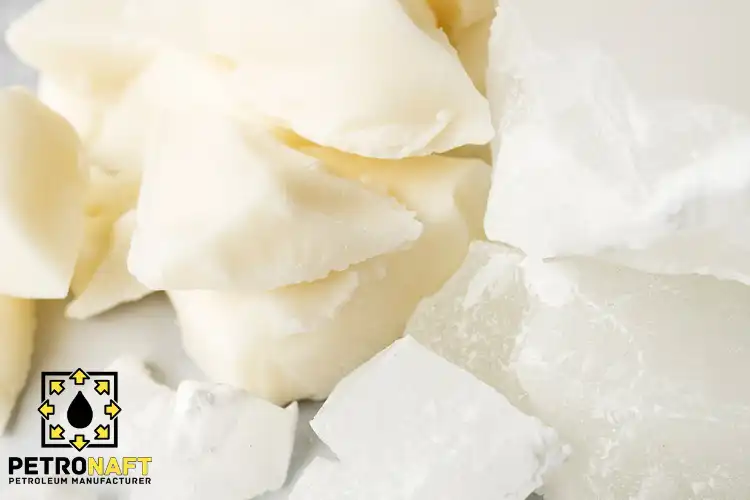
Pick semi-refined when slight color/odor and higher oil content are acceptable and you want better cost-performance for industrial uses. Choose fully refined when you need a cleaner, whiter, lower-odor wax with tighter purity—especially for cosmetics, pharma-adjacent, premium candles, and sensitive packaging. Semi-Refined vs Fully Refined Paraffin Wax comes down to end-use risk, sensory expectations, and spec limits.
Highlights & Key Sections
What “refining” changes (and what it doesn’t)
Refining mainly reduces residual oil and odor-causing trace compounds and improves color/clarity. What it doesn’t automatically change is “melting point = better” or “harder = always fully refined.”
In practice:
- Both grades can be made in multiple melting point ranges (your application decides the range).
- The big levers are oil content, odor, color, and purity consistency.
Think of it like this: fully refined is the “clean-room” version; semi-refined is the “industrial workhorse” version.
Semi-Refined vs Fully Refined Paraffin Wax: Quick Comparison
| Factor that matters | Semi-refined (typical outcome) | Fully refined (typical outcome) | What it means for you |
|---|---|---|---|
| Residual oil | Higher | Lower | Higher oil can boost flexibility/wetting, but may increase odor/bleed risk |
| Odor | Noticeable to mild | Very low | Impacts premium candles, cosmetics, and sensitive packaging |
| Color/appearance | Slight tint possible | Whiter/clearer | Impacts “clean look” products and bright dyes |
| Soot/smoke tendency (in flames) | Can be higher if formulation is tight | Typically easier to keep clean | Still depends heavily on wick, fragrance load, airflow |
| Consistency batch-to-batch | Good | Often tighter | Reduces rejects in high-volume consumer goods |
| Cost | Usually lower | Usually higher | Decide based on rejection cost and customer expectations |
| Best-fit mindset | Performance-per-dollar | Purity-per-risk | Choose based on “what failure looks like” for your product |
The decision drivers that actually affect performance
1) Residual oil: friend or enemy (depends on the job)
Residual oil can help wax wet fibers, reduce brittleness, and improve flex. That’s why semi-refined often performs well in industrial coatings and some board treatments.
But residual oil can also:
- Compete with fragrance or additives for “space” in a candle matrix
- Increase the chance of oil migration into porous materials
- Add “background odor” that premium customers notice fast
Practical rule: if your product is seen/smelled/skin-adjacent, lower oil usually wins.
2) Odor and color: the silent deal-breakers
Odor and color rarely show up as “catastrophic failures,” but they quietly create:
- Customer complaints (premium candles: “smells like petroleum”)
- Shade drift (bright crayons, waxed paper, colored polishes)
- Extra deodorizing steps in production (time and cost)
Real example: A container-candle brand running light fragrances (linen, cotton, white tea) often finds that semi-refined “works,” but the scent profile feels flatter. Switching to fully refined can make the same fragrance smell cleaner without changing the formula.
3) Melting range and hardness: choose by process, not ego
People over-focus on melting point. Better questions:
- Will my wax survive summer logistics without sweating?
- Do I need fast set on a production line?
- Will my finished product crack in winter?
Mini guideline:
- If you need faster line speed / sharper set, prioritize the right melting range and crystallization behavior.
- If you need flexibility, semi-refined (or a blend strategy) often helps—without forcing exotic additives.
4) Compatibility with additives (the “blend tax”)
Both grades can blend beautifully—but semi-refined may demand a bit more formulation discipline:
- Fragrances: watch for sweating and throw inconsistency at higher loadings
- Polymers/resins: semi-refined often wets well, but you may need tighter temperature control
- Pigments/dyes: fully refined can deliver cleaner, brighter color outcomes
If your product uses multiple additives, the stability advantage of fully refined can reduce trial-and-error.
Best choice by application (quick buyer guidance)
| Application | Best default choice | Why | Watch-outs |
|---|---|---|---|
| Premium container candles | Fully refined | Cleaner odor, more consistent sensory results | Still optimize wick + fragrance load |
| Economy candles / utility candles | Semi-refined or blend | Cost-effective, can perform well | Manage soot/smoke via wick and airflow |
| Cosmetics (lip, balm, creams) | Fully refined | Lower odor and tighter purity expectations | Confirm suitability for skin-contact use |
| Pharma-adjacent / sensitive uses | Fully refined | Purity and consistency matter most | Tight documentation and traceability |
| Corrugated/board waxing | Semi-refined | Better cost-performance; good wetting | Control oil migration and smell |
| Hot-melt / rubber compounding | Often semi-refined | Flexibility and wetting can help | Confirm compatibility and stability |
| Polishes (floor/shoe) | Depends on finish target | Semi can give body; fully gives clean look | Balance gloss, hardness, and buffability |
| Food-adjacent packaging | Usually fully refined (or stricter) | Lower odor/migration risk | Verify compliance expectations for the market |
Mini tutorials: choose confidently in 15 minutes
Tutorial A: A fast “sensory risk” test (for candles, cosmetics, packaging)
- Warm a small sample until just melted (use safe heating).
- Waft-test odor at warm and near-room temperatures.
- Cast a thin film on a clean surface.
- After cooling, check:
- Odor intensity
- Visible tint/haze
- Surface feel (greasy vs dry)
Decision: If odor/tint is noticeable in a quiet room, fully refined is usually the safer commercial bet.
Tutorial B: Simple oil-migration screen (for paper/board and porous products)
- Place a small piece of wax on absorbent paper.
- Keep it warm (not hot) for 1–2 hours.
- Look for a translucent “halo” around the wax.
- A larger halo often indicates higher mobile oil.
- For packaging that must look clean, this can predict staining complaints.
Tutorial C: “No-regrets” approach for candle makers (blend logic)
If you’re stuck between grades, do this:
- Start with fully refined as the base for clean odor.
- If you need better jar adhesion or reduced brittleness, adjust with:
- A controlled portion of semi-refined or
- A specialty modifier wax/additive strategy
Why it works: You protect sensory quality first, then tune mechanics second.
Buying & QC: the specs you should ask for (and why)
A strong purchase decision comes from a short list of measurable controls.
Ask for:
- Oil content (key predictor of odor, migration, and some stability issues)
- Melting behavior (match to climate and process temperature)
- Color/clarity (predicts visual cleanliness)
- Penetration/hardness (predicts brittleness vs flexibility)
- Odor statement (even a simple grading system helps)
- Batch consistency (trend data, not just one COA)
COA spec cheat-sheet (example targets to discuss with suppliers)
| Spec on COA | Why it matters | If it’s out of range, you’ll see… |
|---|---|---|
| Oil content | Migration, odor, flexibility | Greasy feel, staining, weaker “clean” scent profile |
| Melting / set behavior | Production speed, heat resistance | Softening in transit, slow demold, warping |
| Color rating | Visual quality, dye results | Yellowing, muddy colors, “not premium” look |
| Hardness / penetration | Crack risk vs scuff resistance | Brittle candles, cracked coatings, poor buffing |
| Odor grade | Consumer acceptance | Complaints even if performance is “fine” |
Pro tip: If your product is consumer-facing, treat “odor” as a spec—not a guess.
Cost vs value: when each grade is the smarter business choice
Semi-refined usually wins when…
- Your application is industrial or not smell-sensitive
- Minor tint or background odor is acceptable
- You benefit from added flexibility or wetting
- Your biggest KPI is cost-per-ton, not premium presentation
Example: Waxed corrugated for moisture resistance often prioritizes throughput and cost. Semi-refined can deliver strong performance if oil migration is controlled.
Fully refined usually pays off when…
- Customers experience the product up close (smell, touch, appearance)
- You need fewer rejects and tighter batch-to-batch consistency
- You’re supplying regulated or highly scrutinized markets
- Product reviews and brand perception matter
Example: A “clean scent” candle line may spend slightly more on fully refined wax but save money by reducing returns, complaints, and reformulation time.
Troubleshooting table (fast fixes)
| Symptom | Likely cause (common) | Grade move | Practical fix |
|---|---|---|---|
| Candle smells “petroleum-like” | Wax odor competing with fragrance | Toward fully refined | Lower fragrance load slightly; test cleaner base |
| Oily stain on paper/board | Mobile oil migrating | Toward fully refined | Tighten oil spec; reduce application temperature |
| Poor dye brightness | Tint/haze in wax | Toward fully refined | Use cleaner wax or adjust dye system |
| Cracking in cold | Wax too brittle for climate | Toward semi-refined or blend | Adjust melting range; add flexibility strategy |
| Smoke/soot complaints | Wick/fragrance/airflow mismatch | Either (depends) | Re-wick; reduce fragrance; improve burn environment |
Trends shaping how buyers choose wax right now
Two shifts are changing specs conversations:
- Higher scrutiny on odor/migration in packaging and consumer goods. Buyers increasingly ask for tighter control because even small sensory issues show up in reviews and audits.
- Growth of ultra-clean wax options and blending innovation. More manufacturers tune wax blends for low odor, consistent crystallization, and better performance across climates—so selection is no longer “one grade fits all.”
The practical takeaway: purchasing decisions are moving from “grade names” toward measurable specs + documented consistency.
Conclusion
The safest way to decide is to start with the end-user experience and failure risk. If odor, color, purity, and consistency define success, fully refined is usually the smart default. If your application rewards flexibility and cost-efficiency and can tolerate minor sensory differences, semi-refined is often ideal. Semi-Refined vs Fully Refined Paraffin Wax is less about labels and more about measurable specs that match your product reality.
Executive Summary & Checklist
Executive Summary (one-screen version)
- Choose fully refined for: premium candles, cosmetics, sensitive packaging, low-odor requirements, and tighter consistency.
- Choose semi-refined for: industrial coatings, board waxing, compounding, and cost-sensitive use where slight odor/tint is acceptable.
- Don’t guess: control oil content, odor, color, melting behavior, hardness, and batch consistency.
Practical Checklist (use this before you buy)
- Is the product smell-sensitive or consumer-facing? → lean fully refined
- Is staining/migration into paper/porous materials a risk? → tighten oil spec (often fully refined)
- Do you need flexibility at low temperature? → consider semi-refined or a blend strategy
- Do you rely on bright dyes or “clean white” appearance? → lean fully refined
- Do you have target specs for oil, color, melting behavior, and hardness on the COA?
- Did you run a quick odor + migration screen on a sample before ordering bulk?
FAQ
1) Can semi-refined paraffin wax be used for candles?
Yes—many candles burn well with semi-refined wax, especially in utility or cost-focused lines. For premium “clean scent” candles, fully refined often reduces background odor and improves consistency.
2) Does fully refined always have a higher melting point than semi-refined?
Not necessarily. Both grades can be produced across similar melting ranges; refining mainly changes oil/odor/color and purity consistency, not the melting range by default.
3) Which one is better for cosmetics and skin-contact products?
Fully refined is typically preferred because it offers lower odor and tighter purity expectations. Always match the wax grade to the compliance and documentation requirements of your target market.
4) What’s the fastest lab-style indicator of “how refined” a wax feels in use?
Odor and oil migration screening are quick and revealing. Warm odor checks and a simple absorbent-paper migration test often predict real-world complaints better than a single melting point number.
5) Can I blend semi-refined and fully refined wax?
Yes, blending is common to balance cost, flexibility, and sensory quality. Start from the performance requirement (odor/appearance vs flex/price), then lock in measurable specs so the blend stays consistent.
Sources
- U.S. eCFR (FDA) – 21 CFR 172.886 Paraffin — Regulatory text outlining conditions of use for paraffin in food-related applications (U.S.).
- USP–NF (United States Pharmacopeia) – Compendial Standards Overview — Reference framework used in pharma-adjacent quality discussions and compendial expectations.
- EFSA – Mineral Oil Hydrocarbons Topic — Scientific context on mineral oil hydrocarbon considerations that influence migration and safety conversations in food-adjacent uses.