


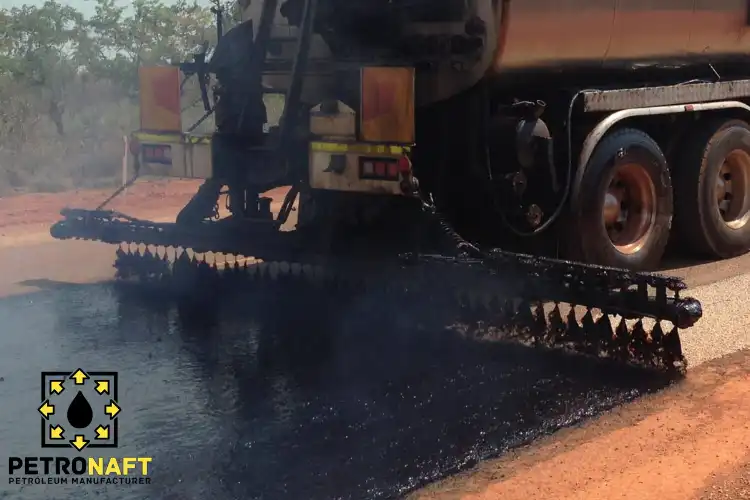
Rapid-Curing Cutback Bitumen (RC) is a low-viscosity asphalt binder made by blending asphalt cement with a highly volatile solvent, so it sprays easily and cures fast as the solvent evaporates. When local regulations allow it, RC can speed up surface treatments, patching, and certain prime/tack jobs—especially in cool or time-critical work.
In this guide, you’ll learn:
- Where RC performs best (and where it creates risk)
- How to pick RC grades (RC-70 to RC-3000) with confidence
- Field-ready application steps, QC checks, and safety rules
- What buyers should request from suppliers to meet road specs
Highlights & Key Sections
Rapid-Curing Cutback Bitumen: What It Is and How It Works
RC is a “cutback” asphalt: asphalt cement + a fast-evaporating, gasoline/naphtha-range solvent. The solvent temporarily lowers viscosity so crews can:
- Spray it through distributors at lower temperatures
- Coat aggregate quickly for surface treatments and patch mixes
- Get faster “set” compared with slower-curing cutbacks
How it cures (simple mental model):
- You apply RC as a thin film or binder spray.
- The solvent flashes off (evaporates) into the air.
- The remaining asphalt binder gains strength and adhesiveness.
Because that evaporation releases VOCs and the product is flammable, RC is often restricted or seasonally limited in many jurisdictions. Treat RC as a “right tool, right place” material—not a default choice.
Where RC Makes Sense in Roadwork (and Where It Doesn’t)
RC shines when you need fast turnaround and reliable coating—especially in maintenance work.
Best-fit situations
- Chip seals / surface dressing when you want quick aggregate retention
- Spray patching and maintenance where opening to traffic quickly matters
- Cold or cool-weather work where high-viscosity binders become hard to spray
- Remote sites where heating equipment is limited
Not a great fit
- Areas with strict VOC rules or air-quality limits
- Wet substrates or damp aggregate (evaporation and adhesion suffer)
- Projects where emulsions or hot-applied binders meet performance with fewer environmental constraints
Decision table: RC vs common alternatives
| Goal on site | RC cutback (rapid cure) | Asphalt emulsion | Hot-applied asphalt binder |
|—|—|—|
| Fast set in surface treatment | Strong option | Often good, depends on breaking/curing | Not typical for chip seal binder spray |
| Low VOC / air-quality compliance | Often difficult | Usually easier | Better than cutbacks on VOC, but needs heat |
| Works on damp surfaces | Weak | Better | Moderate (depends on conditions) |
| Minimal heating equipment | Good | Good | Weak |
| Flammability risk | Higher | Lower | Moderate |
RC Grades at a Glance: Picking the Right Viscosity
RC grades (commonly RC-70, RC-250, RC-800, RC-3000) mainly differ by viscosity—think “how thick it is” and how heavy a binder film you need.
Quick selection table
| Grade (common) | Relative viscosity | Typical road uses | When it’s a smart pick |
|---|---|---|---|
| RC-70 | Thinnest | Light sprays, penetration needs | Cooler temps, tight spray nozzles, thin applications |
| RC-250 | Light–medium | Chip seals, spray work, patching | General-purpose maintenance and surface treatments |
| RC-800 | Medium | Heavier surface treatments | When you need a thicker film / stronger early hold |
| RC-3000 | Thickest | Heavy binder applications, special treatments | High binder demand, higher temps, thicker films |
Mini tutorial: Choose an RC grade in 5 steps
- Step 1 — Identify the job: chip seal, tack/prime (if specified), patching, cold mix.
- Step 2 — Check weather + surface: temperature, wind, humidity, and whether the base is dry.
- Step 3 — Match binder film need: lighter film → lower grade; thicker film → higher grade.
- Step 4 — Confirm equipment capability: nozzle size, pump pressure, filtration, and temperature control.
- Step 5 — Follow local specs: DOT/municipal requirements override “rules of thumb.”
Practical Applications That Actually Drive Results
1) Chip seal / surface dressing (RC is a classic maintenance play)
What you’re trying to achieve: fast aggregate retention with minimal tracking.
Field example (typical scenario):
- A rural two-lane road needs a quick preventive treatment in cool morning conditions.
- Crew sprays a lighter RC grade for good coverage and quicker set, then rolls promptly to lock aggregate.
Best-practice moves
- Calibrate spray bar and verify uniform fan pattern before production.
- Start with a conservative binder rate and adjust based on:
- aggregate absorption
- existing surface texture
- early “bleeding” or “loss of stone” signs
- Roll immediately and use sufficient passes to seat aggregate.
2) Spray patching and pothole maintenance
RC-based spray patch systems (or similar rapid-setting binders) can reduce downtime.
What to watch
- Too much binder can cause pickup and tracking.
- Too little binder leads to raveling and early pop-outs.
3) Prime and tack (only when specified)
Many agencies prefer emulsions for prime/tack today, but some specifications still allow cutbacks—including certain RC grades—under defined conditions.
Use RC only if:
- Your specification explicitly permits it, and
- The base is dry and ready, and
- You can control traffic so the material cures without tracking.
Benefits You Can Measure (Not Just Marketing Claims)
Rapid-Curing Cutback Bitumen can deliver real jobsite advantages when used correctly:
- Faster return to traffic: quicker set can shorten lane closure windows.
- Easier spraying at lower temps: lower viscosity reduces heating demand and improves sprayability.
- Strong early aggregate hold in surface treatments: helps reduce early stone loss.
- Penetration on suitable bases: can aid bonding when conditions and specs align.
Simple field checks that correlate with performance
- Uniform spray: no streaking, gaps, or heavy bands.
- No tracking: tires don’t pick up binder after the expected cure window.
- Early retention: minimal stone loss after initial traffic and sweeping.
Buyer-Focused QC: What to Ask For Before You Purchase
If you buy RC for professional roadwork, insist on documentation and basic quality signals—this protects performance and reduces disputes.
Supplier document checklist
- Certificate of Analysis (COA) by batch/lot
- Safety Data Sheet (SDS) and transport classification
- Stated compliance to relevant standards (per your contract)
- Clear storage and handling instructions
Key properties that matter (and why)
| Property to verify | Why it matters on roads | What a buyer should do |
|---|---|---|
| Viscosity (at specified temp) | Controls sprayability + film thickness | Match grade to equipment + job |
| Flash point / flammability indicators | Safety and transport compliance | Enforce hot-work and ignition controls |
| Water content | Excess water disrupts application | Reject suspect loads; check handling |
| Distillation / solvent fraction | Drives curing behavior | Ensure consistency lot-to-lot |
| Residue properties (penetration/ductility) | Predicts binder flexibility + durability | Prefer consistent residue behavior for your climate |
Practical tip: Don’t buy RC on grade name alone. Buy it on verified test results + consistency across deliveries.
Application Mini Tutorial: Estimating Spray Quantity Without Guesswork
Use this quick method to estimate how much material you need. Then refine with calibration.
- Area (m²) = road length (m) × spray width (m)
- Volume (L) = Area × target application rate (L/m²)
Example:
- Length: 2,000 m
- Width: 3.5 m
- Area = 7,000 m²
- If target rate ≈ 1.0 L/m² → volume ≈ 7,000 L
Reality check before production
- Do a short test strip.
- Confirm uniform coverage and no excessive tracking.
- Adjust rate for surface texture and aggregate type.
Handling, Storage, and Safety: Non-Negotiables
RC products are flammable and can generate significant vapors. Build safety into the method statement.
- Keep away from ignition sources (sparks, open flames, hot engines nearby).
- Use appropriate PPE and respiratory protection where required.
- Maintain ventilation around spray and storage areas.
- Control spills immediately; prevent runoff into drains and waterways.
- Store in compatible tanks/containers, shaded where possible, and follow temperature guidance.
- Train crews on emergency response, especially for fire risk.
Troubleshooting: Fast Fixes for Common Field Problems
| Symptom | Likely cause | Practical fix |
|---|---|---|
| Tracking/pickup on tires | Over-application, insufficient cure time, cool surface | Reduce rate, extend cure, manage traffic, adjust grade |
| Poor aggregate retention | Too little binder, dusty aggregate, delayed rolling | Increase rate slightly, clean aggregate, roll immediately |
| Streaky spray pattern | Plugged nozzles, wrong nozzle angle, low pressure | Clean/replace nozzles, correct angle, recalibrate |
| Slow curing | Low temperature, high humidity, thick film | Use lighter grade (if allowed), reduce rate, schedule warmer window |
| Bleeding/flushing | Excess binder, high temps, wrong aggregate gradation | Reduce rate, use absorptive aggregate, apply blotter if specified |
Trend Watch: Why RC Use Is Narrowing (and How Pros Adapt)
Two forces shape modern binder choices:
- Air-quality and VOC pressure: many agencies restrict cutbacks, pushing crews toward emulsions and other lower-VOC solutions.
- Performance-focused maintenance: more programs prioritize repeatable outcomes (bonding, retention, durability), which favors well-controlled emulsions, polymer-modified systems, and better calibration methods.
RC still has a place—but it increasingly wins on specific constraints: speed, equipment limits, cool-weather spraying, and targeted maintenance needs.
Conclusion
Rapid-Curing Cutback Bitumen can be a smart, high-impact material for surface treatments and maintenance when you need fast set and reliable sprayability—provided your project meets local VOC rules and your team controls application rate, curing, and safety. Buy it by verified test data, apply it with calibration and traffic control, and you’ll capture the benefits without the common failures.
Executive Summary & Field Checklist
Use this before you spec, buy, or apply RC:
- Confirm local rules allow cutbacks for your application and season.
- Select grade based on temperature, equipment, and required binder film.
- Demand COA + SDS + batch identification from the supplier.
- Calibrate distributor (nozzles, pressure, temperature, and output rate).
- Apply on dry surfaces; manage traffic to prevent tracking.
- Roll promptly for chip seals; verify early aggregate retention.
- Enforce flammability controls and vapor safety at all times.
- Document test strip results and final application rates for traceability.
FAQs
1) What is the main difference between RC cutback and asphalt emulsion?
RC uses a volatile petroleum solvent to reduce viscosity and cures as that solvent evaporates. Emulsions use water and emulsifiers, and they “break” and cure differently—often with lower VOC impact.
2) Which RC grade should I start with for chip seals?
Many crews start with a mid-range grade and adjust by climate and aggregate behavior. Always follow local specifications and confirm performance on a short test strip before full production.
3) Can RC be used for prime or tack coats?
Sometimes, but it depends on your governing specification and environmental restrictions. If allowed, apply sparingly, ensure full cure, and manage traffic to avoid pickup and bonding loss.
4) Why does RC sometimes track even after hours?
Tracking usually points to over-application, low surface temperature, high humidity, or insufficient curing time. Reducing the rate, choosing a lighter grade (if permitted), and extending cure time typically solve it.
5) What should I request from a supplier to ensure quality?
Ask for batch-specific test results (COA), safety documentation (SDS), stated standard compliance for your contract, and storage/handling guidance. Consistency across deliveries matters as much as the nominal grade.
Sources
- Asphalt Institute glossary definition of Rapid-Curing (RC) asphalt and related paving terminology — https://www.asphaltinstitute.org/engineering/glossary-of-terms/
- AASHTO index confirming the active materials standards that include rapid-curing cutback asphalt specifications — https://downloads.transportation.org/AASHTO_Materials_Standards_by_Standard_Number.pdf
- Federal Highway Administration technical brief summarizing tack coat fundamentals, bonding risks, and best practices — https://www.fhwa.dot.gov/pavement/asphalt/pubs/hif16017.pdf
- U.S. EPA asphalt paving chapter discussing VOC drivers and why cutback use is regulated in many areas — https://www.epa.gov/sites/default/files/2015-08/documents/iii17_apr2001.pdf
- Texas A&M Transportation Institute research report on practical prime coat methods and materials that replace cutback asphalt — https://static.tti.tamu.edu/tti.tamu.edu/documents/1334-1F.pdf