


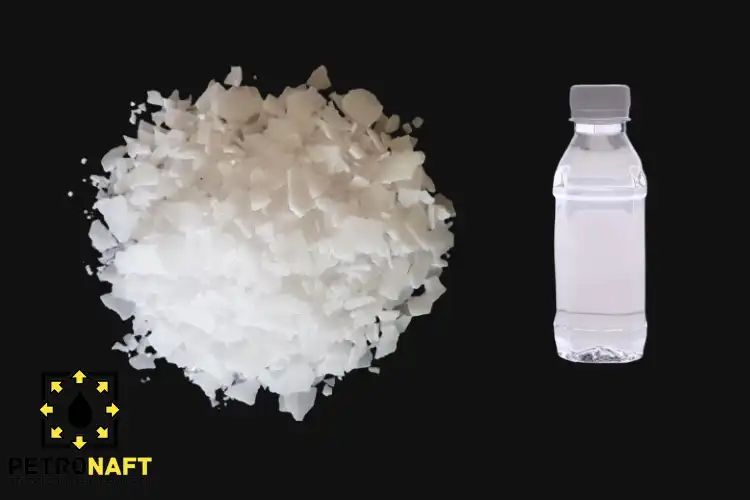
Caustic Soda Flakes vs Liquid comes down to control vs convenience: flakes ship as a high-purity solid you dissolve when needed, while liquid arrives pre-dissolved for faster, safer dosing. Choose flakes when water-free transport and long storage matter; choose liquid when consistent concentration, automated feeding, and lower dust risk drive performance.
Highlights & Key Sections
Why this comparison matters (in real operations)
If you’re buying, specifying, or using sodium hydroxide, the “best” form depends on:
- How you dose it (manual additions vs metering pumps)
- Your water balance (do you want to add water or avoid it?)
- Safety and housekeeping (dust, splashes, exotherm control)
- Logistics (bags vs bulk tanker, winter temperatures, storage footprint)
Caustic Soda Flakes vs Liquid: Quick Comparison
| Factor | Flakes (Solid) | Liquid (Solution) |
|---|---|---|
| Typical strength | ~98–99% NaOH (product-dependent) | Commonly ~50% w/w NaOH (other grades exist) |
| Water content | Very low | High (it’s already diluted) |
| Best for | Remote sites, long storage, minimizing shipped water | Continuous dosing, automation, fast start-up |
| Handling profile | Dust risk; must dissolve; moisture pickup (caking) | Splash risk; freezing/crystallization risk in cold |
| Dosing accuracy | Depends on dissolution and mixing control | Highly consistent when pumped and calibrated |
| Packaging & transport | Bags, drums, big bags | IBCs, tankers, bulk storage |
What are caustic soda flakes?
Caustic soda flakes are solid sodium hydroxide formed into thin, brittle pieces to improve handling and dissolution speed.
What users notice in practice
- Flakes absorb moisture and CO₂ from air, which can cause caking and slowly form sodium carbonate on the surface.
- They dissolve quickly, but the process is strongly exothermic—you must manage heat and splashing.
Where flakes shine
- Sites that can’t receive bulk liquids (no tanker access, limited unloading equipment)
- Operations that want maximum NaOH per kilogram shipped
- Emergency/backup stock where long shelf life (with proper packaging) matters
What is liquid caustic soda?
Liquid caustic soda is sodium hydroxide pre-dissolved in water, most commonly supplied around 50% w/w for industrial use (other concentrations exist for specific applications).
What users notice in practice
- Liquid enables repeatable dosing: pumps, flow meters, and inline controls deliver steady alkalinity.
- In cold weather, concentrated caustic can crystallize, slowing unloading and flow if temperatures drop.
Where liquid shines
- Continuous processes needing steady pH/alkalinity control
- Plants with dosing skids, metering pumps, and closed-transfer systems
- High-throughput users where labor reduction and consistency matter
The key differences that affect performance
1) Concentration and “active NaOH per shipment”
- Flakes ship mostly as “active” NaOH.
- Liquid ships active NaOH plus water, which affects freight economics and storage volume.
Procurement tip
- Compare quotes on a cost-per-ton of 100% NaOH basis, not just delivered ton price.
2) Dosing precision and process stability
Liquid usually wins when you need tight control:
- Water treatment pH control
- CIP systems
- Chemical neutralization and scrubbing
- Automated blending and batching
Flakes can match precision, but only if you standardize:
- dissolution tank size
- mixing time
- temperature management
- verification (density or titration)
3) Safety: dust vs splash (and heat of dissolution)
- Flakes: dust and solid contact hazards; dissolution can boil locally if added too fast.
- Liquid: splash hazards; transfer leaks can spread quickly; freezing can tempt unsafe “quick fixes.”
Good rule
- If you dose daily or continuously, liquid plus closed transfer typically reduces routine exposure points.
Application fit: which form performs better?
| Application | What matters most | Usually better choice | Why |
|---|---|---|---|
| Water treatment (pH raise, alkalinity) | Smooth control, fast response | Liquid | Metering pumps + consistent strength |
| Pulp & paper (alkaline pulping, bleaching stages) | Large volume, steady demand | Liquid (bulk) | Efficient logistics + stable dosing |
| Alumina refining (Bayer) | Massive consumption, process continuity | Liquid (bulk) | Scale favors bulk handling |
| Soaps & detergents | Recipe accuracy, consistent saponification | Liquid for larger lines; flakes for small batches | Liquids meter well; flakes suit manual craft batches |
| Textile mercerizing | Consistency and concentration control | Liquid | Stable concentration improves uniformity |
| Petroleum / gas treating (neutralization, washing) | Controlled addition, compatibility | Liquid (for dosing) or flakes (for remote) | Depends on site logistics and automation |
| Food-grade cleaning (where permitted) | Traceability, controlled dilution | Liquid | Easier standardization and QA |
| Remote mining/camps | Storage, shipment efficiency | Flakes | Easier to ship and store without freezing concerns |
Mini case examples (what actually changes)
Case 1: A mid-size soap plant reduces batch variability
Problem: Inconsistent trace alkalinity and occasional “lye pockets” from rushed dissolution.
Change: Switched from manual flakes dissolution to 50% liquid with a metering pump and a simple calibration routine.
Result: More consistent saponification, fewer reworks, better operator safety (less dust and fewer open-top mixing steps).
Case 2: A remote site avoids winter unloading delays
Problem: Liquid deliveries partially crystallized during cold transport; unloading took hours and strained equipment.
Change: Moved to flakes with a dedicated dissolution tote and controlled mixing SOP.
Result: More predictable logistics and easier inventory planning, at the cost of adding a controlled dissolution step.
Practical buying guide: how to choose fast
Choose flakes if you need:
- Low freight cost per “active” NaOH (especially long distances)
- Long-term storage with minimal infrastructure
- A form that avoids cold-weather crystallization issues in transit
- Flexibility to make any concentration on site
Choose liquid if you need:
- Consistent dosing with pumps/flow meters
- Faster start-up and less operator handling
- Cleaner operations (less dust) and easier SOP enforcement
- High-volume use that justifies bulk tanks and unloading systems
Mini tutorial: making a standard solution from flakes (safely)
Goal: Prepare 10% w/w NaOH (common for cleaning and lab-scale prep).
Math:
- Target total solution = 100 kg
- NaOH needed = 10% of 100 kg = 10 kg NaOH flakes
- Water needed = 90 kg water
Safe steps
- Use a clean HDPE/PP tank with mixing and a lid.
- Add most of the water first (never start with dry tank).
- Add flakes slowly, in small portions, while mixing.
- Let temperature rise and stabilize; keep the tank ventilated and covered.
- Top up to final weight with water after cooling if needed.
- Label the tank with concentration, date, and responsible person.
Practical warning
- NaOH dissolution releases heat fast. Rushing additions can cause violent boiling, splashing, and burns.
Storage, materials, and winter realities
Compatibility quick-check (common materials)
| Material | Typical compatibility with NaOH | Notes |
|---|---|---|
| HDPE / PP | Excellent | Common for tanks, drums, IBC bottles |
| Carbon steel | Generally good for many industrial solutions | Verify temperature/concentration limits for your system |
| Stainless steel (certain grades) | Often good | Check for stress/temperature considerations |
| Aluminum / zinc / galvanized | Not recommended | Can react and generate hydrogen gas |
Liquid handling in cold climates
- Concentrated solutions can crystallize near cool ambient temperatures, slowing pumping and unloading.
- Design around it with:
- insulated lines
- heat tracing where justified
- temperature checks before unloading
- realistic transit and storage temperature planning
Quality and specification checks that protect your process
Whether you buy flakes or liquid, ask for a clear, consistent specification and verify it matches your use case.
What to check on a COA
- NaOH assay (strength)
- Carbonate content (especially if air exposure is common)
- Chloride limits (critical for some downstream sensitivity)
- Metals like iron (matters for color-sensitive products)
- Appearance and insolubles
Field-friendly verification ideas
- Liquid: density check at a known temperature (quick screening)
- Flakes: controlled dissolution + simple titration for strength confirmation (QA or lab)
Two current trends shaping the choice
- Closed-transfer and automated dilution skids are expanding in chemical plants and utilities to reduce routine exposure, improve dosing repeatability, and support audit-ready SOPs.
- Energy and logistics volatility continues to push buyers to compare products on a “delivered active NaOH” basis and to plan for temperature-related handling risks in supply chains.
Conclusion
In Caustic Soda Flakes vs Liquid, flakes give you maximum active material and flexibility—at the cost of managing dissolution and dust—while liquid gives you speed, dosing control, and easier automation—at the cost of shipping water and managing cold-weather flow risks. Match the form to your dosing method, logistics, safety controls, and quality tolerance.
Executive Summary Checklist
Use this quick checklist before you choose or switch:
- Do we need metered, repeatable dosing? (If yes, favor liquid.)
- Can we safely manage dissolution heat and dust controls? (If yes, flakes are workable.)
- Will cold weather cause crystallization/unloading delays for liquid?
- Are we comparing suppliers on cost per ton of 100% NaOH?
- Do we have compatible storage materials and labeled SOPs?
- Are COA limits (carbonates, chlorides, metals) aligned with our process?
FAQs
1) Is liquid caustic soda always 50%?
No. 50% is common industrially, but suppliers offer other concentrations. Always confirm strength on the COA and align your dosing calculations accordingly.
2) Which dissolves faster in water: flakes or liquid?
Liquid is already dissolved, so it “mixes in” immediately. Flakes dissolve quickly but still require controlled addition, mixing time, and temperature management.
3) Why does liquid caustic sometimes get thick or form crystals?
Concentrated sodium hydroxide solutions can crystallize at cooler temperatures. This raises viscosity, slows pumping, and can delay unloading if not managed with temperature planning.
4) Can I store caustic soda in stainless steel?
Often yes, but compatibility depends on concentration, temperature, and the exact stainless grade. For any permanent installation, confirm with materials guidance and your equipment supplier.
5) What’s the biggest operational mistake when using flakes?
Adding water onto flakes (or adding flakes too fast into too little water). Both can cause localized boiling and splashing. Add flakes slowly into water with mixing and PPE.
Sources
- CDC Medical Management Guidelines – Sodium Hydroxide — Authoritative health and safety guidance including identifiers and exposure considerations.
- Euro Chlor – Membrane cell process — Industry reference explaining how caustic soda is produced and typical concentrations from modern plants.
- OxyChem – Caustic Soda Handbook — Practical industrial handling guidance, including temperature and crystallization behavior of common solutions.
- NOAA CAMEO Chemicals – UN/NA 1824 — Reliable emergency response and transport classification reference for sodium hydroxide solution.
- New Jersey Department of Health – Sodium Hydroxide Fact Sheet — Clear regulatory-style summary of hazards, identifiers, and common uses.