


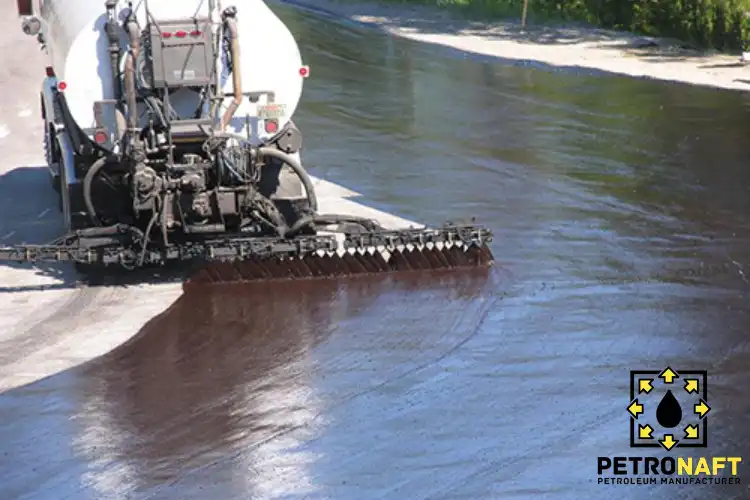
Anionic Vs Cationic Bitumen Emulsifiers comes down to surface charge and how fast you need the emulsion to “break” on aggregate. Cationic (positive) emulsifiers usually bond faster to most mineral aggregates (often negative), making them the modern default for tack coats, chip seals, and slurry systems. Anionic (negative) emulsifiers can be ideal when aggregate chemistry, mix design, or set-time control favors slower, soap-based stability.
You’ll learn the real-world differences (not just definitions)
See selection rules that work on site
Get troubleshooting fixes for common emulsion failures
Leave with a procurement-ready checklist
Highlights & Key Sections
Anionic Vs Cationic Bitumen Emulsifiers: The differences that actually matter on site
Both types are surfactants (emulsifiers) that keep tiny bitumen droplets suspended in water. The practical difference is the electrical charge on those droplets and how they interact with aggregate, fillers, and water chemistry.
Here’s what changes in the real world:
Adhesion speed: how quickly droplets attach and “set” on stone
Breaking behavior: whether the emulsion breaks too fast (clogging/mixing issues) or too slow (tracking/bleeding risks)
pH window: cationic systems are typically run more acidic; anionic systems typically more alkaline
Aggregate compatibility: many aggregates attract cationic emulsions more strongly, especially siliceous stone
How bitumen emulsifiers work (in 90 seconds)
A bitumen emulsion is basically:
Bitumen droplets (the “binder”)
Water (the “carrier”)
Emulsifier molecules that wrap the droplets and prevent them from merging
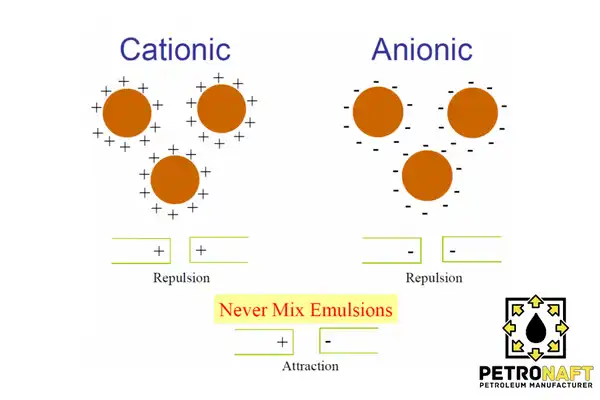
Think of the emulsifier as a “charged jacket” around each droplet:
The jacket creates repulsion between droplets (so the emulsion stays stable in storage).
When the emulsion contacts aggregate, that same charge can promote attraction, pushing droplets to deposit onto the stone.
Once enough droplets deposit and water leaves (absorption + evaporation), the binder coalesces into a continuous film.
If your emulsion is stable in the tank but fails on aggregate, it’s usually a charge + chemistry mismatch, not “bad bitumen.”
Anionic bitumen emulsifiers: where they shine (and where they don’t)
Anionic emulsifiers create negatively charged bitumen droplets. They’re often soap-like salts of fatty acids and typically perform best in an alkaline operating range.
Where anionic systems are a strong choice
When you want slower, more controllable breaking (useful in some cold mixes and certain mixing-intensive applications)
When aggregate/mineral fillers and local practice are built around anionic recipes
When alkaline stability helps with your specific water chemistry or process equipment
Common limitations to plan for
Slower initial adhesion on many common aggregates can mean higher sensitivity to early traffic, dust, or moisture.
More dependent on field conditions (humidity, temperature, and aggregate moisture can dominate outcome).
Mini example (why anionic can still win)
A contractor producing a plant-mixed cold mix with longer hauling and stockpiling needs may prefer an anionic slow-setting approach because it can tolerate mixing time and storage better—provided coatability and moisture resistance are validated with local aggregate.
Cationic bitumen emulsifiers: the modern workhorse for adhesion
Cationic emulsifiers create positively charged bitumen droplets. Many are based on amines or quaternary ammonium chemistry and typically operate in a mildly acidic pH range.
Why cationic is widely preferred today
Faster wetting and bonding to many mineral surfaces
Better performance in many chip seal, tack coat, slurry seal, and microsurfacing workflows
Easier to tune for rapid-, medium-, or slow-setting behavior without sacrificing adhesion
Real-world example (chip seal success pattern)
If you’re shooting a chip seal on a siliceous aggregate (common in many regions), a cationic rapid-setting system often reduces early stone loss because the positively charged droplets deposit quickly onto aggregate—especially when aggregate dust is controlled and spread rate is correct.
Quick comparison table
| Feature | Anionic emulsifiers | Cationic emulsifiers |
|---|---|---|
| Droplet charge | Negative | Positive |
| Typical operating pH (general) | Alkaline | Mildly acidic |
| Typical chemistry families | Fatty-acid soaps/salts | Amines, amine salts, quats |
| Early adhesion on many aggregates | Often slower | Often faster |
| Common use cases | Some cold mixes, select surface treatments depending on local specs | Tack coats, chip seals, slurry/microsurfacing, cold recycling systems |
| “Break” control | Often stable; can be slower to set | Highly tunable; can be very fast-setting |
| Typical grade naming (common practice) | RS / MS / SS (varies by standard) | CRS / CMS / CSS (varies by standard) |
| Risk if mismatched | Tracking / delayed set | Premature break / mixing problems |
Selection mini-tutorial: choose the right emulsifier in 6 steps
If you’re specifying (or buying) emulsified bitumen, don’t start with “anionic vs cationic.” Start with your aggregate + application + climate.
Step 1) Identify your aggregate “personality”
Use supplier data plus simple site checks:
Siliceous (often more “acidic”) vs calcareous/limestone (often more “basic”)
Dust/clay content and cleanliness
Absorption and moisture sensitivity
Field hint: If you fight stripping and stone loss, you’re usually fighting the surface chemistry, not just the binder.
Step 2) Define the application’s set-time requirement
Tack coat: must set quickly, resist tracking
Chip seal: needs fast adhesion to prevent early stone loss
Slurry/microsurfacing: needs controlled break in the mixer, then fast set on the road
Cold mix/cold recycling: must survive mixing energy and workability time
Step 3) Check water chemistry (this is the silent killer)
Hardness, salts, and contaminants can destabilize emulsions or cause weird breaking behavior.
If you see unpredictable viscosity swings, suspect water first.
If you see “overnight” storage instability, suspect contamination or ionic imbalance.
Step 4) Match emulsifier type to performance priority
Use this simple rule-of-thumb:
Prioritize fast adhesion and broad aggregate compatibility → usually cationic
Prioritize mixing tolerance and longer workability windows (validated by testing) → often anionic or a slower-setting system
Step 5) Tune the setting class (rapid / medium / slow)
Don’t over-specify. Choose the class that matches operations:
Rapid: chip seals, some tack workflows
Medium: many cold mixes, some recycling scenarios
Slow: mixing-intensive, longer handling time applications
Step 6) Prove it with two quick validation tests
Before committing a full project, do:
Coatability + adhesion check on your actual aggregate (wet and dry)
Break/set observation at expected temperature and humidity
Practical rule: If the lab looks great but the field fails, the missing variable is usually aggregate moisture, dust, or water chemistry—not the emulsifier “brand.”
Application-to-choice matrix (fast reference)
| Application | What matters most | Usually favored direction |
|---|---|---|
| Tack coat | Quick set, low tracking, uniform spray | Often cationic |
| Chip seal | Early chip retention, wetting, fast adhesion | Often cationic rapid-setting |
| Slurry seal | Controlled break in mixer, strong cohesion after set | Often cationic (common modern practice) |
| Microsurfacing | Very controlled break + fast traffic return | Often cationic with tuned set control |
| Cold mix (plant/stockpile) | Workability time, mixing tolerance | Often slower-setting systems; anionic can be viable with proper design |
| Cold recycling | Compatibility with fines, cement/lime, set control | Often cationic or engineered systems validated by mix design |
“Usually favored” isn’t a guarantee—local specs and aggregate can flip the answer. The goal is predictable breaking + durable adhesion.
Troubleshooting guide: symptoms, causes, fixes
| Symptom | Likely cause | Practical fix |
|---|---|---|
| Emulsion breaks in the tank or lines | Contamination, wrong pH window, hard/dirty water | Flush system, control water quality, verify pH, avoid cross-contamination between emulsion types |
| Poor adhesion / stripping | Wrong charge for aggregate, dusty/wet aggregate, insufficient adhesion promoter | Clean aggregate, adjust set class, evaluate cationic vs anionic match, add adhesion promoter if allowed |
| Tracking after tack coat | Too slow set, excess spray rate, cool/humid conditions | Use faster-setting class, reduce rate, allow curing time, verify nozzle pattern and dilution practices |
| Premature break in slurry/micro mixer | Set too fast, high fines reactivity, temperature effects | Move to slower-setting system, adjust filler/additive package, control temperature and mixing water |
| “Foamy” spray / inconsistent fan | Air entrainment, pump issues, incompatible dilution water | Check pump suction leaks, verify dilution method, stabilize water quality |
Buying and specifying: what to ask suppliers (commercial-ready)
When you request quotes or issue a purchase order, vague specs create expensive surprises. Ask for the details that control field outcome.
A practical supplier question list
-
Emulsion type and setting class (and which standard it is produced to)
-
Residue properties (penetration/softening point, polymer modification if any)
-
Recommended spray/mix temperature range
-
Storage stability guidance (time, circulation needs, freeze protection)
-
Compatible additives (cement/lime/fillers, adhesion promoters, break control agents)
-
Water sensitivity guidance (dilution rules, acceptable hardness/chlorides)
-
Typical field use cases they support with the same formulation family
Simple contract-protection tip
Include a clause that the supplier supports pre-job trials and provides job-mix guidance if aggregate or climate changes.
Trends and current challenges shaping emulsifier choice
A few developments are changing how professionals evaluate Anionic Vs Cationic Bitumen Emulsifiers:
-
Polymer-modified emulsions are increasingly used to improve chip retention, rut resistance, and cohesion—especially where traffic loads and heat cycles are harsher.
-
Sustainability and low-impact chemistry is pushing more interest in bio-based or lower-hazard emulsifier packages, alongside higher use of recycling (RAP/cold recycling) that demands tighter break control.
-
Performance-focused specs are gradually replacing recipe specs, meaning field results (adhesion, set time, durability) matter more than the label alone.
Conclusion: choosing Anionic Vs Cationic Bitumen Emulsifiers without costly trial-and-error
The most reliable way to choose Anionic Vs Cationic Bitumen Emulsifiers is to match aggregate chemistry + application set-time + water quality, then confirm with quick coatability and break checks. Cationic systems often win on early adhesion and versatility, while anionic systems can be excellent when workability and stability requirements favor them. The best choice is the one that breaks predictably and bonds durably in your exact field conditions.
Executive Summary checklist (print this for your next job)
-
Identify aggregate type, cleanliness, and moisture sensitivity
-
Define application set-time needs (traffic return time matters)
-
Verify water quality and contamination risks
-
Select emulsion type + setting class suited to operations
-
Run coatability/adhesion checks on actual aggregate (wet + dry)
-
Confirm break behavior at expected temperature/humidity
-
Lock spray rates/mix water and document field adjustments
-
Keep cationic/anionic systems separated in tanks/lines to avoid contamination
FAQ (5)
1) Is cationic always better than anionic for road work?
Not always. Cationic often gives faster adhesion on many aggregates, but anionic can outperform when your mix design needs longer workability or when local aggregate and process conditions favor anionic stability.
2) Why does an emulsion “break” too fast in the mixer?
Usually due to a mismatch between setting class and fines/mineral reactivity, temperature, or water chemistry. Switching to a slower-setting system and controlling fillers/additives typically stabilizes the break.
3) Can I dilute emulsions with any water source?
No. Water hardness, salts, and contaminants can destabilize emulsions or change spray behavior. Use controlled, consistent water and follow supplier dilution limits.
4) What’s the biggest cause of poor chip retention in chip seals?
Early-stage adhesion failure—often from dusty/wet aggregate, incorrect spray rate, or an emulsion/aggregate mismatch. Improving surface cleanliness and selecting a suitable rapid-setting system usually helps.
5) Do emulsifiers affect long-term performance or only construction behavior?
Both. Emulsifiers control breaking and initial bonding, and that early bond quality strongly influences moisture resistance, stripping risk, and durability over the service life.
Sources
-
One of the most widely used standards bodies for emulsion classification and test methods across asphalt materials: ASTM International
-
Practical industry guidance and technical publications focused on asphalt materials and pavements: Asphalt Institute
-
Road maintenance and pavement preservation guidance, including surface treatments and field best practices: FHWA (Federal Highway Administration)
-
Industry reference organization for slurry seal and microsurfacing guidance and best practices: International Slurry Surfacing Association (ISSA)
-
European standardization reference point for bituminous binders and emulsions used in EU-aligned specifications: CEN (European Committee for Standardization)