

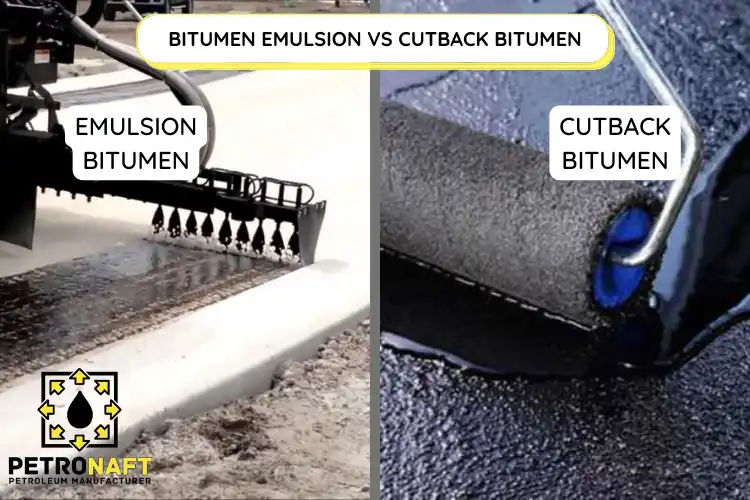
For most projects, Bitumen Emulsion vs Cutback Bitumen usually ends with bitumen emulsion as the better option because it is safer to handle, produces lower emissions, and suits many paving, maintenance, and recycling applications. Cutback bitumen still has value in selected cases, especially where deeper penetration into a dry base is required.
The right choice depends on the job, climate, base condition, curing needs, and local specification. A lower purchase price alone should never decide the material.
Highlights & Key Sections
Bitumen Emulsion vs Cutback Bitumen: What Is the Real Difference?
- Bitumen emulsion is bitumen dispersed in water with an emulsifier.
- Cutback bitumen is bitumen diluted with petroleum solvents.
That single difference changes how each material behaves on site. It affects curing, safety, storage, emissions, and the type of work each product handles best.
| Factor | Bitumen Emulsion | Cutback Bitumen | Why it matters |
|---|---|---|---|
| Carrier | Water + emulsifier | Petroleum solvent | Controls curing and safety |
| Cure mechanism | Breaking + water evaporation | Solvent evaporation | Affects opening time |
| Emissions | Lower in most cases | Higher in most cases | Important for compliance and worker exposure |
| Flammability | Lower | Higher | Impacts handling and storage risk |
| Typical use | Tack coat, chip seal, slurry seal, recycling | Prime coat, selected penetrating uses | Helps match material to application |
| Modern preference | Usually preferred | More limited use | Better fit with current project requirements |
In simple terms, emulsions are often preferred for bonding and surface treatments, while cutbacks are mostly reserved for specific jobs where penetration is more important.
What is bitumen emulsion?
Bitumen emulsion is a mixture of bitumen, water, and an emulsifying agent. It allows bitumen to be applied at lower temperatures and with improved safety compared with solvent-based materials.
It is widely used in:
- Tack coats
- Chip seals
- Slurry seals
- Micro-surfacing
- Fog seals
- Cold recycling
A major practical advantage is that many emulsion systems work well under normal field conditions without the strong solvent odor and fire risk associated with cutbacks.
What is cutback bitumen?
Cutback bitumen is produced by reducing the viscosity of bitumen with petroleum-based solvents. This makes it easier to spray or penetrate surfaces at lower temperatures.
It is commonly used in more limited applications such as:
- Prime coats on dry granular bases
- Some patching operations
- Penetrating treatments in specific specifications
Its main drawback is the solvent content. That affects emissions, safety, and in many regions, regulatory acceptance.
Where bitumen emulsion usually wins
Bitumen emulsion is usually the better choice when you need:
- Lower emissions
- Safer handling
- Better suitability for bonding layers
- Good performance in preservation treatments
- Better alignment with modern sustainability goals
This is one reason emulsions dominate many maintenance and pavement preservation programs today. For contractors and buyers, that often means fewer handling concerns and better fit with standard practice.
Real-world example
A municipal road resurfacing project usually benefits more from emulsion-based tack coat than from cutback. The crew gets a material designed for bond strength, and the project reduces solvent-related concerns near traffic and nearby businesses.
When cutback bitumen still makes sense
Cutback bitumen still has practical value when the project needs:
- Deep penetration into a dry, absorbent granular base
- A prime coat system that specifically calls for cutback
- A product for a selected niche application under approved conditions
The key is not to choose cutback because it is familiar. It should be selected only when the technical purpose clearly supports it.
Real-world example
On a dry, open granular road base, a project engineer may still specify cutback for prime coat if penetration into the base is the main objective and local project requirements allow it.
Best choice by application
| Application | Usually better option | Why |
|---|---|---|
| Tack coat between asphalt layers | Bitumen emulsion | Better for bonding |
| Chip seal | Bitumen emulsion | Common and effective for surface treatment |
| Slurry seal / micro-surfacing | Bitumen emulsion | Standard binder type |
| Fog seal | Bitumen emulsion | Better suited to light surface sealing |
| Prime coat on dry granular base | Depends; cutback may be used | Penetration may matter more |
| Dust control | Depends on local specification | Job conditions vary |
| Cold recycling | Bitumen emulsion | Better fit for modern recycling methods |
| Remote maintenance work | Depends | Climate and logistics decide |
For most commercial buyers, this is the practical rule: if the goal is bonding, preservation, or recycling, start with emulsion. If the goal is penetration into a dry untreated base, evaluate whether cutback is technically justified.
Performance, cost, and buying logic
Many buyers compare only the invoice price and miss the bigger picture.
A better procurement decision looks at:
- Residual binder value
- Curing speed
- Site safety
- Fire and storage risk
- Application suitability
- Compliance with project requirements
- Risk of failure or rework
A cheaper liquid material can become more expensive if it slows the job, creates safety issues, or performs poorly in the actual application.
Mini tutorial: how to choose the right one
1) Define the application
Start by identifying whether the material is for tack coat, prime coat, seal coat, patching, or recycling.
2) Decide whether you need bond or penetration
- Need bond between layers? Choose emulsion first.
- Need penetration into a dry granular base? Review cutback or another approved prime option.
3) Check field conditions
Moisture, temperature, traffic pressure, and aggregate condition all affect performance. A product that works well in one site condition may be the wrong fit somewhere else.
4) Review compliance and safety
Before buying, confirm the material fits the project specification and local handling requirements. This step prevents costly procurement mistakes.
5) Test before full application
For important jobs, a trial section helps confirm spray behavior, curing, penetration, and early performance.
Current market direction
The industry is moving toward safer, lower-emission, and more sustainable pavement materials. That shift supports broader use of bitumen emulsion, especially in maintenance and recycling applications.
At the same time, buyers are under more pressure to justify material choice with performance, not just habit. That makes application-based selection more important than ever.
Common mistakes to avoid
- Choosing by price alone
- Using cutback where bond performance matters most
- Ignoring site moisture and climate
- Assuming all emulsions behave the same way
- Skipping a small field test before large-scale use
- Buying a familiar product instead of the technically correct one
These mistakes can turn a routine project into a performance or cost problem.
Conclusion
In Bitumen Emulsion vs Cutback Bitumen, bitumen emulsion is the better choice for most modern applications because it offers a stronger balance of safety, practicality, performance, and environmental suitability. Cutback bitumen still has a place in selected prime and penetrating uses, but it should be chosen only when the project conditions and technical purpose clearly support it.
Executive Summary Checklist
- Use bitumen emulsion first for tack coats, seals, slurry systems, and recycling work.
- Consider cutback bitumen only when penetration into a dry granular base is required.
- Compare materials by job performance, not just delivered price.
- Check temperature, moisture, and traffic conditions before final selection.
- Review safety, storage, and compliance before procurement.
- Match the binder to the actual application need.
- Use a trial section for important projects.
FAQ
1) Is bitumen emulsion always better than cutback bitumen?
Not always, but it is the better choice for most modern maintenance, bonding, and surface treatment work. Cutback still has value in selected applications where deeper penetration is the main requirement.
2) Why is cutback bitumen used less often today?
Its solvent content creates higher handling and environmental concerns in many cases. That makes emulsion a more practical option for many current projects.
3) Can bitumen emulsion replace cutback bitumen in prime coats?
Sometimes yes, but not in every case. The answer depends on base condition, required penetration, and the project specification.
4) Which one is better in cold weather?
There is no universal answer. The correct choice depends on the product grade, field conditions, curing requirements, and the exact job type.
5) Which one is better for recycled asphalt work?
Bitumen emulsion is generally better suited for many modern cold recycling applications because it supports efficient processing and aligns well with sustainable pavement strategies.
Sources
- Federal Highway Administration — A practical technical reference on tack coats, pavement bonding, and asphalt application best practices. Tack Coat Best Practices
- U.S. Environmental Protection Agency — A technical resource explaining how emulsified and cutback asphalt differ in composition, curing, and emissions. AP-42, Chapter 4.5: Asphalt Paving Operations
- Asphalt Institute — A respected industry manual covering asphalt emulsion types, properties, and field applications. MS-19 Basic Asphalt Emulsion Manual
- Federal Highway Administration — A technical overview of asphalt pavement recycling technologies and the role of emulsion-based systems. Asphalt Pavement Recycling Technologies
- Transportation Research Board — A research publication hub covering pavement preservation, asphalt performance, and sustainability trends. Transportation Research Circulars