


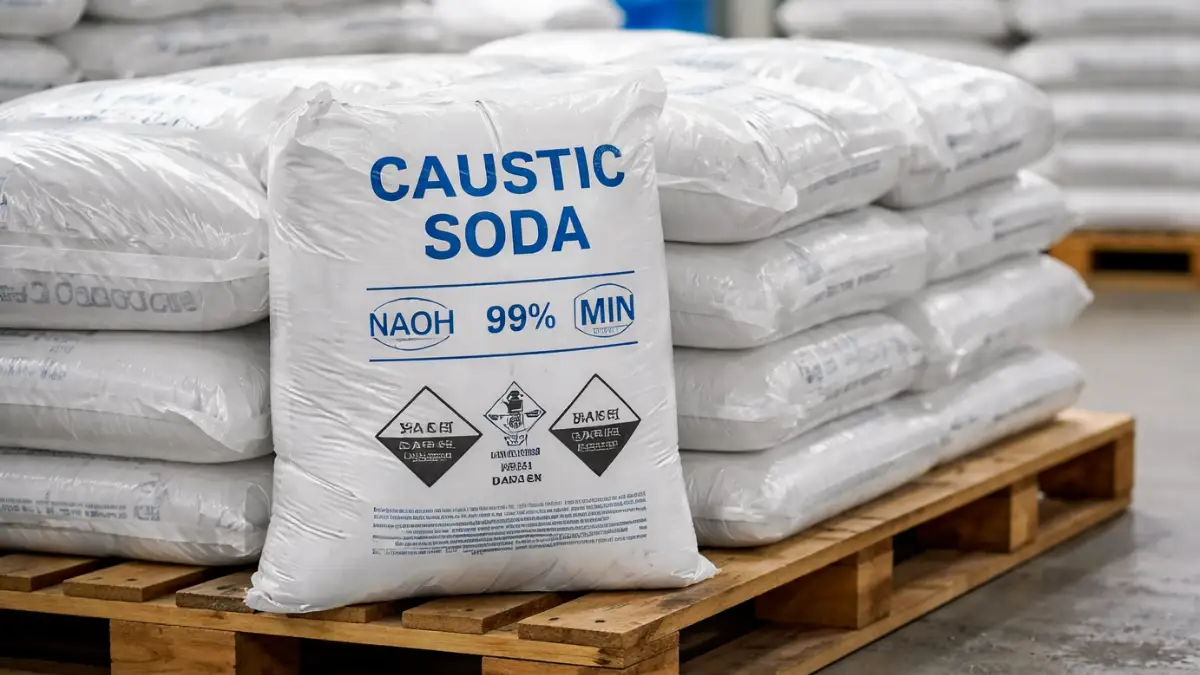
Buying bulk caustic soda is mainly a specification, safety, and logistics decision. Industrial buyers should confirm the required form and concentration, impurity limits, packaging and transport method, storage compatibility, and supplier documentation before comparing offers, because sodium hydroxide is highly corrosive and procurement mistakes can create safety, quality, and downtime risks.
Bulk caustic soda is purchased across water treatment, pulp and paper, detergents, chemicals, alumina, petroleum refining, and other industrial operations because it is a widely used strong alkali. In practice, the best purchase is not simply the lowest quoted price. It is the option that arrives in the right specification, in the right package, with the right documentation and handling controls for your process.
Highlights & Key Sections
What should industrial buyers evaluate first?
Start with application fit, not supplier marketing. The first screen is whether the product form, purity profile, delivery method, and storage plan match your process and site conditions.
Before requesting quotations, define these six items internally:
- Use case
Is the product being used for pH control, neutralization, cleaning, refining, regeneration, or chemical manufacture? The application affects acceptable impurities and handling requirements. - Required form
Sodium hydroxide is commonly encountered as solid material and as liquid solution. The solid product may appear as flakes, beads, or granules, while transport and handling requirements differ between dry product and solution. - Required concentration or grade
Many industrial systems buy liquid caustic because transfer and dosing are simpler at scale, while some buyers prefer solid material where storage, shipping economics, or local dilution practice justify it. Liquid caustic soda is commonly supplied at 50% concentration in many industrial markets, but the required specification should always match the process. - Packaging and delivery mode
Your volume and unloading setup usually determine whether bags, drums, IBCs, tank trucks, railcars, barges, or ship quantities are realistic. Liquid bulk may lower unit handling effort, but only if the receiving site is designed for it. - Storage and materials compatibility
Caustic soda is incompatible with acids and certain metals such as aluminum, tin, and zinc. It can also generate substantial heat on contact with water, which makes transfer and dilution planning essential. - Documentation and compliance needs
Procurement should confirm the need for an SDS, certificate of analysis, transport classification, batch traceability, and any sector-specific requirements such as water treatment or food-related purity criteria.
Which form of caustic soda is the right choice?
The right form depends on throughput, site equipment, storage conditions, and how much handling risk your operation can absorb.
Solid vs. liquid: what is the practical difference?
Solid caustic soda can suit buyers that need flexibility, lower inbound water content, or smaller distributed consumption points. Liquid caustic soda usually suits larger continuous users with fixed storage, controlled transfer systems, and regular consumption.
| Purchase format | Often suits | Main advantages | Main watchouts |
|---|---|---|---|
| Solid flakes / beads / granular | Smaller or intermittent users, sites that dilute on demand | Easier to store without bulk liquid tanks; useful where liquid deliveries are impractical | Manual handling risk, dust/contact exposure, dilution generates substantial heat |
| Liquid solution | Continuous industrial users with dedicated tanks and transfer lines | Faster unloading, easier dosing, less manual handling at scale | Requires compatible tanks, unloading controls, temperature management, spill planning |
| Drums / IBCs / totes | Medium users or backup supply | Operational flexibility, lower infrastructure requirement | Higher packaging and handling burden per ton |
| Bulk tank truck / rail / marine | High-volume users | Lower handling per unit, efficient recurring supply | Demands site readiness, receiving discipline, and reliable consumption planning |
The best buying decision usually follows total operating fit, not only delivered price.
How do grade and purity affect buying decisions?
Grade matters when downstream quality, corrosion, product performance, or regulatory acceptance can be affected by impurities.
Industrial buyers should avoid treating all sodium hydroxide as interchangeable. Production route, impurity profile, and intended end use can all matter. That does not mean every process needs premium grade, but it does mean the purchasing specification should match the application.
Ask suppliers for a specification sheet and certificate of analysis that clearly states:
- concentration or assay
- production route when relevant
- key impurity limits
- appearance
- batch identification
- applicable standards or customer-specific limits
- shelf-life or storage guidance where relevant
For critical operations, involve process engineering or quality teams before approval. A cheaper offer can become costly if impurities affect product color, catalyst life, membranes, downstream neutralization, or cleaning performance.
What packaging and logistics options work best for bulk caustic soda?
Choose the delivery method that your site can receive safely and consistently, not simply the format that looks cheapest on paper.
When comparing packaging and logistics, assess:
- annual and monthly consumption
- minimum order quantity
- unloading rate and allowed delivery window
- available tank or warehouse space
- emergency replenishment options
- local transport restrictions for corrosives
- demurrage, detention, and returnable packaging terms
- weather and temperature exposure during transit and storage
A quotation is incomplete if it does not make these assumptions explicit.
What safety and handling checks should buyers treat as non-negotiable?
Bulk caustic soda must be purchased with handling controls in mind. Safety is not a separate issue from procurement; it is part of the specification.
Sodium hydroxide can cause severe burns and serious eye injury, and exposure may occur through skin or eye contact, ingestion, or inhalation of mist or dust depending on the form and handling conditions. Buyers should treat storage, unloading, transfer, emergency equipment, and training as core purchasing criteria.
Minimum buyer checks should include:
- current SDS from the actual supplier
- compatible storage tank and line materials
- closed or controlled transfer procedures
- emergency shower and eyewash readiness
- spill response planning
- receiving and unloading training
- PPE requirements aligned with the SDS and site risk assessment
- clear segregation from incompatible materials such as acids and certain metals
One common procurement mistake is approving a source before confirming the receiving site is equipped to unload and store it safely.
How should industrial buyers compare suppliers?
The strongest supplier is the one that can repeatedly meet specification, ship reliably, and support safe use, not merely the one with the lowest first quote.
A practical supplier evaluation framework looks like this:
Step 1: Confirm technical fit
Request the product data sheet, typical analysis, SDS, and available packaging formats. Check whether the offered product matches your concentration, impurity, and application requirements.
Step 2: Check production and supply continuity
Ask where the material is produced, whether supply is direct or distributor-based, and what backup arrangements exist if a plant, terminal, or transport lane is disrupted.
Step 3: Review documentation quality
Look for clear batch traceability, transport classification, certificates, and responsive technical support. Weak documentation is often an early sign of weak operational control.
Step 4: Validate logistics compatibility
Confirm lead time, minimum order quantity, unloading assumptions, tank truck or marine access, and emergency supply options.
Step 5: Evaluate commercial terms
Compare delivered basis, payment terms, Incoterms where applicable, packaging charges, freight assumptions, and claims procedures for off-spec or damaged deliveries.
Step 6: Run a risk-adjusted comparison
Choose on total cost of ownership, not headline unit price. Include downtime risk, yield impact, receiving labor, packaging disposal, and safety controls.
What usually drives bulk caustic soda pricing?
Pricing typically reflects concentration, grade, volume, packaging, freight mode, regional supply conditions, and contract structure rather than a single global benchmark.
Because sodium hydroxide is tied to chlor-alkali production and industrial transport networks, buyers should expect pricing to vary by region, order size, urgency, and supply chain conditions.
Instead of chasing a generic market number, ask suppliers to break quotations into:
- product basis and concentration
- packaging format
- freight and delivery basis
- terminal or port assumptions
- surcharges or hazardous-material handling costs
- validity period
- emergency or spot-supply premium conditions
That gives procurement teams a quote they can actually compare.
What mistakes do buyers make when sourcing bulk caustic soda?
Most problems come from incomplete specifications, weak receiving preparation, or comparing offers that are not commercially equivalent.
Frequent mistakes include:
- buying by price alone without defining impurities or grade
- selecting liquid bulk without verifying storage and unloading readiness
- underestimating the heat and hazard involved in dilution and transfer
- ignoring incompatibility with acids or susceptible metals
- failing to request the latest SDS and certificate of analysis
- comparing ex-works, delivered, drum, and bulk offers as if they were the same
- relying on a single source without contingency planning
A good buying process prevents operational surprises before the first shipment moves.
What is a practical procurement workflow for Bulk Caustic Soda?
The best workflow is simple: define the requirement, validate site readiness, compare equivalent offers, then lock in documentation and supply terms.
Use this sequence:
- Define the application and consumption rate
State what the caustic does in your process and how much you use per day, week, and month. - Set the technical specification
Specify form, concentration, impurity limits, packaging, and documentation requirements. - Check site capability
Confirm storage capacity, transfer method, compatible materials, and emergency response readiness. - Request comparable quotations
Ask each supplier to quote the same basis, packaging type, freight scope, and delivery schedule. - Review technical and commercial risk together
Procurement, operations, EHS, and quality should review the offers jointly. - Approve the supplier and receiving protocol
Finalize unloading instructions, inspection points, and non-conformance handling before the first delivery.
That workflow is especially important for Bulk Caustic Soda because the product’s hazard profile and logistics profile are tightly linked.
Executive buyer checklist
Before issuing a purchase order, confirm all of the following:
- the required form and concentration are written into the PO
- the supplier specification and your internal requirement match
- the latest SDS has been reviewed by operations and EHS
- the receiving site can safely unload, transfer, and store the product
- incompatible materials have been checked
- packaging and freight assumptions are clear
- the quote basis is comparable across suppliers
- batch documentation and COA requirements are defined
- emergency contact and claims procedures are known
- backup supply or contingency options have been considered
Conclusion
For most industrial buyers, Bulk Caustic Soda should be sourced as a controlled procurement category rather than a simple commodity purchase. The best outcome comes from matching specification, packaging, safety, logistics, and supplier reliability to the actual process requirement. When those factors are defined early, buyers reduce commercial risk, avoid handling problems, and make supplier comparisons that hold up under technical review.
FAQs
1. Is liquid caustic soda always better than solid caustic soda?
No. Liquid product often suits large continuous users because transfer and dosing are easier at scale, but solid material can still make sense where consumption is intermittent, bulk liquid infrastructure is unavailable, or on-site dilution is already controlled.
2. What documents should a buyer request before approving a supplier?
At minimum, ask for the latest SDS, a product specification sheet, a certificate of analysis format, transport classification details, and packaging information. For critical applications, also request traceability and any sector-specific compliance statements.
3. Why is concentration so important when comparing offers?
Concentration affects delivered value, handling conditions, storage planning, and process design. Two offers can look similar commercially but differ materially once you account for actual NaOH content and the operating impact of dilution or transfer.
4. What are the main site risks during receiving and unloading?
The main risks are corrosive exposure, incompatible materials, transfer errors, and inadequate emergency readiness. Buyers should verify eyewash and drench capability, operator training, compatible tanks and lines, and clear unloading procedures before the first delivery.
5. How should buyers compare supplier quotations fairly?
Compare equivalent offers only. Standardize concentration, delivery basis, packaging, freight scope, lead time, documentation, and claims terms. Then review total operating fit, not just unit price, because downtime and handling burdens can outweigh a cheaper quote.
Sources
- CDC/NIOSH Pocket Guide to Chemical Hazards — Sodium Hydroxide
Relevant for exposure routes, physical form, incompatibilities, emergency controls, and occupational exposure limits. - OSHA Chemical Data — Sodium Hydroxide
Relevant for official occupational safety reference information and cross-checking hazard handling requirements. - Health Canada — Hazardous Substance Assessment: Sodium Hydroxide
Relevant for classification details, including transport distinctions between solid and liquid product. - OxyChem Caustic Soda Handbook
Relevant for industrial production context, common liquid concentration, shipping methods, and broad industrial use cases.