

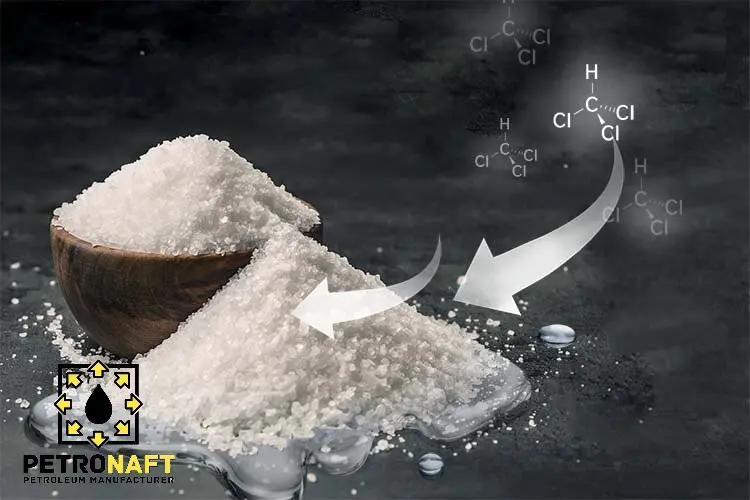
Calcium Chloride and Indoor VOC Pollution intersect when CaCl₂ absorbs moisture and turns into brine, which can then dissolve or retain certain VOCs—especially polar solvents—changing odors, corrosion risk, and even sampling results. In high-VOC environments, organic vapors can also trigger salt dissolution (organic deliquescence) without obvious wetness.
Indoor VOCs (volatile organic compounds) are sneaky: you can’t “see” them, but you’ll often smell them—fresh paint, new furniture, strong cleaners, adhesives, fuels, solvents. Now add calcium chloride, the classic moisture absorber. The result can be helpful (humidity control) or messy (brine + trapped smells + corrosion), depending on where and how you use it.
Highlights & Key Sections
Calcium Chloride and Indoor VOC Pollution: The chemistry behind organic vapor–induced salt dissolution
1) Why calcium chloride “melts” in normal room air
Calcium chloride is hygroscopic (pulls water from air) and deliquescent (pulls so much water it becomes liquid). In practical terms:
-
At modest relative humidity, CaCl₂ can transition from pellets/flakes → wet clumps → liquid brine
-
The brine keeps absorbing water until it reaches an equilibrium with the room’s humidity
-
This is why closet tubs and moisture boxes eventually fill with salty liquid
What matters indoors: once CaCl₂ becomes brine, it stops behaving like a dry “salt” and starts behaving like a liquid chemical phase that can interact with other airborne chemicals.
2) Organic vapor–induced salt dissolution (the “VOC can liquefy a salt” idea)
A newer concept from lab research is organic deliquescence: certain salts can undergo a solid→liquid transition when exposed to organic solvent vapors, not just water vapor.
The key design rule is simple: like dissolves like.
-
If a salt is highly soluble in a given organic liquid, its vapor can sometimes deliver enough molecules to create a liquid phase (in a closed setup, over time).
-
If it’s insoluble, nothing happens.
What matters indoors: typical homes usually don’t reach the high organic vapor levels used in lab demonstrations—but workshops, print rooms, garages, finishing areas, labs, and some industrial sites can, especially with poor ventilation.
3) Where CaCl₂ fits in “VOC-driven dissolution”
CaCl₂ is famous for water-driven deliquescence, but VOCs can still become part of the story in three practical ways:
-
Water-first pathway (most common at home): CaCl₂ → brine from humidity → brine absorbs/retains some VOCs
-
Mixed pathway (renovation/cleaning spikes): high humidity + fresh VOC emissions → brine becomes a “sink” for certain odors
-
VOC-first pathway (rare at home, more relevant in solvent-heavy spaces): very high organic vapor levels can contribute to liquid formation mechanisms observed in organic deliquescence research (more likely for salts designed for that solvent than for CaCl₂ itself)
At-a-glance: Water-first vs VOC-first behavior
| Scenario | What you’ll notice | What’s happening chemically | Risk level |
|---|---|---|---|
| Normal home, humid closet | CaCl₂ tub fills with liquid | Water vapor deliquescence → brine | Low–Medium |
| After painting/cleaning | Odor seems “stuck” near tub | Polar VOCs partition into brine | Medium |
| Workshop with solvents stored | Metal rust nearby, persistent smell | Brine + solvent vapors + chloride corrosion | Medium–High |
| Industrial solvent area | Unexpected wetting/liquefaction of certain salts | Organic vapor can drive dissolution for compatible salts | High (process-dependent) |
Real-world scenarios where CaCl₂ changes VOC exposure
Scenario A: Newly painted room + closet dehumidifier tub
What people report
-
“The paint smell never leaves the closet.”
-
“The room is fine, but the closet still smells solvent-y.”
What’s likely happening
-
Fresh paints, sealants, and new furnishings can emit VOCs heavily in the first days/weeks.
-
The CaCl₂ tub quickly becomes brine, and polar-ish VOCs (some solvents, oxygenated organics) can partition into that liquid.
-
You’ve basically created a small “chemical reservoir” that can re-emit odor when warmed or disturbed.
Practical fix
-
During the first 7–14 days after painting: prioritize ventilation + activated carbon (VOC control), and use CaCl₂ only if you truly need moisture control—and keep it away from odor sources.
Scenario B: Garage/workshop cabinet with solvents + CaCl₂ bucket
Typical setup
-
Thinners, sprays, fuels, adhesives in one cabinet
-
CaCl₂ moisture absorber placed inside “to prevent rust”
What can go wrong
-
CaCl₂ turns into brine.
-
Chloride brine + oxygen + humidity is a recipe for aggressive corrosion on nearby metal tools, hinges, and shelving.
-
Some solvent vapors can dissolve into the brine and intensify “chemical cabinet smell.”
Better approach
-
Store solvents in a sealed, vented, fire-safe storage method (as appropriate).
-
Use silica gel or a regenerable desiccant unit if you must control humidity in a metal/tool space.
-
Keep CaCl₂ out of enclosed metal-heavy environments unless you have secondary containment and corrosion-resistant materials.
Scenario C: “Museum problem” that teaches a home lesson
In heritage collections, organic acid vapors (notably from wood products) can lead to salt formation on calcareous materials. The lesson for buildings and storage is clear:
-
VOCs aren’t only “smells”—some are reactive.
-
When reactive vapors meet salts, minerals, dust, and moisture films, you can get new compounds, sticky residues, or crystalline deposits.
For indoor storage rooms, the takeaway is to treat VOC control and humidity control as a system, not separate gadgets.
Mini tutorial: Diagnose and reduce VOCs without creating a salt-brine problem
Step 1 — Identify your VOC “spike moments”
Common spikes:
-
Painting, varnishing, flooring adhesive work
-
Heavy cleaning (especially fragranced products)
-
New furniture installation
-
Hobby solvents, fuels, printer/plotter areas
Fast test: if you smell it more when doors are closed, you likely have accumulation + poor air exchange.
Step 2 — Separate humidity control from VOC control
CaCl₂ is great at moisture. It is not a primary VOC air cleaner.
Use this simple pairing logic:
-
High humidity problem (musty, condensation, mold risk): dehumidification first
-
High odor/chemical problem (fresh paint, solvents): VOC capture + ventilation first
Most effective “VOC-first” tools
-
Activated carbon (proper mass, not a tiny sheet)
-
Adequate ventilation / purge cycles
-
Source control (low-VOC materials, sealed containers)
Step 3 — If you use CaCl₂ indoors, set it up like a pro
Do:
-
Place tubs in a secondary tray (spill containment)
-
Keep away from metals, electronics, and valuable surfaces
-
Keep away from fresh VOC emitters (paint cans, adhesives, new composite wood products)
-
Check weekly in the first month, then monthly
Don’t:
-
Put CaCl₂ tubs in cars, boats, safes, tool chests, or metal cabinets unless you fully understand the corrosion risk
-
Let brine sit for months (it becomes a long-lived chemical sink)
Step 4 — If odor seems “trapped” in the brine
Try this sequence:
-
Remove the CaCl₂ tub (seal it in a bag)
-
Ventilate the space for several hours (or multiple purge cycles)
-
Add a real carbon sorbent (not fragrance masking)
-
Only reintroduce moisture control after VOC emissions drop (often days to weeks post-renovation)

Buying and engineering guide: choosing the right moisture + VOC control combo
Quick comparison table
| Option | Best for | Weak for | Typical buyer fit |
|---|---|---|---|
| Calcium chloride tubs | Small enclosed damp spots (closets, cabinets) | VOC removal, metal-heavy spaces | Home users (low cost) |
| Refrigerant dehumidifier | Whole-room moisture reduction | VOC removal without carbon | Home + light commercial |
| Silica gel (regenerable) | Dry storage, less messy | Large humid loads | Tools, optics, storage |
| Activated carbon (bulk) | VOC odors, many solvents | High humidity (capacity drops) | Renovation, workshops |
| Zeolite media | Some VOCs, drying in systems | Broad odor control varies | HVAC/process users |
| Advanced oxidation / catalytic |
Continuous VOC destruction (designed systems) |
DIY/home use | Industrial/pro facilities |
Two “best-practice” bundles that usually work
Home renovation bundle (first 2–4 weeks)
-
Ventilation purge strategy
-
Activated carbon filtration
-
Humidity control only as needed (aim for comfortable indoor RH)
Workshop / solvent-storage bundle
-
Sealed chemical storage + ventilation where appropriate
-
Activated carbon near emission zones (not inside corrosive brine zones)
-
Regenerable desiccant for metal protection (instead of CaCl₂ brine risk)
Practical conclusion
Used correctly, CaCl₂ is a strong ally against dampness—but once it becomes brine, it can also become a chemical “collector” for certain odors and reactive vapors, and it can accelerate corrosion nearby. Treat humidity control and VOC control as one indoor-air strategy, especially during renovations and in solvent-handling spaces. That’s the real connection between Calcium Chloride and Indoor VOC Pollution.
Executive Summary Checklist
If you want the safest, most effective setup:
-
Identify VOC sources (paint, cleaners, adhesives, fuels, new furniture)
-
Use ventilation purge cycles during and after VOC-heavy activities
-
Use activated carbon for odors/VOCs (enough media mass matters)
-
Use CaCl₂ only where moisture control is needed—and with spill containment
-
Keep CaCl₂ brine away from metals, electronics, and valuables
-
Replace/empty CaCl₂ brine regularly; don’t let it become a long-term “odor sink”
-
For workshops/industrial: separate VOC capture from dehumidification design
FAQ
1) Can calcium chloride remove VOCs from indoor air?
Not reliably as an air purifier. CaCl₂ primarily removes water vapor; once it becomes brine, it may absorb some polar VOCs, but this is inconsistent and can create odor “reservoir” effects rather than clean-air performance.
2) Why does a calcium chloride tub sometimes smell like chemicals?
Because the brine phase can dissolve or retain certain VOCs (especially polar compounds) and then slowly re-emit them. This is more noticeable after painting, deep cleaning, or when solvents are stored nearby.
3) Is organic vapor–induced salt dissolution realistic in homes?
In most normal living spaces, VOC levels are typically too low for the dramatic lab-style “organic deliquescence” behavior. But it can become relevant in poorly ventilated rooms with heavy solvent use or in industrial solvent environments.
4) Can CaCl₂ increase corrosion risk indoors?
Yes. Chloride brines are corrosive to many metals. If CaCl₂ deliquesces and you have metal nearby (tools, hinges, fasteners), you can see rusting accelerate—especially in humid air.
5) What’s the best low-maintenance way to reduce indoor VOCs?
Source control (low-VOC products, sealed containers), ventilation, and proper sorbents (activated carbon) typically outperform “humidity-only” solutions. Pair them with steady humidity management for best results.
Sources
-
RSC Advances (2022) — Peer-reviewed study introducing the concept of organic deliquescence and demonstrating how compatible organic vapors can induce dissolution of molecular salts, providing the theoretical basis for VOC-responsive salt behavior.
https://pubs.rsc.org/en/content/articlelanding/2022/ra/d2ra03390a -
United States Environmental Protection Agency (EPA) — Authoritative indoor air quality guidance explaining what VOCs are, their major indoor sources, health relevance, and why indoor concentrations often exceed outdoor levels.
https://www.epa.gov/indoor-air-quality-iaq/what-are-volatile-organic-compounds-vocs -
OxyChem – Calcium Chloride Handbook — Industrial reference detailing calcium chloride’s hygroscopic and deliquescent properties, moisture absorption mechanisms, and solid-to-brine phase behavior under real-world humidity conditions.
https://www.oxy.com/OurBusinesses/Chemicals/Products/Documents/CalciumChloride/173-01791.pdf -
Atmospheric Chemistry and Physics (2019) — Peer-reviewed atmospheric chemistry research quantifying hygroscopic growth, deliquescence relative humidity, and phase transitions of calcium chloride particles.
https://acp.copernicus.org/articles/19/2115/2019/acp-19-2115-2019.pdf -
ScienceDirect – Indoor Air Study — Field-based measurements analyzing VOC concentration dynamics in residential buildings during interior finishing and renovation phases, with implications for exposure risk and indoor air management.
https://www.sciencedirect.com/science/article/pii/S2773049223000430