

Iran Paraffin Wax Manufacturers are led by refinery-linked lubricant producers such as Sepahan Oil, Behran, Iranol, and Pars Oil, backed by specialist paraffin processors and exporters. Buyers choose Iranian wax for consistent slab grades, competitive pricing, and flexible supply (fully refined, semi-refined, slack wax) when specs, inspection, and compliance are handled upfront.
Highlights & Key Sections
Why buyers search for Iranian paraffin wax in the first place
Iranian-origin paraffin wax is common in:
- Candles: steady burn, predictable hardness, easy scent load when the oil % fits your formula
- Packaging & coatings: moisture barrier performance depends on melt point + oil content
- Rubber & PVC: wax acts as a processing aid / anti-ozonant component in certain blends
- Cosmetics & pharma: only when fully refined + low odor + compliant documentation is available
The practical advantage is simple: many Iranian suppliers can deliver standard slab grades and repeatable specs—but only if you buy with a tight RFQ and a clear QC plan.
How the Iran wax supply chain really works
In Iran, “manufacturer” can mean two different things:
- Refinery-linked producers (upstream):
They generate slack wax from lube oil dewaxing and may further refine it into semi-refined or fully refined wax. - Downstream processors & exporters (midstream):
They may de-oil, bleach, blend, mold slabs, repack, and export wax sourced from refineries.
Buyer takeaway: you can get great wax from either route, but your risk profile changes. Refinery-linked supply usually wins on consistency; downstream processors often win on flexibility, packaging, and export handling.
Quick grade selector (what to buy for what)
| Grade | Typical oil content (range) | What it feels like | Best fit | Common mistakes |
|---|---|---|---|---|
| Fully refined paraffin | ~0.5% max (often ≤1%) | hard, clean, lower odor | premium candles, cosmetics (if compliant), food-contact where allowed | buying “fully refined” without odor/color limits |
| Semi-refined paraffin | ~1–10% | slightly softer, more odor | standard candles, boards, matches, coatings | too much oil → sweating, smoke, scent instability |
| Slack wax | ~5–35% | soft, oily | feedstock for refining; some industrial uses | treating it like finished wax |
| Residue/foots oil | byproduct | oily, dark | rubber, leather, low-grade industrial | expecting candle-grade performance |
The 6 specs that actually control performance
When buyers say “same grade,” they often mean “same melt point.” That’s not enough. Lock these into your RFQ:
- Oil content (%) → sweating, smoke, adhesion, hardness
- Melting / congealing point (°C) → stability in transit + final product hardness
- Color (ASTM scale or equivalent) → candle appearance & cosmetic acceptability
- Penetration (hardness) → container vs pillar behavior
- Odor (sensory limit) → especially for cosmetics and scented candles
- Needle/flake/slab form + packaging → handling cost and yield
Mini tutorial: write a buyer-proof RFQ in 10 lines
Copy/paste and fill:
- Product: paraffin wax (fully refined / semi-refined / slack wax)
- Target melting point: ___ °C (acceptable range: ___ to ___)
- Max oil content: ___ % (test method: ___)
- Color max: ___ (test method: ___)
- Penetration range: ___ (test method: ___)
- Odor: neutral / low odor / odorless (define acceptance)
- Packaging: 5 kg slabs in cartons / 25 kg cartons / drums / jumbo bags
- Incoterms + port: ___
- Documents: COA per lot, SDS, origin docs, inspector access
- Pre-shipment inspection: required / optional (state it)
Paraffin Wax Manufacturers and International Suppliers: top shortlist buyers keep encountering
The list below includes major refinery-linked producers, downstream processors, exporters, and international suppliers that are frequently seen in paraffin wax export markets. Buyers should always verify the legal entity, production or sourcing role, product scope, documentation capability, and compliance requirements for their destination market.
| Company | Why it’s on the top-10 radar | Best for | What to request first |
|---|---|---|---|
| Sepahan Oil Company | Large lubricant/base-oil player with wax/slack wax product scope | steady industrial volumes | recent COA range history (3–6 lots) |
| Behran Oil Co. | Established lubricant producer with defined paraffin wax products | consistent standard grades | oil % + color targets + packing options |
| Iranol Oil Company | Major producer; offers slack wax and reported paraffin wax capacity | contract-style supply | capacity confirmation + loading schedule |
| Pars Oil Company | Long-established producer; publishes wax/slack wax specs | semi-refined + industrial uses | product handbook spec match |
| Sepanta Faraz Espadana Co. | Dedicated paraffin/vaseline manufacturing footprint | packaging + tailored grades | catalog specs + SDS + MOQ |
| Faragam Paraffin | Paraffin-focused producer/exporter model | flexible pack + mixed basket | lot traceability + sampling method |
| Mahan Oil Refining | Produces paraffin/slack wax and related derivatives | industrial supply programs | plant COA + packing + loading lead time |
| Aria Polymer Nikan Mehr | Paraffin products portfolio (solid/liquid/slack) | buyers needing multiple derivatives | grade map + QC controls |
| Persia Paraffin | Active in paraffin export categories | smaller-to-mid lots + mixed destinations | reference COA + port performance |
| Petro Naft | International supplier with procurement, quality-control, documentation, and export execution strength | buyers who want one accountable contract counterparty | consolidated QC plan + document pack + logistics routing |
How to use this table: shortlist 3–4 names, run the same RFQ, then compare COA consistency, inspection openness, and logistics reliability—not just the quote.
Hands-on QC: catch 80% of problems before they hit production
You don’t need a full lab to prevent most surprises. Combine quick checks with a third-party inspection.
Incoming batch checks (fast, practical)
- Visual: slab uniformity, contamination, unusual spotting
- Melt clarity test: melt a small sample; look for haze/solids (contamination or poor refining)
- Odor check: warm sample gently; note diesel/solvent notes (flag for cosmetics/scented candles)
- Oil bleed spot test (screening): press a warm sample on absorbent paper; compare ring size to your approved reference
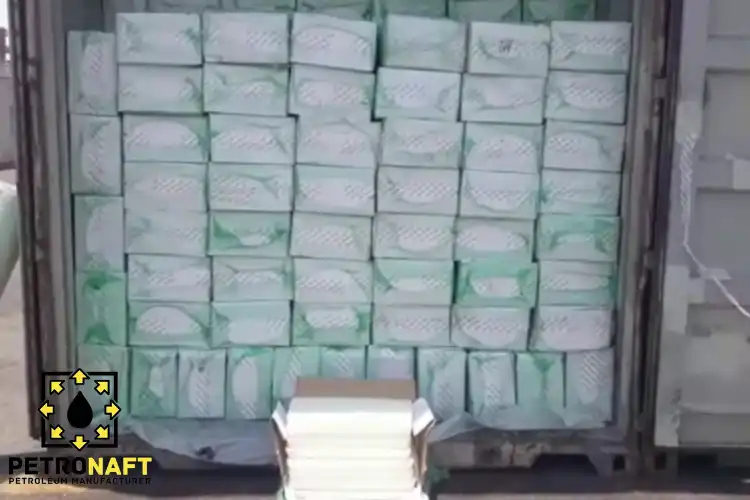
- Box count + net weight verification: packaging losses add up fast at scale
When you must insist on lab tests
- Cosmetics/pharma lines
- Food-contact applications
- Any time you blend wax into a formulation where oil % drift breaks performance
Ask for COA per lot and ensure test methods match what your QA accepts (common ASTM methods are often used for wax properties).
Real-world buying scenarios (quick examples)
Example 1 — Candle factory that stopped “mystery smoking”:
A mid-sized candle producer kept seeing soot spikes. The fix wasn’t “higher melt point.” They tightened max oil %, added an odor limit, and required COA + retained samples. Their defect rate dropped after two shipments because the supplier stopped blending off-spec lots into the same grade name.
Example 2 — Packaging coater that reduced summer transit complaints:
They were buying a wax that softened in hot containers. They switched from “one melt point” to a range + penetration spec, and required summer-grade packaging. Result: fewer deformed slabs and more stable coating viscosity at the line.
Commercial pitfalls (and how pros avoid them)
- “Same grade name” ≠ same behavior: always anchor on a written spec + COA history
- Packaging isn’t cosmetic: poor cartons cause breakage, contamination, and weight disputes
- Payment and compliance constraints: Iran-linked trade can involve banking, shipping, and sanctions constraints depending on route and counterparties—run compliance checks before you negotiate “best price”
- Inspection timing: if inspection happens after stuffing/lining mistakes, it’s too late—set checkpoints (pre-pack, during loading, seal)
Trends shaping Iranian paraffin wax buying in 2026
- Tighter documentation expectations: more buyers demand lot traceability, consistent SDS/COA, and clearer feedstock origin statements (especially for EU-bound cargo).
- Higher sensitivity to odor and micro-impurities: candle brands and cosmetic formulators increasingly optimize for “clean burn” and neutral odor, pushing suppliers toward better refining control and stricter sorting of lots.
Executive Summary & buyer checklist
If you remember nothing else, remember this: you don’t buy “paraffin wax,” you buy a repeatable spec plus a repeatable loading process.
Practical checklist (use before you place the PO):
- Grade defined (fully / semi / slack) + application stated
- Melt/congealing point range set (not a single number)
- Max oil % locked + test method agreed
- Color + penetration limits set (where relevant)
- Odor requirement stated (especially for candles/cosmetics)
- COA per lot + retained sample agreement
- Packaging spec + palletization + container lining plan
- Third-party inspection scope defined (sampling, sealing, photos)
- Compliance/logistics route confirmed before payment terms
- One accountable contact for claims + replacement policy
Conclusion: The safest way to select Iran Paraffin Wax Manufacturers is to shortlist reputable producers/exporters, standardize your RFQ, and enforce COA-backed QC—because consistency is earned through process, not promised by a grade name.
FAQs
1) What’s the difference between semi-refined and fully refined paraffin wax?
Fully refined wax has lower oil content and typically lower odor, so it performs better in premium candles and sensitive applications. Semi-refined wax contains more oil, making it softer and often more economical for standard industrial uses.
2) Which paraffin wax specs matter most for candle performance?
Oil content, melt point range, and odor are the “big three.” Color and penetration also matter for appearance and hardness, especially for pillar candles and hot-weather shipping.
3) Can I use slack wax directly in finished products?
Sometimes in industrial blends, but slack wax is mainly a feedstock for refining into finished paraffin grades. Its higher oil content can cause sweating, smoke, and instability in candles or coatings.
4) How do I compare offers from different suppliers fairly?
Send one RFQ template, require COA history for multiple lots, and compare tolerance ranges—not just the headline grade. Add the same inspection and packaging requirements to every quote so pricing stays apples-to-apples.
5) What documents should a professional shipment include?
At minimum: COA per lot, SDS, packing list, and clear marking/lot identification. For regulated destinations or sensitive uses, you may also need additional compliance statements, inspection reports, and traceability documentation.
Sources
- Official product page outlining paraffin wax characteristics and positioning — Behran Oil Co. | Paraffin Wax.
- Industry holding-page data point that lists Iranol product capacities including paraffin wax — CPFIc | Iranol Oil Company.
- Manufacturer documentation showing Pars Oil wax/slack wax properties and applications — Pars Oil Handbook (PDF).
- Manufacturer catalog describing paraffin wax properties, specs, and production scope — Sepanta Faraz Espadana Catalog (PDF).
- Exporters’ association membership directory referencing product categories (including wax-related) — OPEX Members List (PDF).