

Paraffin Wax Production Process turns waxy petroleum (or synthetic wax feed) into controlled-melting, low-odor wax by separating wax crystals from oil, then polishing the wax with deoiling and hydrofinishing. The result is a consistent grade (candle, packaging, cosmetic, industrial) verified by standard lab tests like melting point and oil content.
Paraffin wax looks simple, but the best-performing grades come from tight process control: crystal formation, oil removal, hydrogen finishing, and final blending. If you’re a buyer, technician, or plant operator, this guide helps you understand what “good wax” really means and how it’s made.
What you’ll get here:
- A clear, step-by-step production map (with the “why” behind each step)
- A buyer-friendly way to read a COA (Certificate of Analysis) and specify the right grade
- Practical troubleshooting tips that explain common defects (smoke, odor, sweating, brittleness)
- A checklist you can use to evaluate suppliers or improve plant consistency
Highlights & Key Sections
Paraffin Wax Production Process: From Waxy Feed to Finished Wax
Industrial paraffin wax is mainly produced as a refinery co-product from lube/base-oil streams (waxy distillates) or from synthetic waxes (e.g., Fischer–Tropsch) that are then refined to meet end-use requirements. Most quality differences come down to oil content, molecular cleanliness (odor/color stability), and melting profile consistency.
Process flow at a glance
| Stage | What happens | Output | Why it matters |
|---|---|---|---|
| Feed preparation | Select waxy stream; remove water/solids | Stable waxy feed | Prevents haze, odor, filtration issues |
| Wax separation (dewaxing) | Crystallize wax; separate wax from oil | “Slack wax” / crude wax | Creates the wax “skeleton” (crystal structure) |
| Deoiling | Remove trapped oil from wax | Lower-oil wax | Reduces sweating, odor, smoke, tackiness |
| Hydrofinishing | Hydrogen “polish” to remove color/odor precursors | Refined wax | Improves color, odor, stability, compliance |
| Blending & grading | Adjust melt point and penetration; homogenize | Final grade | Ensures repeatable performance |
| Forming & packing | Pastilles/slabs; labeling; storage | Shippable product | Prevents contamination and deformation |
Step-by-step guide (what happens in the plant)
Step 1) Choose and qualify the feedstock
Producers typically start with a waxy fraction that naturally contains long-chain paraffins. The feed must be consistent enough to crystallize predictably.
In practice, teams check:
- Water and sediment (to avoid haze and filtration plugging)
- General composition and volatility (to avoid excessive odor)
- Expected yield behavior (to plan solvent load, cooling capacity, and filtration rate)
Real-world example: A plant sees frequent “soft batches” in winter. The root cause often isn’t the finishing step—it’s feed variability. Stabilizing the waxy stream blend before dewaxing usually fixes the downstream melt point drift.
Step 2) Prepare the waxy stream for separation
Before crystallization, operators stabilize temperature and remove anything that would interfere with crystal growth:
- Preheating to fully melt wax components
- Filtration to remove fine solids (which can seed messy crystals)
- Tight temperature control to prevent premature crystallization
Why this matters: Wax crystal size and shape directly affect filtration speed, deoiling efficiency, and even final candle burn behavior.
Step 3) Dewaxing: create wax crystals, then separate them
This is the “birth” of wax. The goal is to encourage wax crystals to form while keeping most oil liquid.
Common industrial routes:
- Solvent dewaxing: mix the waxy stream with solvent(s), cool in stages, crystallize wax, then separate by filtration.
- Catalytic dewaxing / isomerization: used primarily to improve base-oil cold flow; it can reduce wax formation rather than produce wax as a product (so it’s not the usual route when wax is the main output).
Mini tutorial: what good crystallization looks like
- Too fast cooling: many tiny crystals → slow filtration, more oil trapped in wax.
- Controlled staged cooling: fewer, stronger crystals → faster filtration and better deoiling.
- Poor agitation: uneven crystal growth → batch-to-batch inconsistency.
Step 4) Separate wax from oil (filtration or centrifugation)
Once crystals form, the plant separates solid wax crystals from the oil/solvent mixture.
Operators optimize:
- Filtration temperature profile (affects oil trapped in wax)
- Wash efficiency (removes oil from wax cake)
- Filter media and cycle timing (controls throughput and clarity)
Practical operator insight: If throughput suddenly drops, it’s often crystal morphology (from cooling profile drift) rather than “bad filters.”
Step 5) Deoiling: reduce residual oil for performance and cleanliness
After the first separation, wax still holds oil between crystals. Deoiling removes that oil to meet product requirements.
Why deoiling changes the end-use experience:
- Lower oil generally means less sweating, less odor, cleaner burn, and better hardness
- Higher oil grades can be fine for some industrial uses, but buyers must know what they’re getting
Buyer reality check: Two waxes with the same melting point can perform very differently if oil content differs. That’s why oil testing appears on serious COAs.
Step 6) Solvent recovery and reuse (quality + economics)
In solvent-based plants, solvent recovery is not an afterthought—it’s a core quality and cost lever.
Key points:
- Closed-loop recovery keeps odor and contamination down
- Stable solvent ratios help crystallization repeatability
- Efficient recovery reduces VOC losses and operating cost
Step 7) Hydrofinishing: the “polish” for premium wax
Hydrofinishing (a mild hydrogen treatment) improves:
- Color
- Odor neutrality
- Oxidation stability (less yellowing, less off-smell over time)
This step is what often separates “works fine” wax from food/cosmetic-friendly, low-odor, bright-white wax.
Mini case: A packaging converter complains about odor transfer to wrapped products. The fix is rarely “more fragrance masking.” It’s usually a better-finished wax (tighter hydrofinishing control) plus cleaner packaging and storage.
Step 8) Fractionation, blending, and grading
Waxes are commonly graded by melting point range, penetration/hardness, oil content, and appearance. Producers blend streams to hit tight specs consistently.
Typical production controls include:
- Blending to target melt point and penetration
- Homogenization time (to reduce “split batches”)
- Hold-and-test release (to avoid shipping borderline lots)
Step 9) Forming, packaging, storage, and shipment
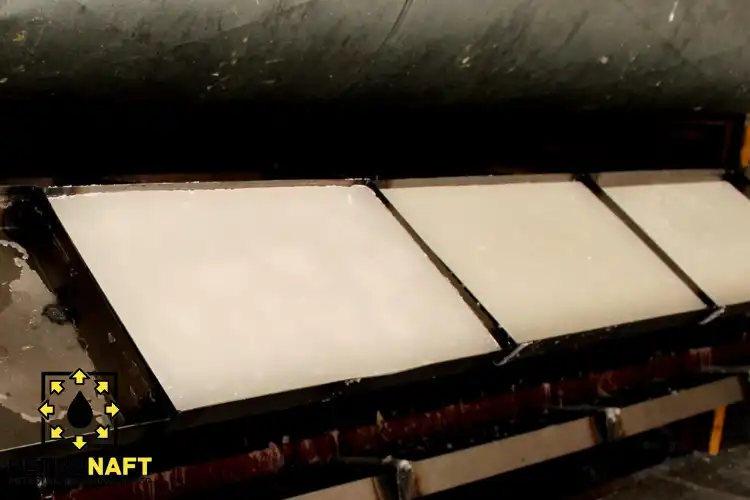
Final wax is formed into:
- Slabs
- Pastilles/prills
- Granules
Storage best practices:
- Keep away from strong odors (waxes can absorb smells)
- Avoid direct heat and sunlight (prevents deformation and discoloration)
- Use clean, sealed packaging to prevent dust and fibers from embedding in wax
Quality control: tests that actually predict performance
A good wax COA is not just paperwork—it’s a performance forecast.
| Property | What it tells you | Where it matters most | Typical COA note |
|---|---|---|---|
| Melting point | Heat resistance and burn/softening behavior | Candles, coatings, hot climates | “Melting point (cooling curve)” |
| Congealing point | Solidification behavior | Processing consistency | “Congealing point” |
| Oil content | Cleanliness, sweating risk, odor/smoke tendency | Candles, cosmetics, packaging | “Oil content” |
| Color/appearance | Refining effectiveness and stability | Cosmetics, white candles, packaging | “Color / Saybolt / visual” |
| Penetration (hardness) | Brittleness vs flexibility | Candles, blends, pastilles | “Needle penetration” |
| Odor | Practical cleanliness | Packaging, cosmetics | “Odor: pass” (often sensory panel) |
Mini tutorial: how to read a COA like a buyer
- Start with melting point + oil content (performance backbone)
- Then check color/appearance (finishing quality)
- Match penetration to your process (too hard can crack; too soft can slump)
- Ask if results are from recognized standard methods and consistent lab conditions
Choosing the right paraffin wax grade (buyer-focused)
Different applications prefer different balances of melt point, oil content, and hardness.
| Application | What buyers usually prioritize | Common pitfalls | Better specification approach |
|---|---|---|---|
| Container candles | Stable melt profile, low soot/smoke, good adhesion | “Same melt point, different behavior” | Specify melt point + oil content + penetration |
| Pillar candles | Hardness, shrink control, clean burn | Cracking or poor mold release | Include penetration target and cooling profile guidance |
| Packaging / food contact | Odor neutrality, cleanliness, regulatory fit | Odor transfer, migration concerns | Require hydrofinished grade + compliance statement + COA |
| Cosmetics | Very low odor, color, consistency | Yellowing, off-odor | Request refined/hydrofinished wax + stability notes |
| Rubber/tires | Processing compatibility, consistency | Batch-to-batch drift | Specify viscosity-related behavior and blend tolerance |
| Board/coatings | Fast set, uniform coverage | Blooming or uneven coating | Specify congealing behavior and coating trial data |
Troubleshooting: common problems and what they usually mean
| Symptom | Likely cause (often) | What to do (practical fix) |
|---|---|---|
| Candle sweating / oily surface | Higher residual oil or incompatible fragrance load | Use lower-oil wax; reduce fragrance; adjust blend |
| Excess soot/smoke | Impurities, high oil, poor wick match | Improve wax finishing; re-test oil; wick re-selection |
| Yellowing during storage | Insufficient finishing or exposure to heat/light | Choose better-finished wax; improve storage conditions |
| Brittle slabs or cracking | Wax too hard or poor blend balance | Adjust penetration target; blend with softer wax fraction |
| Odor transfer to packaged goods | Residual odor precursors, contaminated storage | Specify hydrofinished wax; improve packaging hygiene |
| Slow filtration in production | Crystal morphology issues | Re-tune cooling/agitation profile; stabilize feed blend |
Safety, compliance, and sustainability notes (what professionals watch)
Industrial wax production typically involves hot materials, pressurized hydrogen in finishing, and (in many plants) solvents—so design and operating discipline matter.
Commercially important compliance angles:
- Food contact use requires specific regulatory alignment and documentation in the target market.
- Many buyers request a documentation pack: COA + SDS + compliance statements + allergen/odor declarations (where relevant).
- Sustainability pressure is rising: solvent management, energy efficiency, emissions control, and traceable supply chains increasingly influence supplier selection.
Trends shaping wax production and buying decisions
A couple of shifts that have real market impact right now:
- Cleaner “low-odor” demand is expanding beyond cosmetics into packaging, household goods, and premium candles—pushing more producers toward stronger finishing and tighter QC.
- Synthetic/GTL wax growth and blending strategies are increasingly used to improve consistency and reduce variability tied to crude selection, especially for performance-sensitive applications.
Conclusion
A strong Paraffin Wax Production Process is less about “making wax” and more about controlling crystallization, deoiling, and hydrofinishing so the final grade behaves predictably in your application—then proving it with the right COA tests and documentation.
Executive Summary & Practical Checklist
Use this as a quick decision tool for production teams and buyers:
- Confirm the wax route: petroleum-derived vs synthetic-derived (and why it matters for consistency)
- Require a COA with at least: melting point, oil content, color/appearance, penetration (as relevant)
- Match melting point to climate and end-use (shipping/storage temperatures included)
- Match penetration/hardness to your process (molding, blending, pelletizing, coating)
- If odor matters, specify hydrofinished/low-odor grade and enforce clean storage/packing
- For candles: validate with a small burn trial (wick + fragrance + container system)
- For packaging: evaluate odor transfer and stability in real storage conditions
- Ask how the supplier controls batch consistency (blending strategy, hold-and-test release)
- Verify solvent and impurity management practices (quality and sustainability signal)
- Request SDS + compliance statements for your market (food contact/cosmetic/pharma as needed)
- Align packaging format to your operation (slabs vs pastilles vs granules)
- Document your “must-hit” specs and your “nice-to-have” specs to avoid overpaying
FAQ
1) What is the difference between slack wax, semi-refined wax, and fully refined wax?
Slack wax typically contains more oil and requires further deoiling/finishing. Semi-refined wax has reduced oil and improved appearance but may still carry more odor or variability. Fully refined wax is more thoroughly deoiled and finished for cleaner color, odor, and stability.
2) Why can two waxes with the same melting point perform differently in candles?
Melting point is only one dimension. Oil content, crystal structure, and finishing level strongly affect sweating, fragrance binding, soot behavior, and adhesion. That’s why serious candle specs include oil content and penetration, not just melt point.
3) What does hydrofinishing improve in paraffin wax?
Hydrofinishing “polishes” the wax by reducing compounds that contribute to odor, color, and instability. It typically improves brightness and reduces the risk of off-odor and yellowing during storage, which matters for packaging and personal care.
4) Which lab tests matter most when buying paraffin wax?
Start with melting point and oil content, then check appearance/color and penetration/hardness if performance depends on it. If the end-use is sensitive (packaging/cosmetics), odor evaluation and stability indicators become critical as well.
5) Is paraffin wax allowed for food contact applications?
In some jurisdictions it can be permitted under specific conditions, but requirements vary by region and use case. Buyers should request market-specific compliance statements and ensure the wax grade and documentation align with intended food-contact conditions.
Sources
- Defines the cooling-curve melting point method widely used to grade petroleum waxes. ASTM D87 Standard Test Method
- Summarizes the standard method scope for measuring oil content in petroleum waxes. ASTM D721 (ANSI Webstore listing)
- Explains why and how hydrofinishing is used to improve wax color, odor, and stability. Topsoe – Wax Hydrofinishing
- Provides U.S. regulatory text describing conditions for petroleum wax use in or on food. eCFR – 21 CFR 172.886
- Scientific opinion evaluating refined paraffinic waxes for use in food contact materials. EFSA Journal (2023) – Safety assessment