

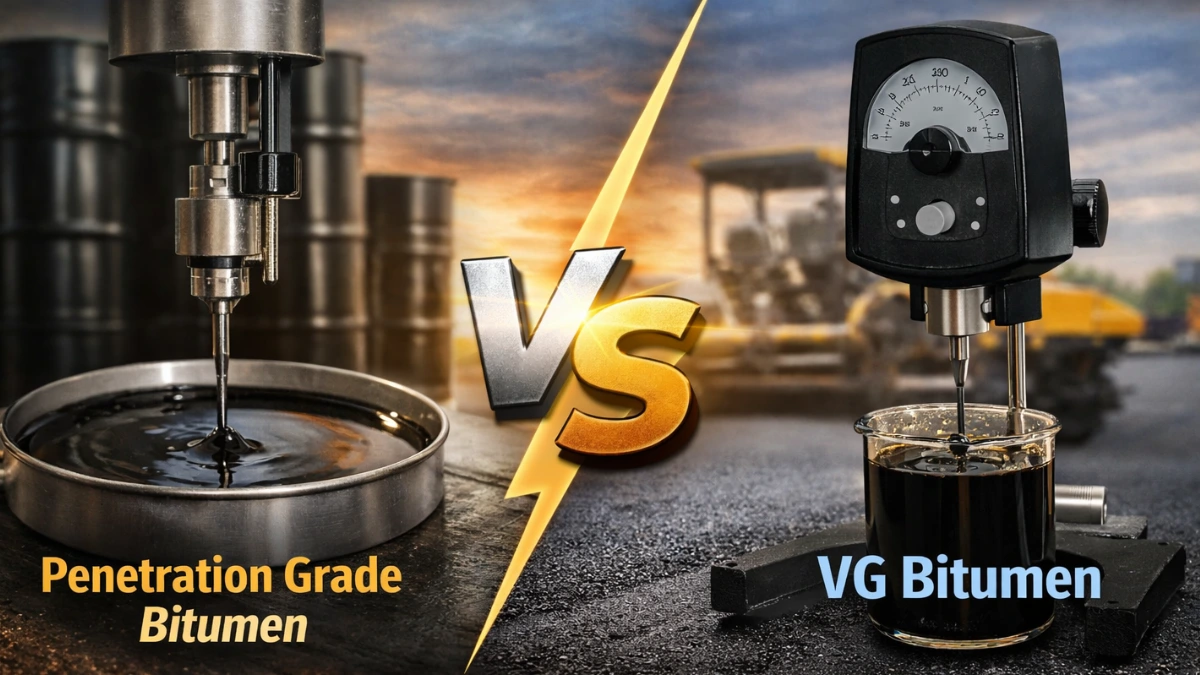
Penetration Grade vs VG Bitumen is mainly a grading choice: penetration grades rank hardness by needle penetration at 25°C, while VG grades rank binders by measured viscosity at 60°C (plus minimum penetration). If your climate and traffic are demanding, VG usually gives tighter high-temperature control and more predictable rutting resistance.
Bitumen “grade” isn’t a marketing label—it’s a shortcut for how the binder is expected to behave during mixing, compaction, and service life.
This guide helps you:
- Compare penetration grade and viscosity grade (VG) in practical terms
- Translate numbers into real-world performance and buying decisions
- Choose the right grade for climate, traffic, and project risk
Highlights & Key Sections
Penetration Grade vs VG Bitumen: Quick Comparison
| What you’re comparing | Penetration Grade Bitumen | VG (Viscosity Grade) Bitumen |
|---|---|---|
| Primary property used to grade | Needle penetration at 25°C (dmm) | Absolute viscosity at 60°C (Poise), plus minimum penetration |
| What the number means | Higher penetration = softer binder | Higher VG = stiffer binder at high service temperatures |
| Best at indicating | Consistency around 25°C | High-temp stiffness control (rutting resistance signal) |
| Common grades you’ll see | 40/50, 60/70, 80/100, 120/150, 200/300 | VG10, VG20, VG30, VG40 |
| Where it can mislead | Same penetration can still hide different high-temp viscosity | Still not fully “performance grade,” but more controlled than penetration alone |
| Buyer benefit | Familiar, widely traded | More predictable for hot climates/heavy traffic; easier spec compliance in many regions |
Rule of thumb: If your project faces high pavement temperatures, slow traffic, or heavy axle loads, VG grading usually reduces performance uncertainty.
What penetration grades actually measure (and what they don’t)
Penetration grading measures how far a standard needle penetrates into bitumen at 25°C under a set load and time. It’s a consistency test, not a full performance prediction.
What it tells you well
- Relative “hardness/softness” at 25°C
- A rough idea of workability and handling
What it can miss
- Two binders can both be 60/70 yet behave differently at high temperature (rutting conditions)
- Crude source and refining can shift viscosity–temperature behavior without changing penetration much
Practical takeaway for buyers: Penetration is useful for comparison, but it’s not the tightest control point for hot-service performance.
What VG grades measure (and why many specs prefer them)
VG grading classifies bitumen primarily by absolute viscosity at 60°C, a temperature closer to real hot-service conditions than 25°C. Most VG specs also keep a minimum penetration requirement to avoid overly brittle binders.
Why 60°C matters
- It better represents binder behavior during hot weather service conditions
- Viscosity is a more “fundamental” consistency measure than penetration alone
What VG adds for procurement
- Clear viscosity windows that tighten supplier variability
- Easier acceptance checks when you rely on lab certificates and lot testing
What the numbers mean in plain language
Penetration grade numbers (simple interpretation)
- 40/50: harder binder (lower penetration), generally higher stiffness
- 60/70: medium stiffness, common in many paving applications
- 80/100: softer binder, often used in cooler climates or for specific applications
Important: These are general behaviors. Always verify with the project specification and certificate tests.
VG grade numbers (engineering interpretation)
VG grades are based on viscosity at 60°C, plus minimum penetration and other controls.
VG grade limits (commonly referenced specification values)
| Property | VG10 | VG20 | VG30 | VG40 |
|---|---|---|---|---|
| Penetration @ 25°C (min, dmm) | 80 | 60 | 45 | 35 |
| Absolute viscosity @ 60°C (Poise) | 800–1200 | 1600–2400 | 2400–3600 | 3200–4800 |
| Kinematic viscosity @ 135°C (min, cSt) | 250 | 300 | 350 | 400 |
| Softening point (min, °C) | 40 | 45 | 47 | 50 |
Climate selection shortcut (VG by 7-day average max air temperature)
| Design maximum air temperature | Suggested VG grade |
|---|---|
| < 30°C | VG10 |
| 30–38°C | VG20 |
| 38–45°C | VG30 |
| > 45°C | VG40 |
How to read that as a buyer: Higher VG generally targets higher temperature stiffness and rut resistance, but you still need the right balance to avoid cracking risk in colder periods.
Common market equivalences (useful, but don’t treat as a guarantee)
In real trade and project specs, buyers often use these “in-lieu-of” comparisons:
| Common penetration grade | Often treated as roughly similar to | Why it’s only approximate |
|---|---|---|
| 80/100 | VG10 | Different crude sources can shift viscosity–temperature curve |
| 60/70 | VG30 | Same penetration can still hide different high-temp viscosity |
| 30/40 | VG40 | Aging susceptibility and modification can change outcomes |
Buyer-safe rule: Use equivalences for shortlisting, then confirm via test certificate (viscosity, penetration, softening point, and aging residue requirements).
Performance implications that matter on real roads
1) Rutting resistance (hot weather + heavy traffic)
Rutting risk rises when:
- Pavement temperatures stay high
- Vehicles move slowly (intersections, ports, industrial zones)
- Axle loads are heavy and repetitive
Practical insight: VG grading generally reduces rutting surprises because it controls viscosity at 60°C more tightly than penetration alone.
2) Workability during mixing and compaction
A binder that is too stiff can:
- Require higher mixing/compaction temperatures
- Increase fuel use
- Raise oxidation/aging risk if overheated
A binder that is too soft can:
- Compact easily
- But rut sooner under heat and load
Balanced selection beats “harder is always better.”
3) Aging and durability
Aging increases stiffness over time. If you start too stiff, you can push the pavement toward cracking earlier—especially where nights get cold or where the asphalt layer is thin.
How to choose the right grade (a practical mini tutorial)
Step 1: Classify the job, not just the climate
Use these quick triggers:
- Standard city roads, moderate traffic: medium grade often fits
- Highways, heavy trucks, slow lanes: prioritize higher high-temp stiffness control
- Intersections, toll plazas, bus stops, ports: treat as “high-shear zones”
Step 2: Use a simple decision matrix
| Condition | Risk you’re fighting | What tends to help |
|---|---|---|
| Hot region / hot season paving | Rutting, shoving | Higher VG or performance-oriented binder choice |
| Heavy trucks / industrial corridors | Permanent deformation | Higher stiffness at service temps + strong QC |
| Cooler region / high altitude | Thermal cracking | Avoid overly stiff binders; ensure minimum penetration and balanced properties |
| Thin overlays | Aging + cracking | Don’t overspec stiffness; control construction temperature and compaction |
Step 3: Check the certificate like a pro (2-minute buyer checklist)
Ask for a lot-specific test certificate that includes:
- Penetration @ 25°C
- Absolute viscosity @ 60°C (for VG)
- Kinematic viscosity @ 135°C
- Softening point
- Flash point
- Solubility
- Aging residue controls (RTFOT/TFOT residue requirements where applicable)
If any value sits near the limit, increase incoming inspection frequency for that shipment lot.
Two quick case studies (how professionals decide)
Case study A: Hot coastal city + frequent traffic stops
A contractor experiences rutting near roundabouts and bus lanes despite using a “standard” penetration grade.
Fix approach
- Switch selection method to emphasize high-temperature viscosity control
- Specify VG grade with a tighter viscosity window and verify at receipt
- Focus on high-shear areas as their own risk category
Result you’re aiming for
- Better resistance to shoving/rutting in stop-go zones
- Fewer early maintenance patches
Case study B: Mixed climate region + heavy trucks on a logistics route
The road must handle heavy loads, but nighttime temperatures drop enough to raise cracking risk.
Fix approach
- Choose a grade that controls rutting without becoming overly brittle
- Add strict handling limits (avoid overheating and extended storage at high temperature)
- Prioritize compaction quality to reduce air voids (air voids accelerate aging)
Result you’re aiming for
- Lower rutting under load
- Controlled stiffness growth over time
Buying and specification tips that prevent expensive mistakes
1) Don’t buy by grade name alone
Different refineries can produce the same grade while showing different temperature susceptibility. Make the test certificate part of your purchase acceptance.
2) Align grade with the real distress mechanism
- Rutting problems → look harder at high-temp stiffness indicators (VG helps)
- Cracking problems → avoid overspecifying stiffness; verify minimum penetration and aging behavior
3) Control logistics like it’s part of quality
- Use clean tanks and avoid contamination
- Prevent water ingress
- Avoid excessive heating time and overheating, which accelerates oxidation
Industry trends that affect your choice right now
- Heavier axle loads + more stop-go traffic in logistics corridors are pushing specs toward tighter binder control and, increasingly, performance-based grading where available.
- Hotter summer extremes are making high-temperature performance more critical, especially for urban intersections and industrial zones where shear stress is highest.
If you’re repeatedly seeing rutting despite “correct” penetration grade, it’s often a signal to upgrade your selection method (VG or performance-based approaches) and tighten QC.
Executive Summary and Practical Checklist
Penetration Grade vs VG Bitumen is less about “which is better” and more about risk control. Penetration grades compare consistency at 25°C, while VG grades control viscosity at 60°C and usually deliver more predictable high-temperature behavior—especially under heavy traffic and heat.
Final selection checklist (use this before every purchase order)
- Identify the dominant risk: rutting or cracking
- Classify the road: standard, heavy truck, or high-shear zones (intersections/ports/tolls)
- Choose grade with climate logic (hotter → stiffer control, but avoid brittleness)
- Require a lot-based test certificate (not a generic datasheet)
- Verify key results at receipt on critical projects
- Control heating and storage to reduce premature aging
FAQ
1) Is VG30 always equal to penetration 60/70?
Not always. Many markets treat them as roughly comparable, but crude source and refining can shift viscosity–temperature behavior. Use equivalence only for shortlisting, then confirm via test data.
2) Which is better for very hot climates: VG40 or a harder penetration grade?
For hot climates and high-shear areas, VG40 can offer clearer high-temperature control because the grade is defined by viscosity at 60°C. Still, confirm workability and construction temperatures to avoid overheating and aging.
3) Why can two 60/70 binders perform differently on the road?
Penetration is measured at 25°C and doesn’t fully capture high-temperature behavior. Two binders can share penetration but differ in viscosity at service temperatures, temperature susceptibility, or aging response.
4) What’s the fastest way to reduce rutting complaints in intersections?
Treat intersections as high-shear zones: use a more rut-resistant binder selection (often higher VG or performance-oriented binder), tighten QC on viscosity/softening point, and ensure proper compaction and mix design.
5) What tests should I insist on for imported bitumen lots?
At minimum: penetration @25°C, viscosity @60°C (for VG), kinematic viscosity @135°C, softening point, flash point, solubility, and aging residue controls where specified. Ask for lot numbers and sampling method details.
Sources
- Defines VG grades, viscosity ranges at 60°C, and recommended selection by design maximum air temperature. IS 73:2013 Paving Bitumen (PDF)
- Lists standard penetration grades used for asphalt binders and the intent of penetration-graded specifications. ASTM D946 Standard Specification for Penetration-Graded Asphalt Binder
- Explains the penetration test method and how penetration relates to binder consistency. ASTM D5/D5M Standard Test Method for Penetration of Bituminous Materials
- Provides performance-grade binder framework and temperature-linked grading principles used widely in modern specifications. ASTM D6373 Standard Specification for Performance-Graded Asphalt Binder
- Offers a clear overview of Superpave binder concepts and why performance-based grading emerged. FHWA Performance Testing for Superpave and Structural Validation