


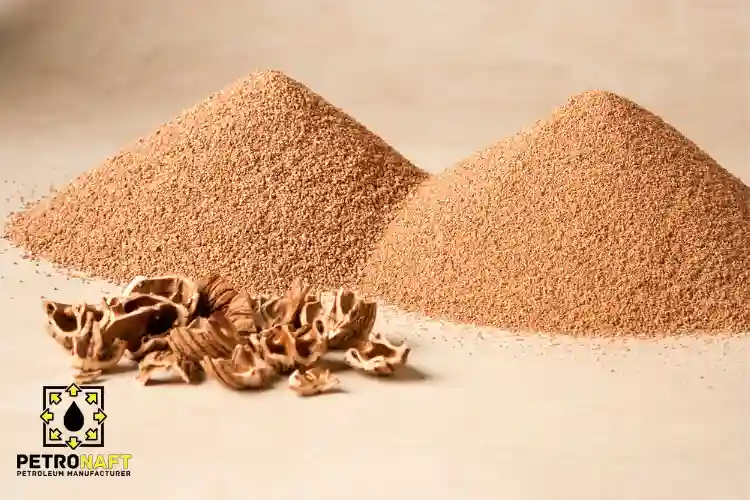
Walnut shells are a lightweight, hard, biodegradable material widely used as an industrial abrasive, filtration and adsorption medium, cosmetic exfoliant, filler and bio-based raw material. Understanding the uses and properties of the walnut shell helps engineers, buyers and formulators replace synthetic materials with a cleaner, circular alternative.
Highlights & Key Sections
Overview: key uses and properties of the walnut shell
When you look at the uses and properties of the walnut shell from a buyer’s perspective, they fall into a few clear value clusters:
Main application clusters
Abrasives & blasting media – for paint stripping, surface cleaning, deburring and polishing.
Liquid & gas filtration – as a porous, low-ash adsorbent and as a precursor to activated carbon and biochar.
Cosmetics & personal care – natural exfoliant replacing plastic microbeads in scrubs, soaps and hand cleaners.
Fillers & functional additives – lightweight filler in composites, friction materials, coatings and putties.
Agriculture & niche uses – carriers for actives, animal bedding components and decorative or landscaping media.
Why industries like it
Biobased, renewable and typically derived from food-industry by-product.
Hard enough to clean surfaces, but soft enough to avoid substrate damage.
Porous structure and good chemical stability, especially after activation or modification.
Low free silica and low toxicity compared with many mineral abrasives.
Physical and chemical properties that drive performance
At a micro level, walnut shells are a lignocellulosic material (mainly cellulose, hemicellulose and lignin) with a dense, porous structure. This combination explains many of their industrial behaviors.
Key physical properties of walnut shell media
| Property | Typical range / note | Why it matters in practice |
|---|---|---|
| Mohs hardness | ~3–4 | Cleans coatings without cutting most metals and composites. |
| Specific gravity | ~1.2–1.4 g/cm³ | Lighter than sand; easier to handle and separate. |
| Bulk density | ~40–50 lb/ft³ (≈640–800 kg/m³) | Influences tank sizing, pump selection and shipping costs. |
| Grain shape | Angular, multi-faceted | Provides “scrubbing” action without deep surface etching. |
| Free crystalline silica | Typically <1% | Reduces silicosis risk vs traditional silica sand. |
| Thermal stability | Works well in typical industrial temperature ranges | Suitable for recirculating systems and some hot processes. |
| Chemical stability & ash | Chemically stable, low ash after activation | Favours use as activated carbon precursor and adsorbent. |
Chemical and surface features
Porosity & surface area increase significantly when shells are carbonized/activated, giving high adsorption capacity for oils, metals, dyes and VOCs.
Low ash content helps minimize secondary contamination in filtration and adsorption systems.
Surface functional groups (e.g., hydroxyl and carboxyl groups) can be tailored by chemical or enzymatic treatment to target specific pollutants.
Abrasive and blasting applications
Walnut shell grit is one of the most important “soft abrasives” on the market. It offers a gentle but effective cleaning action where glass bead or sand would be too aggressive.
Typical uses
Stripping paint and carbon deposits from aluminum and magnesium engine parts
Cleaning turbine blades, molds and delicate tooling
Restoring wood, stone and fiberglass without profile damage
Removing coatings from composites and plastics in aerospace and automotive refurbishment
Matching grade to application
| Grade / form | Approx. particle size* | Typical use cases |
|---|---|---|
| Extra coarse | 1.0–2.4 mm | Heavy coating removal, large castings, stone cleaning |
| Coarse | 0.8–1.7 mm | Paint and varnish stripping on wood and metal surfaces |
| Medium | 0.45–1.0 mm | General-purpose blasting, mold and die cleaning |
| Fine | 0.2–0.6 mm | Precision components, electronics housings, threaded parts |
| Flour / powder | <0.2 mm | Fillers, cosmetics, rubber and plastic compounding |
*Size ranges consolidated from typical industrial offerings.
Mini tutorial: choosing walnut shell grit for blasting
Define your substrate and coating.
Soft metals, composites or wood → start with medium to fine grade.
Hard steel or thick epoxy → coarse grade.
Set target finish.
Need a smooth, paint-ready surface → lower pressure and finer grade.
Need more “tooth” for adhesion → slightly coarser grade, moderate pressure.
Check equipment compatibility.
Verify that your blast system can handle organic media and that reclaim cyclones are set for lighter particles.
Trial, then standardize.
Run a small test panel, measure cycle time and media consumption, then lock your process window in a simple SOP.
Filtration, adsorption and environmental technologies
Because of their porosity, low ash and stable structure, walnut shells and their carbonized derivatives are now widely studied and used as low-cost adsorbents.
Key applications
Oil and grease removal from produced water, refinery effluents and bilge water, often in packed walnut shell filters.
Heavy metal removal, where chemically modified shells have achieved very high zinc removal efficiencies in lab-scale tests, making them candidates for plating and mining wastewater treatment.
Pharmaceutical and dye adsorption, where walnut shell-based media have been used to remove antibiotics and colored contaminants from water.
Air and VOC control, using walnut shell-derived activated carbon to capture volatile organic compounds and toxic gases.
Example scenario
A plating plant with zinc-containing rinse water can retrofit a small column packed with modified walnut shells. In trials, similar systems have cut dissolved zinc by more than 90%, reducing reliance on high-dosage chemical precipitation and lowering sludge generation.
Cosmetics, personal care and household uses
In cosmetics, finely ground walnut shell powder is a natural physical exfoliant that helps remove dead skin cells and smooth skin texture. It is widely used in facial scrubs, hand cleaners and bar soaps as an alternative to plastic microbeads.
Recent herbal and polyherbal scrub formulations using walnut shell powders have demonstrated good spreadability, acceptable skin feel and promising antioxidant and antibacterial profiles in lab evaluations, supporting their use in more “clean label” skincare.
Typical uses
Facial and body scrubs (fine flour grades)
Industrial hand cleaners for mechanics and technicians
Exfoliating soaps and shower gels
DIY skincare kits and home-use cosmetic bases
Buyer notes
Cosmetic-grade material is usually sterilized or irradiated, then sieved to tight particle-size specs to avoid micro-cuts.
Many suppliers provide safety data and regulatory documentation (e.g., compliance with microbead bans and cosmetic regulations).
Agriculture, animal care and material uses
Outside heavy industry and cosmetics, walnut shells also find roles in agriculture and materials engineering.
As a component in animal bedding mixes, shells add absorbency and reduce caking.
As carriers for pesticides, micronutrients or probiotics, finely ground shells provide a stable, flowable matrix.
In polymer and rubber composites, walnut shell flour can act as a lightweight filler, improving stiffness while reducing petrochemical filler content.
In friction materials (e.g., some brake pads), shells can tune friction coefficient and noise profile when combined with other fillers.
For many of these uses, the key is balancing cost, availability and processing (surface treatment, coupling agents, etc.) to achieve consistent mechanical properties.
Market trends and innovation around walnut shells
The economic backdrop helps explain why interest in walnut shells is accelerating.
One 2025 market analysis estimates the global walnut shell market at around USD 129.6 million, with a projected CAGR of about 4.9% through 2033, driven mainly by demand in blasting and cosmetics.
Separate research suggests the walnut shell powder segment alone could grow to more than USD 1.1 billion by 2032, at an annual growth rate above 8%, reflecting strong demand for natural abrasives and fillers.
A report on sustainable walnut shell fillers shows a 2024 market size of roughly USD 159 million and a CAGR near 7%, underscoring the shift to biodegradable fillers in coatings, plastics and construction materials.
On the R&D side, new papers showcase advanced adsorbent materials:
Biochar and magnetic biochar from walnut shells with high hydrophobicity and oil adsorption capacity for wastewater treatment and spill response.
Enzymatically modified walnut shells prepared using greener processes that enhance adsorption performance while valorizing agricultural waste.
How to select the right walnut shell grade and supplier
When you’re evaluating walnut shells as a feedstock or media, a structured approach helps you compare offers and avoid costly misfits.
Step 1: Define technical requirements
Function: abrasive blasting, filtration, filler, cosmetic, or adsorbent precursor
Key constraints: allowable dust, pH range, temperature, regulatory limits (e.g., cosmetic INCI, REACH, FDA contact)
Step 2: Specify granulometry and quality parameters
Request at least:
Particle-size distribution (mesh or mm ranges)
Moisture content and loss on drying
Bulk density and apparent density
Free silica and ash content (critical for EHS and filtration)
For advanced adsorption or water treatment work, you may also need information on surface area (BET), pore size distribution and surface functional groups.
Step 3: Run application-specific lab tests
Blasting – measure removal rate, media consumption, surface profile and media recyclability.
Filtration/adsorption – test breakthrough curves, regeneration performance and fouling tendency under realistic conditions.
Cosmetics – conduct stability, microbiology and sensory testing with end formulations, not just raw powder.
Step 4: Evaluate supply security and sustainability
Confirm origin (country, processing plant) and annual capacity.
Ask for documentation on by-product sourcing, energy use and waste handling for ESG reporting.
Check whether the supplier offers consistent grades year-round, especially if you’re in regulated sectors.
Risks, limitations and best practices
Even with attractive uses and properties, walnut shells are not a universal solution.
Allergen considerations – although the protein content of shells is low, nut-allergic users may still require additional risk assessment in consumer products.
Dust generation – fine grades can create combustible dust; facilities may need explosion protection and good housekeeping.
Mechanical limits – for extremely hard coatings or scale, walnut shell abrasives may clean too slowly compared to aluminum oxide or steel grit.
Regeneration and disposal – spent media from blasting or filtration can contain hazardous contaminants and must be managed accordingly, even though the base shell is biodegradable.
Best practice is to treat walnut shells as a targeted tool: ideal where you need gentle cleaning, biobased content or selective adsorption – less suitable when sheer aggressiveness or extreme durability is required.
Executive summary & practical checklist
If you understand the uses and properties of the walnut shell, it becomes a highly versatile lever for performance, sustainability and cost optimization across multiple industries.
Snapshot
Physically, walnut shells are moderately hard, low-density, angular particles with low silica and good stability.
Technically, they excel as soft abrasives, filter/adsorbent media, natural exfoliants and lightweight fillers.
Commercially, they ride strong trends toward biobased, biodegradable and microplastic-free materials, with robust market growth forecasts.
Practical checklist for buyers and engineers
Clarify your goal: blasting, filtration, cosmetics, filler or advanced adsorption.
Choose particle-size grade and verify key physical properties (hardness, bulk density, moisture, silica).
Run small-scale trials under real operating conditions before committing to volume.
Evaluate supplier reliability: origin, capacity, QA systems and sustainability credentials.
Plan for lifecycle: media reuse, regeneration options and compliant disposal of spent material.
Use this checklist as a quick gateway from concept to implementable, spec-driven use of walnut shells in your process or product portfolio.
FAQ
1. Are walnut shells safe to use as blasting media on aircraft and automotive parts?
Yes, when correctly specified, walnut shell grit is widely used to strip coatings from aluminum and composite parts because its moderate hardness cleans without eroding the base metal. Operators must still control dust and ensure that coating residues are handled safely.
2. Can walnut shells replace microplastic beads in cosmetics?
Finely milled, cosmetic-grade walnut shell powders are a proven alternative to plastic microbeads in scrubs and soaps. They provide effective physical exfoliation, are biodegradable and can support “plastic-free” marketing, provided formulations are validated for skin compatibility.
3. Do walnut shells work for heavy metal removal from wastewater?
Unmodified shells show some affinity for metals, but performance improves significantly after chemical or thermal treatment. Modified walnut shell adsorbents have achieved high removal efficiencies for metals like zinc and chromium in controlled studies, making them promising options for polishing steps.
4. How many times can walnut shell blasting media be reused?
In closed-loop systems, walnut shell grit is commonly reused several cycles until it becomes too fine or contaminated. Actual reuse count depends on blast pressure, coating type and reclaim equipment, so many plants track consumption per square meter to set replacement rules.
5. What is the environmental advantage of walnut shells over mineral abrasives?
Walnut shells originate from an agricultural by-product and are biodegradable, with low free silica and typically lower dust toxicity than many mineral abrasives. However, once they pick up paints, metals or oils, spent media must still be treated as industrial waste according to its contamination.
6. Are walnut shell-based adsorbents competitive with commercial activated carbon?
Walnut shell-derived activated carbons can reach high surface areas and show strong adsorption for oils, dyes and some organics. Their competitiveness depends on local shell availability, processing cost and pollutant type, but they are increasingly attractive where sustainability and waste valorization are priorities.
7. Can walnut shells be used in food or pharmaceutical products?
Regulatory status varies by jurisdiction and application. In general, walnut shell derivatives may be used as processing aids, polishing agents or excipients only when they meet purity requirements and do not pose allergen or contamination risks. Regulatory and toxicology checks are mandatory.
8. Do walnut shell filters clog easily in oily water treatment?
Like any granular media, walnut shell beds can foul if loaded beyond their design limits or if solids are not pre-removed. Proper sizing, backwashing, occasional air scouring and upstream separation steps help maintain low pressure drop and stable performance over long operating periods.
9. How fine should walnut shell powder be for use as a filler in plastics?
For polymer compounding, powder is often specified in the low hundreds of microns or finer, with tight size distribution to ensure good dispersion and surface finish. Coupling agents and surface treatments are frequently used to improve compatibility with the resin matrix.
10. Are there supply risks tied to walnut production cycles?
Walnut shells come from the nut industry, so availability can fluctuate with agricultural yields and regional harvests. Large buyers typically mitigate this by multi-sourcing from different regions, contracting with processors that maintain inventory and planning safety stocks around harvest periods.