


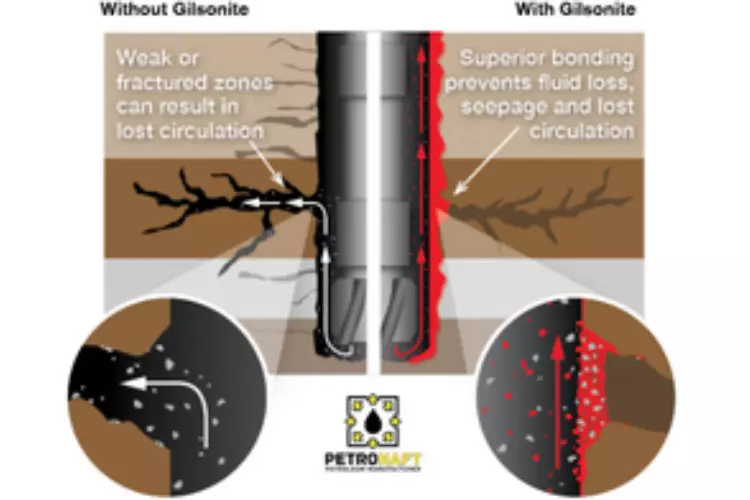
Gilsonite As a Solution to leaky wellbores means using this natural hydrocarbon as a cement and drilling-fluid additive to seal micro-annuli, fractures, and permeable streaks, cutting gas migration, restoring zonal isolation, and lowering sustained casing pressure while often reducing slurry density and overall remediation cost.
Even with modern cementing practices, thousands of wells worldwide still suffer from sustained casing pressure, surface gas seeps, or crossflow years after completion. Regulators now treat these leaky wellbores as both safety and methane-emissions issues, which pushes operators to look beyond conventional neat cement squeezes and simple mechanical fixes.
Gilsonite is particularly interesting in this context because it is not a generic asphalt. It is a solid, naturally occurring hydrocarbon (asphaltite) with low density, thermoplastic behavior, and a long track record as a lost-circulation and cement additive in oil and gas wells.
Over roughly the last decade, laboratory and field work have shown that gilsonite-rich cements can not only reduce losses and lower slurry density but also self-tighten around leak paths when exposed to hydrocarbons. This makes Gilsonite As a Solution a serious candidate for addressing leaky wellbores in both primary and remedial cementing.
Highlights & Key Sections
Why do modern wells still develop leaky wellbores?
Even in highly engineered fields, most long-term well integrity failures trace back to the cement sheath rather than the steel casing. Reviews of global incident data show that debonding, micro-cracks, and channels in cement are the dominant cause of sustained casing pressure and unwanted fluid migration between zones.
What mechanisms usually create a leaky annulus?
Typical leak paths include:
-
Micro-annulus at the casing–cement or cement–formation interface
-
Vertical channels created by poor mud removal or eccentric casing
-
Micro-fractures in cement from thermal and pressure cycling
-
Chemically degraded cement near CO₂, sour fluids, or brines
Common triggers:
-
Inadequate displacement of drilling mud and spacer design mistakes
-
Cement shrinkage as it sets and cools
-
Repeated production, injection, or stimulation cycles
-
Mechanical damage from perforation, fracturing, or workovers
How do classic responses fall short?
Traditional remedies often focus on pumping more of the same:
-
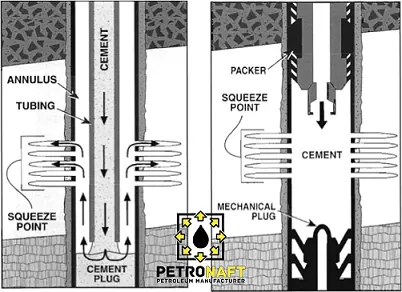
Neat cement squeezes – may reduce pressure temporarily but often fail to seal micro-annuli.
-
Resins and epoxies – bond well but are expensive, sensitive to placement, and volume-limited.
-
Mechanical devices (packers, liners) – isolate pressure but do not repair the damaged cement sheath.
Leak symptoms vs likely mechanisms
| Leak symptom | Likely mechanism in annulus | Typical conventional response | Key limitation |
|---|---|---|---|
| Low, persistent SCP | Micro-annulus at interface | Repeated cement squeezes | Cement shrinkage recreates micro-annulus |
| SCP that grows with temperature | Thermally driven debonding and shrinkage | Squeeze, sometimes resin | Limited tolerance to cycling |
| Shallow gas bubbling at surface or seabed | Vertical gas channel or shallow micro-annuli | Top-up cement, external squeeze | Difficult to access exact leak path |
| Loss of isolation between zones | Cracked or debonded cement after stress cycles | Section milling and full re-cementing | Very costly and time-consuming |
What is gilsonite and why is it suited to sealing wellbore leaks?
What exactly is gilsonite from a materials perspective?
Gilsonite is a naturally occurring solid hydrocarbon classified as an asphaltite. It has:
-
Specific gravity typically around 1.05–1.1, much lighter than Portland cement
-
A relatively high softening point, giving it thermoplastic behavior
-
Low intrinsic permeability and a largely non-porous structure
These traits let gilsonite act as a low-density, non-porous solid inclusion rather than a weak, foamy extender.
How does gilsonite behave in drilling fluids and cement?
In drilling fluids, gilsonite:
-
Forms a tight, resilient filter cake on the wellbore wall
-
Seals micro-fractures and permeable streaks to reduce fluid loss
-
Strengthens the wellbore and minimizes differential sticking, including in HP/HT wells
In cement, gilsonite:
-
Lowers slurry density without adding excess mix water
-
Bridges fractures and micro-annuli with tailored particle-size distributions
-
Contributes to fluid-loss control and enhances zonal isolation
How does gilsonite support self-healing in the cement sheath?
Recent research on gilsonite-rich cements has highlighted a “geomimicry” behavior:
-
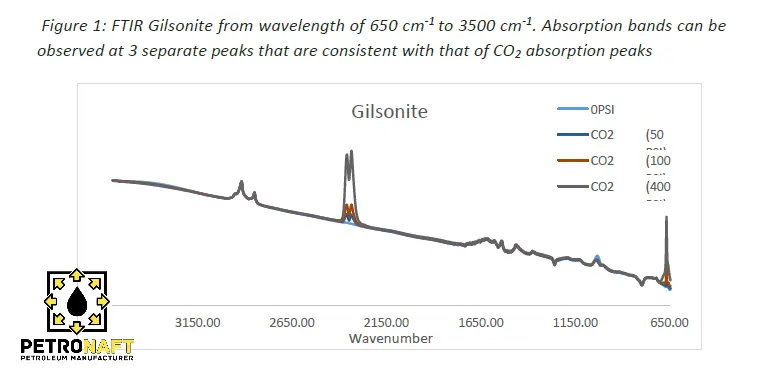
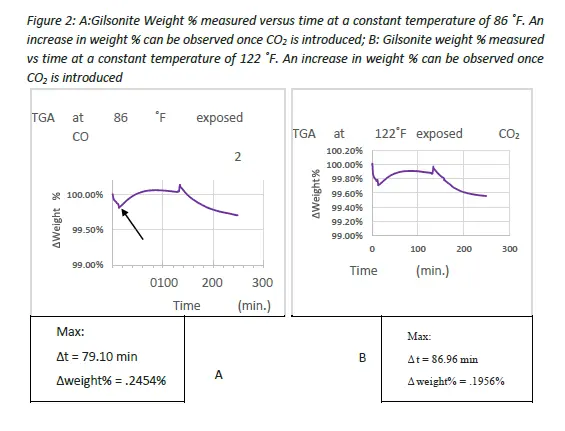
Gilsonite particles in the cement matrix absorb hydrocarbons that enter a micro-annulus.
-
The grains soften and expand slightly, tightening the gap between casing and cement or within the cement itself.
-
Laboratory measurements on gilsonite-enriched cores exposed to gas show permeability decreasing after exposure, not increasing, as you might expect from damage.
In other words, gilsonite turns a hydrocarbon leak into a trigger for localized tightening of the seal, instead of further deterioration.
How can operators design Gilsonite As a Solution for specific leaky wellbores?
What information should engineers gather first?
Before touching cement design, capture:
-
Which annulus is leaking (A, B, C…) and at what pressure range?
-
How does pressure respond to temperature or production rate changes?
-
What is the original cement recipe, top of cement, and quality logs?
-
What were previous remedial attempts and their outcomes?
-
BHST / BHCT, pore and fracture gradients, and maximum allowable ECD.
This context determines whether gilsonite-rich cement is appropriate and where to place it.
How do you choose gilsonite grade and loading?
Practical design ranges (to be validated in the lab for each well):
-
Gilsonite concentration (bwoc)
-
Often in the 2.5–7.5% range for self-healing and bridging systems
-
Higher loadings may provide stronger bridging but can impact rheology and strength at high temperatures
-
-
Slurry density
-
Typical leaky-well designs: ~12.5–14.5 ppg (1.50–1.74 SG), depending on fracture gradient and pore pressure
-
Recent work on Class H cements with ~4% gilsonite shows that, at ambient conditions, compressive strength remains comparable to neat cement while thermal conductivity drops, improving insulation and reducing thermal stresses in some applications.
Example: neat vs gilsonite-enhanced cement design
| Design parameter | Neat Class H example | Gilsonite-enhanced example |
|---|---|---|
| Slurry density (ppg) | 15.8 | 13.5 |
| Gilsonite loading (bwoc) | 0% | 4% |
| BHST design limit (°C) | 150 | 150 (temperature-qualified grade) |
| 24–48 h UCS (MPa, ambient lab) | ~35–40 | ~32–38 |
| Measured permeability (mD) | Higher | Lower (tighter microstructure) |
| Thermal conductivity trend | Baseline | Lower, more insulating |
(Values indicative; final designs must be validated in dedicated lab testing.)
What lab program is essential?
At minimum:
-
Rheology and thickening time
-
Confirm pumpability and safe placement window with gilsonite added.
-
-
Free water, fluid loss, and sedimentation
-
Ensure the lighter additive does not segregate or create channel-prone slurries.
-
-
Mechanical properties
-
UCS vs time at relevant temperatures and confining conditions.
-
Stress–strain behavior to confirm improved flexibility rather than brittleness.
-
-
Leak-path simulations (if available)
-
Micro-annular flow cells or synthetic fractures to compare permeability before and after hydrocarbon exposure in neat vs gilsonite-rich systems.ycle does gilsonite add the most value?
-
How can gilsonite help during primary cementing?
Use cases:
-
Depleted or weak formations – Lower-density gilsonite cement reduces ECD and fracture risk while maintaining strength and low permeability.
-
Gas-prone strings – Built-in self-tightening behavior helps mitigate gas migration risk along the annulus.
-
Geothermal and HP/HT wells – Properly selected gilsonite grade and loading can offer a compromise between mechanical robustness and thermal insulation, important as thermal cycling becomes more severe in modern energy projects.
How does gilsonite support remedial squeezing?
Gilsonite-rich squeeze jobs are particularly attractive when:
-
SCP suggests micro-annuli or fine fractures rather than gross hardware failure.
-
Prior neat-cement squeezes have only delivered short-term pressure relief.
-
Access to the leak interval is limited, so you want the pumped material to work “smarter,” not just “harder,” once in place.
Because gilsonite tends to swell upon hydrocarbon exposure, the squeeze cement can continue tightening around leak paths after the rig leaves.
What about plug and abandonment (P&A) and storage projects?
Trends toward stricter P&A rules and growth in CO₂ and gas storage mean long-term barrier reliability is under new scrutiny. In this context, gilsonite:
-
Offers a solid hydrocarbon that has itself survived geologic time in the subsurface.
-
Helps plugs tolerate pressure cycling and small mechanical shifts.
-
Can be combined with CO₂-resistant binders or supplementary materials in storage wells, where chemical resistance and mechanical compliance must coexist.
What field evidence supports gilsonite-based wellbore repairs?
How does gilsonite perform in leaky gas wells?
In controlled experiments and field-inspired tests:
-
Gilsonite-enriched cement cores showed a drop in permeability after exposure to natural gas, indicating that gas flow actually tightened the micro-structure.
-
Micro-annular flow cells with gilsonite cement often recorded significantly lower gas rates than neat cement under similar pressure and temperature cycles.
In field analogs, operators have reported:
-
Long-term suppression of SCP after gilsonite squeezes in wells where neat cement and standard lost-circulation blends repeatedly failed.
-
Reduced need for section milling and extensive hardware interventions, especially in older gas producers.
Example: remedial squeeze for chronic SCP (simplified)
-
Well type: Onshore gas producer with ~20 bar SCP on the B-annulus.
-
History: Two conventional squeezes reduced pressure temporarily; it rebuilt during production cycles.
-
Intervention:
-
Diagnostics localize likely leak near an intermediate shoe.
-
Gilsonite-rich cement (moderately under-balanced density, ~4–6% bwoc gilsonite) pumped as a squeeze behind casing.
-
-
Outcome:
-
SCP drops to near zero and remains stable through multiple thermal and pressure cycles.
-
No further remedial work needed during the remaining well life.
-
How does gilsonite compare with other leaky-wellbore solutions?
What alternatives are typically evaluated?
Engineers usually benchmark gilsonite against several classes of solutions:
| Solution type | Key strengths | Main limitations | Best suited situations |
|---|---|---|---|
| Neat cement squeeze | Simple, low material cost | Shrinkage, limited micro-annulus sealing | Large, accessible channels |
| Micro-cement / ultra-fine cement | Excellent penetration into tight fractures | Expensive, demanding placement | Fine fractures and tight formations |
| Polymeric self-healing cement | Strong self-sealing, tunable chemistry | High cost, specific temperature/chemical limits | High-risk wells needing aggressive self-healing |
| Epoxy / resin systems | Very strong local bonding | Small volumes, short pump time, high cost | Localised leaks near accessible intervals |
| Mechanical packers / liners | Immediate pressure isolation | Do not repair cement; reduce ID; complex installation | Hardware-dominated problems |
| Gilsonite-rich cement | Lightweight, bridging, and hydrocarbon-triggered tightening in one system | Needs careful lab design and grade selection | Micro-annuli, SCP, weak formations, P&A plugs |
In many modern designs, gilsonite does not replace these options but complements them in layered barrier strategies (e.g., mechanical packer plus gilsonite-rich cement outside).
How does gilsonite fit with newer self-healing and smart materials?
Industry R&D is moving toward:
Graphene-reinforced cements that enhance flexibility and toughness.
Advanced self-healing systems based on microcapsules or swellable polymers.
Geopolymer and CO₂-resistant binders for storage and CCS service.
Gilsonite sits in a practical middle ground: it is a naturally occurring solid with a long field history, offers self-tightening behavior without complex chemistries, and can often be qualified within existing cement standards with a focused lab program.
What are the main risks and QA/QC requirements when using gilsonite?
When is a gilsonite-rich cement not the right answer?
Caution or alternatives are advisable when:
BHST significantly exceeds the proven softening-point range of available gilsonite grades.
The root cause is severe casing damage, collapse, or large-scale channeling that requires section milling.
Regulations mandate specific materials that do not yet list gilsonite as an approved additive.
The well environment involves extreme chemical exposure where long-term behavior of gilsonite has not been tested.
What quality controls should be mandatory?
To keep Gilsonite As a Solution reliable rather than risky:
Material certification – Softening point, particle-size distribution, ash content, moisture, and specific gravity for each batch.
Blend consistency – Prefer pre-blended cement + gilsonite; if not possible, enforce strict mixing sequences and on-site density checks.
Slurry testing per job – Repeat full tests when cement brand, additive supplier, or temperature envelope changes.
Operational monitoring – Track pump pressure, returns, and density in real time to detect early bridging or placement issues.
What checklist should engineers follow before choosing gilsonite?
Use this practical list before committing to a gilsonite-based solution:
Clearly define the leak mechanism (micro-annulus, fracture, channel, hardware problem).
Confirm annular access and feasible placement geometry.
Check BHST and chemistry against qualified gilsonite grades.
Select an initial gilsonite loading range and slurry density target appropriate for fracture gradient.
Run a lab program covering rheology, strength, thermal properties, and leak-path simulations.
Validate compatibility with drilling fluids, spacers, and casing metallurgy.
Model ECD to ensure the lighter slurry does not fracture the formation.
Define measurable success criteria (e.g., maximum allowable post-job SCP and pressure-test protocol).
Plan monitoring and data capture for months after the intervention.
Executive summary: is Gilsonite As a Solution right for your wells?
Gilsonite As a Solution makes most sense when your primary problem is micro-annular gas or fluid migration, especially in wells where conventional squeezes have delivered only temporary relief. In those cases, gilsonite can combine density reduction, fracture bridging, and hydrocarbon-triggered tightening in a single, relatively simple material system.
In higher-risk contexts—such as CCS, long-life geothermal wells, or complex P&A programs—gilsonite rarely acts alone. Instead, it becomes one member of a broader barrier toolbox alongside micro-cements, smart polymers, and mechanical isolation. With disciplined design, lab validation, and QA/QC, gilsonite-rich cements offer operators a scalable, field-proven pathway to reduce emissions, improve integrity, and cut the lifecycle cost of leaky wellbores.
What are the most common questions about gilsonite for leaky wellbores?
1. How does gilsonite actually stop a micro-annulus leak?
Gilsonite particles bridge the narrow gap between casing and cement or within micro-cracks. When hydrocarbons try to flow, the grains can soften and expand slightly, tightening the pathway and reducing permeability. Over time, this creates a composite plug that resists further flow while maintaining overall cement strength.
2. Does gilsonite weaken cement compressive strength?
At equivalent slurry densities, gilsonite-containing cements usually deliver comparable compressive strength to neat systems and can outperform many other lightweight designs. Because density reduction comes from low-density solids rather than extra water, strength remains robust when the system is properly formulated and tested.
3. Can gilsonite-rich cement be used in HP/HT or geothermal wells?
Yes, provided you select a gilsonite grade with a softening point and stability envelope proven for the expected temperature and fluids. HP/HT and geothermal projects require tighter lab validation, but numerous tests show that moderate gilsonite loadings can coexist with strong mechanical and thermal performance.
4. Is gilsonite compatible with CO₂ or storage wells?
Gilsonite itself is a hydrocarbon solid and does not neutralize CO₂, so you should not rely on it for chemical resistance alone. In storage wells, engineers typically combine gilsonite with CO₂-resistant binders or pozzolanic blends, using gilsonite mainly for mechanical compliance and micro-annulus sealing.
5. How is gilsonite different from generic asphalt or bitumen?
Gilsonite is a specific, naturally occurring asphaltite with relatively consistent composition, softening point, and mechanical behavior. Generic asphalt residues may contain higher levels of impurities and volatiles, making them less predictable as engineered wellbore additives and harder to qualify in critical cement systems.
6. Does gilsonite increase the risk of channeling during placement?
Any poorly designed lightweight slurry can channel. In a well-engineered system, gilsonite’s lower density actually helps reduce ECD and fracture risk, which can improve placement. The key is to optimize rheology, use compatible spacers, and prevent particle segregation through proper mixing and anti-settling additives.
7. Can gilsonite-rich cement be pumped with standard cementing equipment?
Yes. Gilsonite-based slurries are normally compatible with conventional cementing equipment and procedures. You may need to adjust mixing energy, sequence, and pump rates to handle the lighter solids and maintain homogeneity, but no special hardware is typically required.
8. How much gilsonite is “too much” in a cement design?
Beyond moderate loadings, gilsonite can start to impact compressive strength, rheology, and high-temperature performance. Many designs cluster in a 2.5–7.5% bwoc range, but the acceptable upper limit depends on temperature, pressure, and the base cement. Lab testing is the only safe way to define “too much” for a specific job.
9. Can gilsonite be blended with other self-healing additives?
Yes. Some operators combine gilsonite with polymeric self-healing systems, micro-cements, or other extenders to tailor properties. The combination can deliver both robust self-sealing and enhanced flexibility, but it increases design complexity and demands a more extensive lab test program to avoid unintended interactions.
10. What kind of wells benefit the most from gilsonite-based solutions?
Wells with chronic SCP, suspected micro-annular gas migration, or leaky shoes in weak, fractured formations are prime candidates. Gilsonite-based systems are especially attractive when operators want a balance of improved sealing performance, manageable material cost, and compatibility with existing cementing infrastructure.
Sources
Yousuf, N., et al. (2021). A comprehensive review on the loss of wellbore integrity due to cement failure and available remedial methods. Journal of Petroleum Science and Engineering.
Available at: https://www.osti.gov/servlets/purl/1977537
Rincon, F., et al. (2023). Effect of gilsonite on mechanical and thermal properties of Class H cement. Journal of Natural Gas Science and Engineering.
https://doi.org/10.1016/j.jgsce.2023.204896
Daniel, W., & Radonjic, M. (2018). Application of geomimicry to engineering problems: Gilsonite as a solution to leaky wellbores. Proceedings of the International Conference on Innovative Research in Science Engineering & Technology (IRSET).
Available at: https://www.dpublication.com/wp-content/uploads/2018/12/IRSET-1-142.pdf
Didier, A. (2018). The wellbore cement additive, gilsonite: A solution to leaky gas wells. 52nd U.S. Rock Mechanics/Geomechanics Symposium.
Available at: https://repository.lsu.edu/geo_pubs/1527/
American Gilsonite Company. (n.d.). Drilling fluids – Gilsonite® improves drilling efficiencies, wellbore stability, and filter cake development.
Available at: https://www.americangilsonite.com/end-markets/oil-gas/drilling-fluids/