


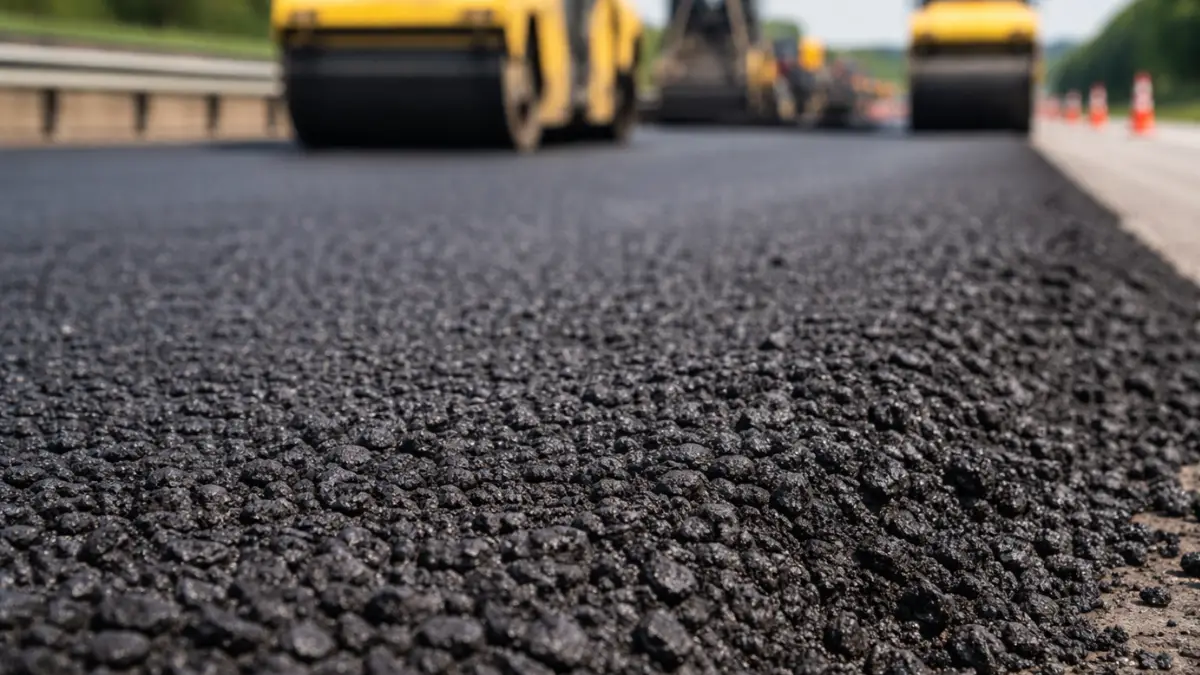
Asphalt Binder types describe the binder family or formulation, while grades describe how that binder is classified for service conditions. In practical pavement design, the most useful approach is to match the binder to climate, traffic, and mixture purpose rather than treating type and grade as interchangeable terms.
Choosing the right binder affects rutting resistance, low-temperature cracking risk, durability, constructability, and long-term maintenance cost. For most technical readers, the key question is not simply which binder exists, but which classification system applies in the project’s market and what performance the pavement must actually deliver.
Highlights & Key Sections
What is Asphalt Binder, and how is it different from a grade?
Asphalt binder is the bituminous material that holds aggregate together in an asphalt mixture. A grade is the specification label used to classify that binder’s expected behavior under defined test and service conditions.
In pavement terms, the binder is the adhesive phase of the mix. It is the component that binds aggregate particles into a cohesive mass. A grade, by contrast, is the language buyers, labs, and agencies use to specify acceptable binder behavior.
That distinction matters because two binders can belong to the same broad type but carry different grades, and two binders with similar grade labels may still differ in formulation, modification method, and project suitability. That is why sound selection starts with the specification system in use, then moves to climate, traffic, mixture design, and local agency requirements.
Which binder grading systems are most commonly used?
The most common systems technical readers encounter are penetration grading, viscosity grading, and performance grading. Performance grading is generally the most decision-useful system for modern paving because it connects binder selection more directly to field conditions.
Comparison of common asphalt binder grading systems
| Grading system | What it classifies | Typical designation style | Best understood as |
|---|---|---|---|
| Penetration grading | Consistency based on penetration at 25°C | 60/70, 85/100 | A traditional specification system still recognized in standards |
| Viscosity grading | Viscosity at a specified temperature | Varies by specification | A laboratory-property-based system used in some specifications |
| Performance grading (PG) | Expected binder performance at high and low pavement temperatures | PG 64-22 | A climate- and performance-oriented system |
| PG with traffic designation or MSCR-based classification | High-temperature rutting performance under traffic severity | PG 58H-28, PG 76E-22 | A performance system with added traffic-loading discrimination |
The main advantage of PG-based systems is that they are tied to expected pavement temperatures, and in updated practice they can also distinguish traffic severity more clearly than older high-temperature criteria alone.
How do PG grades actually work?
A PG grade tells you the pavement temperature window a binder is intended to handle. The first number relates to high-temperature performance, and the second relates to low-temperature performance.
A designation such as PG 58-28 means the binder is intended for a specific range of service conditions. The first number reflects the high pavement temperature, while the second reflects the low pavement temperature. This makes PG more useful than older systems when the goal is to connect specification language to actual field demands.
This is why PG is usually the clearest system for engineers and procurement teams. It turns a vague question such as Do we need a harder binder into a more precise one: What high- and low-temperature demands will this pavement face, and how severe is the traffic loading?
When is a modified binder needed?
Modified binders are typically used when conventional binder performance is not enough for the combination of heat, traffic, speed, and surface-course demands. They are common where rut resistance, elastic recovery, or durability margins need to be improved.
Examples include polymer-modified binders and asphalt-rubber binders. These are treated as meaningful technical distinctions in major paving standards, not merely as marketing terms.
In practical use, modified binders are often selected for:
- heavy truck routes
- intersections, bus lanes, and slow-moving traffic
- thin overlays and premium surface courses
- stone matrix asphalt, open-graded friction courses, and other demanding mix designs
- locations where extra rutting resistance or elastic response is needed
Modification is not automatically necessary. It should be selected when project conditions justify the added performance and when the governing standard or agency specification supports that choice.
Where are different binder types and grades commonly used?
Different binder families and grades are used where their performance logic fits the project. The right binder is always context-specific, not universal.
Conventional paving binders
These are commonly used in standard dense-graded asphalt mixtures where climate and traffic demands can be met without advanced modification. In many cases, a standard PG grade is sufficient for routine road construction and resurfacing.
Traffic-designated PG binders
These are more suitable for corridors with heavier, slower, or more severe traffic where rutting risk is higher. In MSCR-based classification systems, suffixes can indicate increasing traffic severity.
Polymer-modified and rubberized binders
These are commonly used in premium surface mixtures and high-demand applications. They appear frequently in advanced surface treatments, thin overlays, and other projects where additional rut resistance or durability is important.
Penetration-graded binders
These remain a recognized paving-binder specification family in several standards and markets. They are best understood as a traditional classification framework rather than a direct predictor of field performance under modern mixed traffic and climate design conditions.
How should buyers and engineers choose the right binder grade?
Start with service conditions, not catalog labels. Binder selection should move from climate and traffic to mixture purpose, modification need, and local specification compliance.
A practical selection framework
- Define the pavement’s climate exposure.
Identify expected high and low pavement temperatures rather than relying only on air temperature assumptions. PG systems are built around pavement-temperature-based design logic. - Assess traffic severity, not just traffic volume.
Slow, stopping, channelized, or heavy truck traffic can demand more rut-resistant binders than free-flowing traffic on the same route. - Match the binder to the mixture application.
Surface courses, high-performance thin overlays, open-graded mixes, and rut-resistant premium mixes often justify modified binders sooner than standard base or binder courses. - Check which grading system the project specification requires.
Agencies may reference PG standards, MSCR-based approaches, or other grading systems depending on jurisdiction and project type. - Confirm constructability and supply.
A technically stronger binder is not automatically the best choice if it creates unnecessary cost, handling, storage, or mixing complications for the project.
Use a climate-based selection tool when appropriate
For projects where wrong-grade risk is costly, climate-based binder selection tools can provide a more defensible starting point than rule-of-thumb substitution. This is especially relevant for large public works, climate-sensitive pavements, and projects with long performance expectations.
What are the most common specification mistakes?
Most binder mistakes happen when teams simplify the problem too early. The result is often a grade that looks familiar on paper but is poorly matched to field conditions.
Common errors include:
- confusing type with grade
- assuming the same PG label always means the same field behavior
- choosing only by regional habit instead of climate and traffic
- ignoring slow or standing heavy traffic at intersections and terminals
- treating polymer modification as interchangeable across products
- specifying a binder before the intended mixture and pavement function are clear
A good specification is precise about service conditions, performance intent, and applicable standards. A weak specification is only a product label.
Executive checklist before specifying or buying
Use this checklist to keep the selection process disciplined and defensible:
- Confirm the applicable grading system for the project specification.
- Define expected high and low pavement temperatures.
- Identify heavy, slow, or channelized traffic conditions.
- Decide whether the mix type or surface function justifies modification.
- Check whether traffic-based high-temperature classification is required.
- Review constructability, storage, pumping, and mixing implications.
- Verify supplier documentation against the standard named in the contract.
- Align the binder decision with the actual pavement layer and performance objective.
Final takeaway
The most useful way to understand Asphalt Binder is to separate what the binder is from how it is graded. Types describe the binder family or modification approach, while grades describe the service window and performance requirements it must meet. For modern pavement decisions, performance-based selection supported by climate, traffic, and application logic is usually the clearest path to a sound specification.
FAQs
1) Is a higher PG number always better?
No. A higher high-temperature grade can improve rutting resistance, but it may not be appropriate for the project’s low-temperature conditions, traffic pattern, or constructability needs. Better selection is about fit, not simply choosing the hardest binder.
2) What is the difference between PG 64-22 and PG 76-22?
Both share the same low-temperature grade, but PG 76-22 is intended to handle a higher high-temperature pavement environment than PG 64-22. In practice, the higher grade is often associated with more demanding traffic or surface-performance requirements.
3) Does polymer modification automatically mean the binder is superior?
Not automatically. Polymer modification can improve key performance properties, especially rutting resistance and elastic response, but suitability still depends on the target mix, climate, traffic severity, and the governing specification.
4) When should MSCR-based grading matter most?
It matters most where high-temperature rutting risk is critical and traffic severity is not fully represented by older criteria alone. Heavy trucks, slow-moving traffic, intersections, and premium surface systems are common examples.
5) Should procurement teams specify by product name or by standard?
The safer approach is to specify by the required standard and performance designation, then evaluate supplier offerings against that requirement. Product names alone are not a reliable substitute for a clear technical specification.
Sources
- Federal Highway Administration — HMA Pavement Mix Type Selection Guide
Relevant because it defines asphalt binder, explains PG interpretation, and connects binder selection to climate and traffic. - Federal Highway Administration — Long-Term Pavement Performance Bind Online User Guide
Relevant because it explains how climate-based tools support site-specific performance-grade selection. - Federal Highway Administration — The Multiple Stress Creep Recovery (MSCR) Procedure
Relevant because it explains how MSCR improves high-temperature binder evaluation, especially for modified binders. - ASTM International — D946/D946M: Penetration-Graded Asphalt Binder for Use in Pavement Construction
Relevant because it documents the penetration grading system and standard penetration grades used for paving binders. - ASTM International — D6373: Performance-Graded Asphalt Binder
Relevant because it defines how PG binders are classified in relation to pavement design temperatures and performance-based selection.